
This beam calculator gives support reactions, shear force, bending moment and deflection for a single beam carrying point loads, distributed loads and applied moments. Choose a simply supported span, a beam with overhangs, a cantilever, a propped cantilever or a beam fixed at both ends.
Enter E in GPa, I in ×10⁶ mm⁴, and loads in kN and metres. It draws all three diagrams, marks the peaks and gives the span-to-deflection ratio to check against your limit.
How to use it
- Pick the support type in Supports. With Simply supported with overhang(s), also set Support A position and Support B position from the left end.
- Enter the Beam length (m), Young’s modulus E (GPa) and Second moment of area I (×10⁶ mm⁴).
- Add loads with + Point load, + Distributed load or + Moment. Downward loads and clockwise moments are positive.
- Set each load’s size and position, such as w (kN/m), from x (m) and to x (m). The × button removes a load.
- Read the reactions and maximum values, check the diagrams, then use Copy results or Print.
How the beam is analysed
The beam is linear elastic with constant EI. With E in GPa and I in ×10⁶ mm⁴, their product is EI in kN·m²: 200 × 100 = 20,000 kN·m².
- Reactions. For simply supported beams and overhangs, moments about support A give RB, and RA = total load − RB. Cantilever reactions also come from statics.
- Shear and moment. V and M are summed from all forces to the left of each section, on a grid of 4,000 equal steps. Every support, point load, applied moment and load end is also sampled just left and just right, so jumps in the diagrams are exact. Sagging moment is positive.
- Deflection. M/EI is integrated twice with the trapezoidal rule, with the constants set so deflection is zero at the supports.
- Propped and fixed beams. These are statically indeterminate. The tool solves for the left-end reaction and moment from the far-end conditions: zero moment and deflection at a roller, or zero deflection and slope at a fixed end.
Worked example: 6 m simply supported beam, 10 kN/m UDL
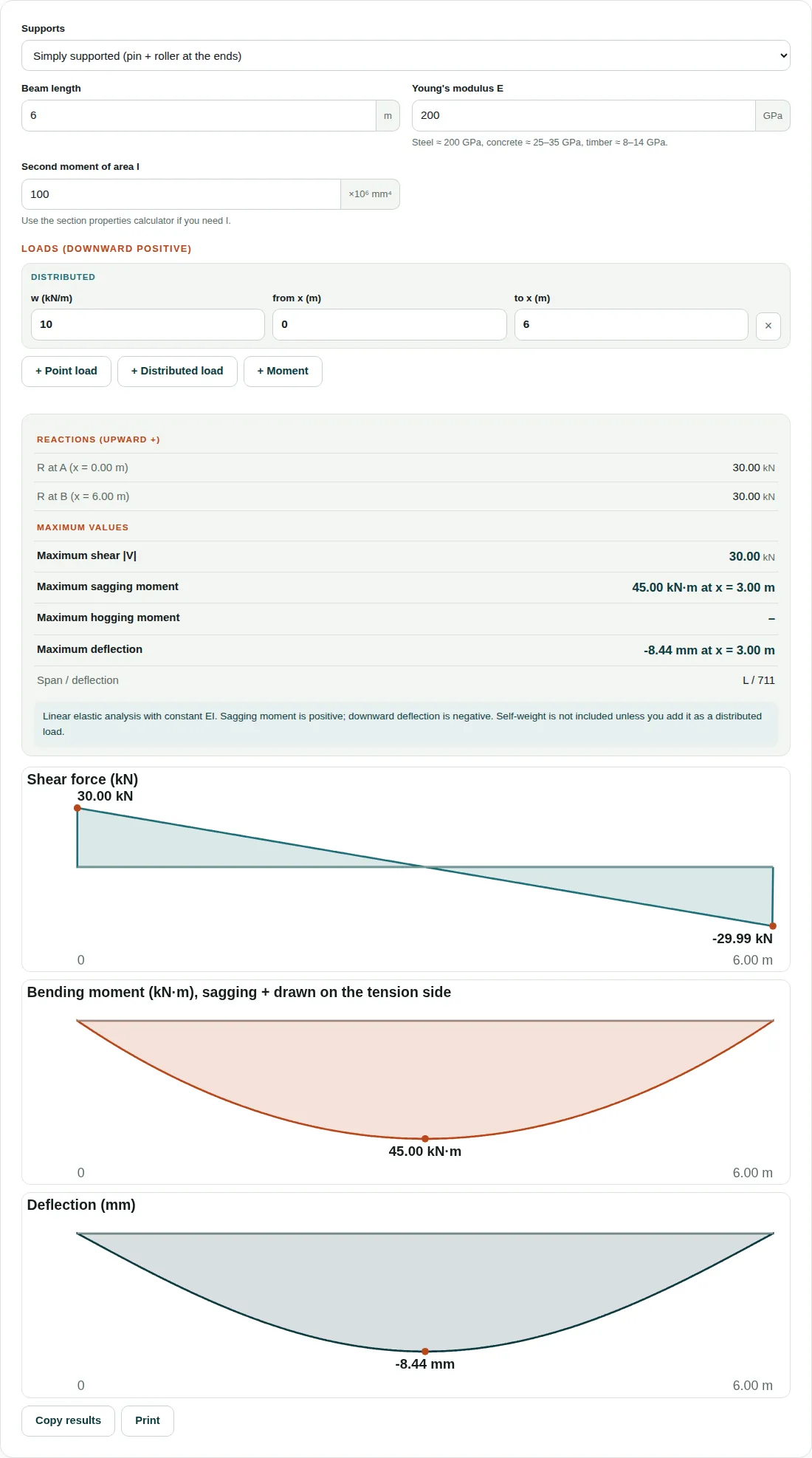
Inputs: L = 6 m, w = 10 kN/m from x = 0 to x = 6 m, E = 200 GPa, I = 100 × 10⁶ mm⁴, so EI = 20,000 kN·m².
- Total load W = 10 × 6 = 60 kN. By symmetry RA = RB = 60 / 2 = 30.00 kN, which is also the maximum shear.
- Shear falls in a straight line from +30 kN to −30 kN and crosses zero at midspan, x = 3.00 m. The diagram labels the ends +30.00 kN and −30.00 kN.
- Maximum moment M = wL²/8 = 10 × 6² / 8 = 45.00 kN·m at x = 3.00 m.
- Midspan deflection δ = 5wL⁴/(384EI) = 5 × 10 × 1,296 / (384 × 20,000) = 0.0084375 m = 8.44 mm, shown as −8.44 mm because downward is negative. The numerical integration agrees with this closed-form value to within 0.001 mm.
- Span / deflection = 6,000 / 8.4375 = L/711. Against an L/360 limit (16.7 mm) the beam passes comfortably.
Limits of this calculator
- Self-weight is not added for you. Enter it as a distributed load over the full length: a 40 kg/m steel section adds about 0.39 kN/m.
- Spring supports, internal hinges and beams whose section changes along the length are outside its scope.
- Loads are point loads, uniform loads over all or part of the span, and applied moments. Model a triangular load as several short uniform strips.
- Use service loads for the deflection check and factored loads for design moments and shears. Section capacity is not checked.
Questions people ask
What is the maximum bending moment in a simply supported beam with a UDL?
It is wL²/8, at midspan. For 10 kN/m over 6 m that is 10 × 36 / 8 = 45 kN·m, which is what the calculator gives for its default example. Each support reaction is wL/2, here 30 kN.
What is the deflection formula for a simply supported beam with a uniform load?
Maximum deflection is 5wL⁴/(384EI) at midspan. With w in kN/m, L in m and EI in kN·m², the answer comes out in metres. A cantilever with the same load deflects wL⁴/(8EI) at its free end.
Can this calculator analyse a continuous beam?
No. It covers a single span with pin and roller supports (with or without overhangs), a cantilever, a propped cantilever or a fixed-fixed beam. A beam continuous over three or more supports needs moment distribution or a frame analysis program.
Related tools
- Section Properties: Area, centroid, moment of inertia, section modulus and radius of gyration.
- Engineering Unit Converter: Stress, force, moment, flow, land area (incl. ropani and bigha) and more.
- Lap & Development Length: Lap and anchorage lengths to Eurocode 2, ACI 318, AS 3600 or IS 456.
Results are for estimating, checking and learning. Design work should be checked against the current code and your project specification, and signed off by a qualified engineer. See all 20 engineering calculators.