
This citation generator turns the details of a journal article, book or web page into a reference list entry and an in-text citation in APA 7th edition, MLA 9th edition or Harvard (Cite Them Right). Change the style and it rebuilds at once.
Copy one reference with its italics, or collect sources in an alphabetical list. You type the details yourself; nothing is looked up from the DOI.
Referencing & Report Cheat-Sheet
A free 4-page PDF: APA 7, Harvard and IEEE at a glance, plus a lab report checklist.
Useful for this job
- PaperpalAcademic language checks for research writing
- Academic writing guidePlan and polish your reports
We may earn a commission if you buy through these links, at no extra cost to you. As an Amazon Associate, EducateLink earns from qualifying purchases. Disclosure
How to use it
- Choose the Style and the Source type (Journal article, Book or Web page).
- In Authors, type one author per line as Last, First Middle. A line with no comma is treated as an organisation.
- Fill in Year, Title of the article, book or page, the other fields shown and DOI or URL.
- Check the Reference list entry and in-text citation, then click Copy reference.
- Click Add to my list for each source, then Copy whole list.
What the generator changes
- Names: given names become initials, spaced in APA (J. D.) and closed up in Harvard (J.D.); Jean-Paul becomes J.-P. MLA keeps full names.
- Author lists: APA lists up to 20 authors; from 21 it gives the first 19, an ellipsis and the last. MLA uses “et al.” from three authors, Harvard from four.
- Links: a bare DOI (10.xxxx/…) or “doi:” becomes https://doi.org/…. Harvard adds an accessed date unless an article or book has a DOI, and MLA adds one to web pages.
- Pages: a hyphen becomes an en dash.
- Titles: used exactly as typed, capitals and all.
Worked example: Watson and Crick (1953)
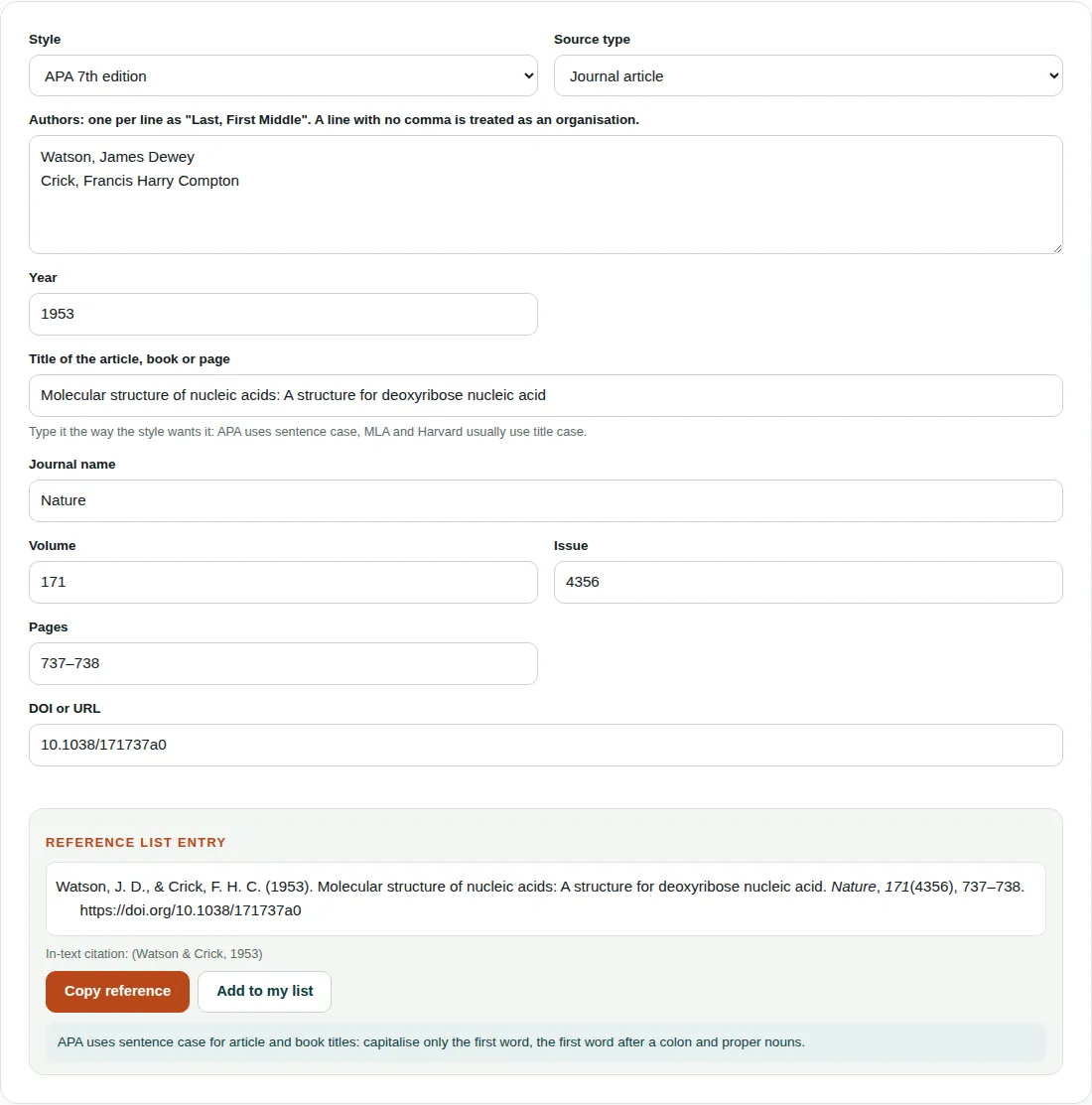
The form opens with Watson and Crick’s 1953 paper in Nature:
| Style | Reference list entry | In-text |
|---|---|---|
| APA 7 | Watson, J. D., & Crick, F. H. C. (1953). Molecular structure of nucleic acids: A structure for deoxyribose nucleic acid. Nature, 171(4356), 737–738. https://doi.org/10.1038/171737a0 | (Watson & Crick, 1953) |
| MLA 9 | Watson, James Dewey, and Francis Harry Compton Crick. “Molecular structure of nucleic acids: A structure for deoxyribose nucleic acid.” Nature, vol. 171, no. 4356, 1953, pp. 737–738. https://doi.org/10.1038/171737a0. | (Watson and Crick 737) |
| Harvard | Watson, J.D. and Crick, F.H.C. (1953) ‘Molecular structure of nucleic acids: A structure for deoxyribose nucleic acid’, Nature, 171(4356), pp. 737–738. Available at: https://doi.org/10.1038/171737a0. | (Watson and Crick, 1953) |
The title stays in sentence case in every row, as typed. MLA wants title case, so retype it before copying the MLA version.
Before you submit
- The MLA in-text citation uses the article’s first page (737 above). Change it to the page you cite.
- Your list lasts only while the page is open. Copy it before you close the tab.
- Book chapters, reports and conference papers need adapting by hand from your style guide.
- Harvard varies between universities; check your own guide.
Questions people ask
What is the difference between APA and Harvard referencing?
Both are author-date styles, so in-text citations look alike: (Watson & Crick, 1953) against (Watson and Crick, 1953). In the reference list, Harvard closes up the initials, quotes the article title and adds “Available at:” before the link.
How do I cite a web page with no author in APA?
Leave Authors empty. The generator puts the page title first in italics, then the date and website name, and uses the title in the in-text citation. For an undated page, clear Year and leave the publication date blank to get n.d.
Does the citation generator fix title capitalisation?
No, titles print exactly as typed. APA wants sentence case for article and book titles and MLA wants title case, so retype the title to suit the style.
Related tools
- Word Counter: Words, characters, sentences, reading time and keywords.
- Grammar & Spelling Checker: Find grammar, spelling and punctuation mistakes.
- Readability Checker: Readability scores with long sentences and passive voice highlighted.