
This Manning’s equation calculator finds the discharge, velocity and Froude number for uniform flow in rectangular, trapezoidal and triangular channels and in circular pipes running part full. It can also work backwards from a design flow to the normal depth.
Pick Manning’s n from eight listed surfaces or type your own. The default is a 1.0 m wide earth channel with 1.5:1 side slopes, flowing 0.6 m deep on a 0.2% bed slope and carrying 1.1736 m³/s.
How to use it
- Set Solve for to Flow and velocity from depth or Normal depth from flow.
- Choose the Channel shape, then fill the sizes it asks for: Bottom width b, Side slope z (horizontal : 1 vertical) or Pipe internal diameter in mm.
- Pick a Manning’s n, or choose Custom n and type the value.
- Enter the Bed slope in percent (1 in 500 is 0.2%).
- Enter Flow depth y, or Design flow Q in m³/s when solving for depth. Results update as you type.
How the tool solves Manning’s equation
The tool uses the SI form of Manning’s equation for steady uniform flow: V = (1/n) R2/3 S1/2, Q = VA and R = A/P. S is in m/m, so the bed slope you type is divided by 100.
| Shape | Area A | Wetted perimeter P | Top width T |
|---|---|---|---|
| Rectangular | by | b + 2y | b |
| Trapezoidal | (b + zy)y | b + 2y√(1 + z²) | b + 2zy |
| Triangular | zy² | 2y√(1 + z²) | 2zy |
| Circular | D²(θ − sin θ)/8 | Dθ/2 | D sin(θ/2) |
For the pipe, θ = 2 arccos(1 − 2y/D). The Froude number is Fr = V/√(gA/T) with g = 9.80665 m/s². Below 0.95 the tool reports subcritical, above 1.05 supercritical, and near critical in between. A pipe flowing full has no free surface, so its Froude number is shown as not applicable.
For normal depth the tool bisects on y until Q matches. In a pipe the search stops at 0.938D, the depth of maximum discharge, and a larger flow returns a warning. Velocities under 0.6 m/s or over 3 m/s are flagged.
Worked example: trapezoidal earth channel, y = 0.6 m
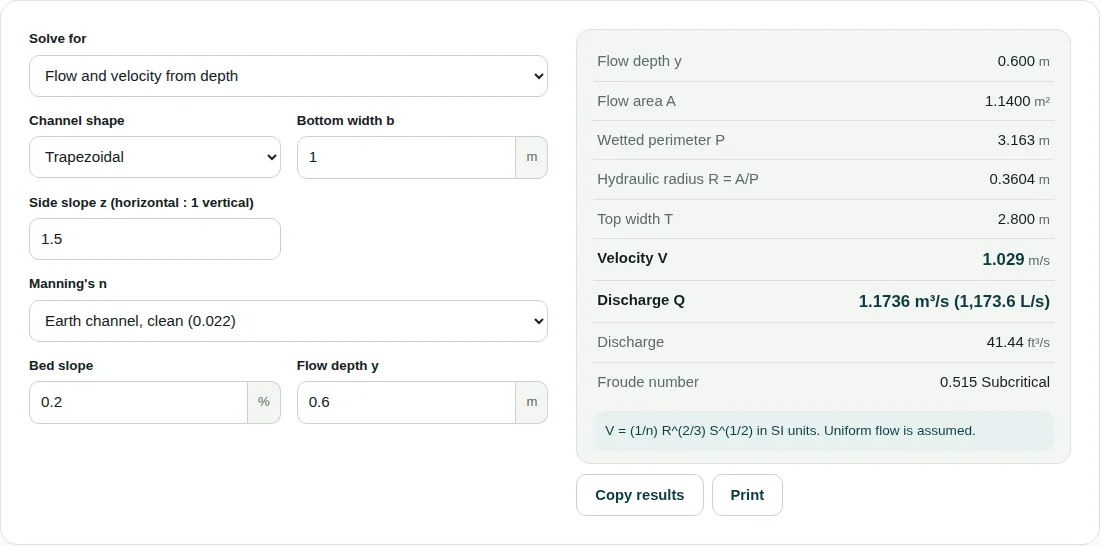
Inputs: b = 1.0 m, z = 1.5, y = 0.6 m, n = 0.022, S = 0.2% = 0.002.
- A = (1.0 + 1.5 × 0.6) × 0.6 = 1.9 × 0.6 = 1.1400 m²
- P = 1.0 + 2 × 0.6 × √(1 + 1.5²) = 1.0 + 1.2 × 1.8028 = 3.163 m
- R = 1.1400 / 3.163 = 0.3604 m; T = 1.0 + 2 × 1.5 × 0.6 = 2.800 m
- V = (1/0.022) × 0.36042/3 × 0.0021/2 = 45.45 × 0.5064 × 0.04472 = 1.029 m/s
- Q = 1.029 × 1.1400 = 1.1736 m³/s (1,173.6 L/s or 41.44 ft³/s)
- Fr = 1.029 / √(9.80665 × 1.1400/2.800) = 1.029 / 1.998 = 0.515, subcritical
Switch to Normal depth from flow with the default design flow of 1.2 m³/s and the tool returns y = 0.607 m.
Limits of this calculator
- Manning’s n controls the answer. Change the example from 0.022 (clean earth) to 0.030 (earth with grass) and Q falls to 0.8606 m³/s. Check the listed values against your drainage manual.
- Uniform flow is assumed. Near culvert inlets, drops, bends or backwater, the real depth is not the normal depth.
- The 3 m/s erosion flag is general. Permissible velocity in an unlined channel depends on the soil and lining.
- A pipe peaks at about 0.938D, roughly 7.6% above full-bore flow at constant n. That peak is unstable, so treat full-pipe capacity as the working limit.
Questions people ask
What Manning’s n should I use for a concrete pipe?
The calculator lists 0.013 for concrete pipe or finished concrete, 0.010 for PVC or HDPE and 0.024 for corrugated metal. Where your drainage authority specifies a value, enter it through Custom n.
What is normal depth in open channel flow?
Normal depth is the depth at which a given flow runs uniformly, with gravity along the slope balanced by bed friction. For the default channel carrying 1.2 m³/s, the calculator gives a normal depth of 0.607 m.
Why does a part-full pipe carry more than a full pipe?
Near the crown, the wetted perimeter grows faster than the flow area, so the hydraulic radius drops. With constant n, discharge peaks at a depth of about 0.938D, around 7.6% above full-bore flow.
Related tools
- Stormwater Runoff: Peak runoff with the rational method Q = CiA.
- Pipe Head Loss: Friction loss with Darcy–Weisbach or Hazen–Williams.
- Slope & Gradient: Convert percent, degrees and 1 in n ratios, and work out falls.
Results are for estimating, checking and learning. Design work should be checked against the current code and your project specification, and signed off by a qualified engineer. See all 20 engineering calculators.