
This slope calculator converts between rise and run, percent grade, angle in degrees and 1 in n ratios, and works out the fall over a length you choose. Use it for drain falls, ramps, road gradients, paving and embankments.
Enter the slope in whichever form you have. You get all the others at once, plus per mille, fall in mm per metre, the total fall over your length and the true sloping length.

Site Engineer Pocket Reference
A free 7-page PDF with the site numbers you use most.
Useful for this job
- Rotating laser levelFast levels for slabs, cuts and fills
- Automatic level kitFor booking levels in the field
We may earn a commission if you buy through these links, at no extra cost to you. As an Amazon Associate, EducateLink earns from qualifying purchases. Disclosure
How to use it
- In I know the slope as, choose Rise and run, Percent (%), Angle (degrees) or Ratio 1 : n.
- Fill in the fields that appear: Rise (vertical) and Run (horizontal), or a single Slope, Angle or Ratio 1 : n, n = value. Rise and run just need to be in the same unit.
- Enter the Horizontal length for fall calculation, for example the pipe length between two manholes.
- Read the grade, angle, ratio, per mille and falls. Clear the length or set it to 0 to hide the fall rows.
Slope formulas used
- Percent grade = rise / run × 100
- Angle θ = arctan(rise / run). From an angle, percent = tan θ × 100.
- Ratio 1 : n, where n = run / rise = 100 / percent
- Per mille (‰) = percent × 10, which is also the fall in mm per metre and in m per km
- Fall over a horizontal length L = percent / 100 × L
- Slope length = L × √(1 + (percent / 100)²)
The run and the length are horizontal distances measured on plan, not along the surface, which is why the slope length comes out slightly longer than L. The ratio here is always rise : run, so 1 : 40 means 1 vertical to 40 horizontal.
Worked example: 1 m rise over 40 m
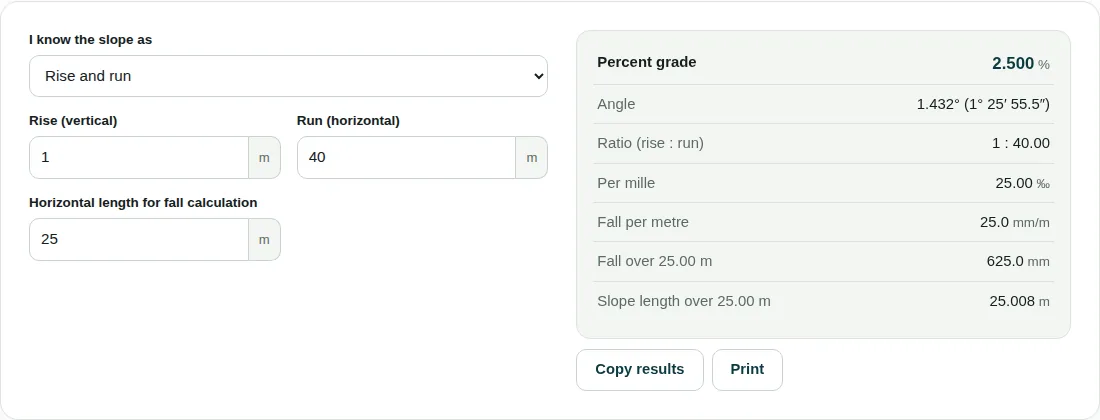
- Percent grade = 1 / 40 × 100 = 2.500%.
- Angle = arctan(0.025) = 1.4321°. For minutes and seconds: 0.43210 × 60 = 25.926′, then 0.926 × 60 = 55.5″, giving 1° 25′ 55.5″.
- Ratio: n = 100 / 2.5 = 40, so 1 : 40.00.
- Per mille = 2.5 × 10 = 25.00‰, a fall of 25.0 mm per metre.
- Fall over 25 m = 0.025 × 25 = 0.625 m = 625.0 mm.
- Slope length over 25 m = 25 × √(1 + 0.025²) = 25.008 m, only 8 mm longer than the plan length.
Check these on site
- Percent is not degrees. A 100% slope is 45°, and a 10% grade is only 5.71°.
- Ratios are written both ways round. Earthworks drawings often give side slopes as horizontal : vertical, so 2H : 1V is 1 : 2 in this tool, or 50%.
- Ramps: the US ADA Standards limit an accessible ramp to 1 : 12, which is 8.33% or 4.76°. Check the regulations where you are building.
- For a drain, the fall is the difference between the two invert levels. Over 25 m at 1 in 40, the lower invert sits 625 mm below the upper one.
Questions people ask
How do you convert percent slope to degrees?
Take the arctangent of the percent divided by 100. A 2.5% slope is arctan(0.025) = 1.432°, and a 10% slope is 5.71°. Going the other way, percent = tan(angle) × 100.
What is 1 in 40 as a percentage?
1 in 40 is 2.5%, from 1 / 40 × 100. That is a fall of 25 mm per metre, or 625 mm over 25 m, and an angle of 1.43°.
Is a 100% slope 45 degrees?
Yes. At 100% the rise equals the run, and arctan(1) = 45°. A vertical face has no percent grade, so the tool shows a warning for an angle of 90° or a ratio of 1 : 0. Percent grade suits gentle slopes and degrees suit steep ones.
Related tools
- Levelling (Rise & Fall): Reduced levels from staff readings with arithmetic check and misclosure.
- Earthwork & Excavation: Pit and trench volumes, and cut and fill from cross-sections.
- Open Channel Flow (Manning): Flow, velocity and normal depth in channels and part-full pipes.
Results are for estimating, checking and learning. Design work should be checked against the current code and your project specification, and signed off by a qualified engineer. See all 20 engineering calculators.