
This pipe head loss calculator gives the friction loss, minor losses and pressure drop for water flowing full in a round pipe. Use Darcy–Weisbach with a Colebrook–White friction factor, or the Hazen–Williams formula.
Water viscosity and density come from a built-in table for temperatures from 0 to 80 °C. The default case, 20 L/s through 500 m of 150 mm PVC at 20 °C, loses 3.535 m of head, a pressure drop of 34.60 kPa.
How to use it
- Enter the Flow rate (L/s), Internal diameter (mm) and Pipe length (m).
- Pick the Pipe material. It sets both the roughness and the Hazen–Williams C; choose Custom to type your own Roughness ε or Hazen–Williams C.
- Choose the Method: Darcy–Weisbach (Colebrook–White) or Hazen–Williams.
- Set the Water temperature in °C.
- Add up the fittings and enter the total in Sum of minor loss coefficients ΣK, for example 0.5 for the entrance plus 1.0 for the exit.
Formulas used
V = Q/A with A = πD²/4, and Re = VD/ν. Viscosity ν and density ρ are interpolated from tables: 1.004 × 10⁻⁶ m²/s and 998.2 kg/m³ at 20 °C.
Darcy–Weisbach
hf = f (L/D) V²/2g, with g = 9.80665 m/s². Below Re = 2,000, f = 64/Re. Otherwise the tool iterates Colebrook–White, 1/√f = −2 log10(ε/3.7D + 2.51/(Re√f)), from a Swamee–Jain starting value, and warns that f is uncertain between Re 2,000 and 4,000.
Hazen–Williams
hf = 10.67 L Q1.852 / (C1.852 D4.8704), with Q in m³/s and D in m. Temperature does not change hf in this method.
Both methods
hm = ΣK V²/2g and Δp = ρg(hf + hm). Material presets (ε in mm, then C): PVC/HDPE/PE 0.0015, 150; copper 0.0015, 140; commercial steel 0.045, 120; galvanised iron 0.15, 120; cement-lined ductile iron 0.05, 140; old cast iron 0.26, 100; concrete 1.0, 120.
Worked example: 20 L/s in a 150 mm PVC main
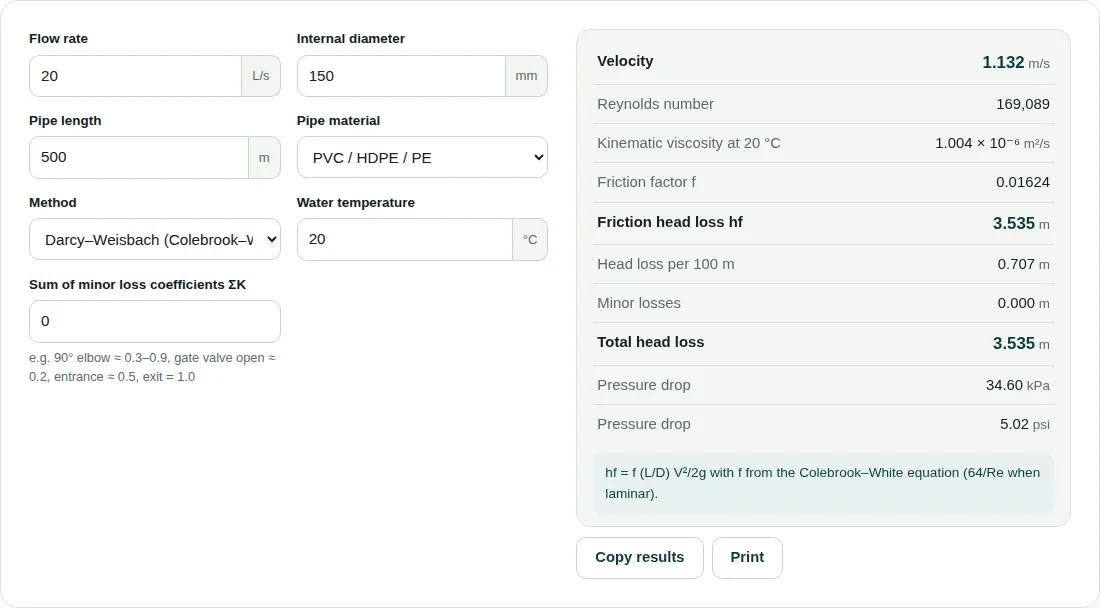
Inputs: Q = 20 L/s = 0.020 m³/s, D = 150 mm, L = 500 m, PVC (ε = 0.0015 mm), 20 °C, ΣK = 0.
- A = π × 0.150²/4 = 0.017671 m²; V = 0.020 / 0.017671 = 1.132 m/s
- Re = 1.1318 × 0.150 / (1.004 × 10⁻⁶) = 169,089, turbulent
- ε/D = 0.0015/150 = 0.00001. Colebrook–White converges to f = 0.01624 from a Swamee–Jain start of 0.01614
- V²/2g = 1.1318² / (2 × 9.80665) = 0.06531 m
- hf = 0.01624 × (500/0.150) × 0.06531 = 3.535 m, or 0.707 m per 100 m
- Minor losses are zero, so the total head loss is 3.535 m
- Δp = 998.2 × 9.80665 × 3.535 / 1000 = 34.60 kPa (5.02 psi)
Switch the method to Hazen–Williams (C = 150 for PVC) and hf becomes 3.658 m.
Check these before you size a pump
- Use the true bore. Plastic pipe is sold by outside diameter and the bore depends on wall thickness, so take it from the manufacturer’s table.
- Diameter matters most. Keep the default flow but drop to a 125 mm bore and hf rises from 3.535 m to 8.500 m.
- Roughness grows with age. The old cast iron preset (ε = 0.26 mm) gives 5.159 m for the default case.
- The tables cover water only, from 0 to 80 °C. Outside that range the tool warns you and uses the nearest end of the table.
- The velocity notes (above 3 m/s, below 0.3 m/s) are prompts to review the design, not limits.
Questions people ask
Is Darcy–Weisbach or Hazen–Williams more accurate?
Darcy–Weisbach is the more general method, because its friction factor depends on Reynolds number and relative roughness, so it holds for any temperature and flow regime. Hazen–Williams is an empirical formula for water in turbulent flow. For the default case they give 3.535 m and 3.658 m of friction loss.
How do you convert head loss to pressure drop?
Use Δp = ρgh. For water at 20 °C, 1 m of head is about 9.79 kPa, so the default 3.535 m head loss is 34.60 kPa or 5.02 psi.
What minor loss coefficient should I use for an elbow?
The tool’s help text gives 0.3–0.9 for a 90° elbow, about 0.2 for an open gate valve, 0.5 for an entrance and 1.0 for the exit. Enter the total for all fittings as ΣK. At the default 1.132 m/s, a ΣK of 2 adds 0.131 m of head.
Related tools
- Open Channel Flow (Manning): Flow, velocity and normal depth in channels and part-full pipes.
- Engineering Unit Converter: Stress, force, moment, flow, land area (incl. ropani and bigha) and more.
- Stormwater Runoff: Peak runoff with the rational method Q = CiA.
Results are for estimating, checking and learning. Design work should be checked against the current code and your project specification, and signed off by a qualified engineer. See all 20 engineering calculators.