
This rational method calculator estimates peak stormwater runoff from a small catchment with Q = CiA. Split the site into surfaces such as roofs, paving and lawns, and the tool works out the area-weighted runoff coefficient for you.
It also estimates the time of concentration with the Kirpich formula, which tells you the storm duration to read from your rainfall chart. The default 4 ha site at 75 mm/h gives 0.4292 m³/s, or 429.2 L/s.
How to use it
- Under Catchment areas, choose a Surface for each row and enter its Area (ha). The C box fills with a typical value; overwrite it if your manual gives another.
- Use + Add area for more surfaces and × to remove a row.
- Optionally enter the Longest flow path (m) and Average slope of flow path (%) to get the Kirpich time of concentration.
- Read the intensity for a storm lasting tc from your local IDF chart and type it into Rainfall intensity i (for storm duration = tc).
- Read the total area, weighted C and peak runoff Q in m³/s, L/s and ft³/s.
How the peak runoff is calculated
The weighted runoff coefficient is C = Σ(CiAi) / ΣAi. Rows with a blank or zero area are skipped.
Peak flow is Q = CiA / 360, with Q in m³/s, i in mm/h and A in hectares. The 360 comes from the units: 1 mm/h falling on 1 ha is 10 m³/h, which is 1/360 m³/s.
Time of concentration uses the metric Kirpich equation, tc = 0.0195 L0.77 S−0.385, with tc in minutes, L the longest flow path in m and S its slope in m/m.
The surface list holds 14 presets, each shown with a typical range. Roofs and asphalt or concrete paving default to 0.90, gravel to 0.50, detached housing to 0.40 and forest to 0.15. Lawns run from 0.08 (sandy, flat) to 0.30 (heavy soil, steep). The tool applies no return-period factor to C and does not choose i for you.
Worked example: 4 ha mixed catchment at 75 mm/h
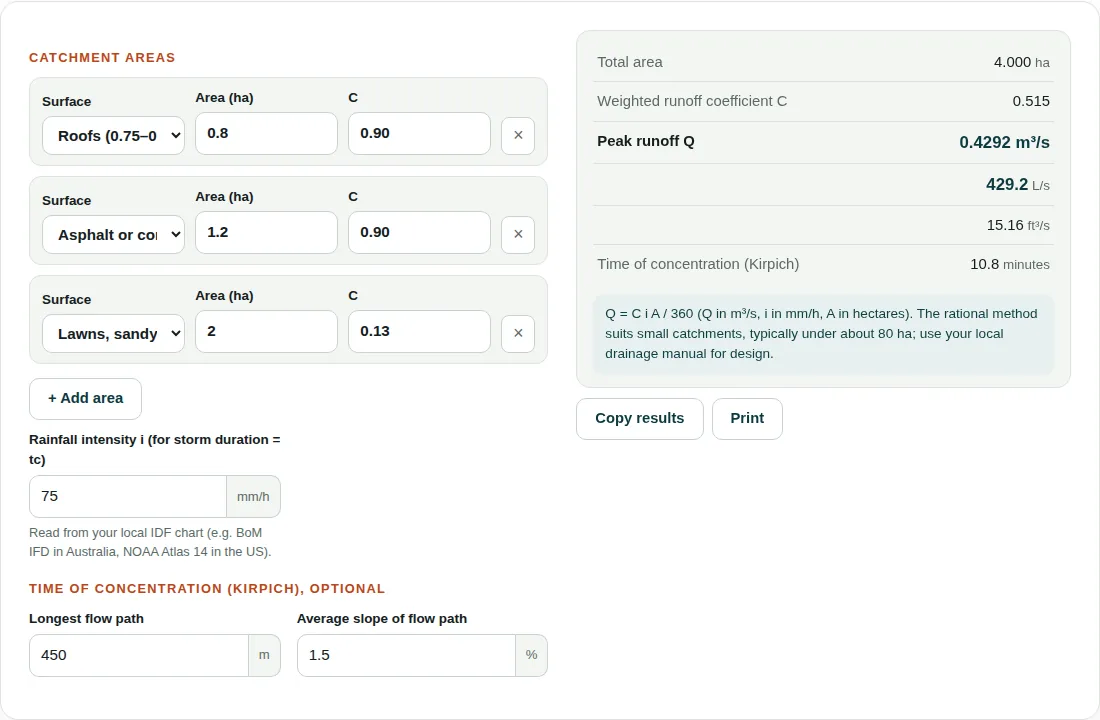
| Surface | Area (ha) | C | C × A |
|---|---|---|---|
| Roofs | 0.8 | 0.90 | 0.720 |
| Asphalt or concrete paving | 1.2 | 0.90 | 1.080 |
| Lawns, sandy soil, 2–7% | 2.0 | 0.13 | 0.260 |
| Total | 4.000 | 2.060 |
- Weighted C = 2.060 / 4.000 = 0.515
- Q = 0.515 × 75 × 4.000 / 360 = 0.4292 m³/s, which is 429.2 L/s or 15.16 ft³/s
- tc = 0.0195 × 4500.77 × 0.015−0.385 = 0.0195 × 110.40 × 5.037 = 10.8 minutes
So the 75 mm/h used here should be the design intensity for a storm of about 11 minutes. The tool does not check that link for you.
Limits of the rational method
- Keep it to small catchments. The tool’s note suggests under about 80 ha; your local drainage manual may set a different limit.
- The intensity i must match both the design return period and a duration equal to tc. A 60-minute intensity used on a 10-minute catchment underestimates the peak.
- C on pervious ground has a big effect. If the lawns in the example were on heavy soil (C = 0.20), weighted C rises to 0.550 and Q to 0.4583 m³/s.
- Kirpich was derived from small rural catchments. On a mostly paved site, compare it with the method in your local manual.
- Areas are in hectares: 1 ha = 10,000 m², so a 2,500 m² roof is 0.25 ha.
Questions people ask
What is the rational method formula in SI units?
Q = CiA/360 gives Q in m³/s when i is in mm/h and A is in hectares. With A in km², the same relationship becomes Q = 0.278 CiA. The calculator uses the hectare form.
What runoff coefficient should I use for a roof?
The calculator uses C = 0.90 for roofs, from a typical range of 0.75–0.95, and the same default for asphalt or concrete paving. Where your local drainage manual gives a different value, type it into the C box.
What is time of concentration?
Time of concentration (tc) is the time runoff takes to travel from the hydraulically most remote point of the catchment to the outlet. The rational method gives the peak when the storm duration equals tc, because the whole catchment is then contributing. For the default 450 m flow path at 1.5%, Kirpich gives 10.8 minutes.
Related tools
- Open Channel Flow (Manning): Flow, velocity and normal depth in channels and part-full pipes.
- Pipe Head Loss: Friction loss with Darcy–Weisbach or Hazen–Williams.
- Slope & Gradient: Convert percent, degrees and 1 in n ratios, and work out falls.
Results are for estimating, checking and learning. Design work should be checked against the current code and your project specification, and signed off by a qualified engineer. See all 20 engineering calculators.