
APA 7 referencing works in two places at once. In your text you give a short citation, usually the author’s surname and the year, such as (Yeh, 1998). At the end, the reference list gives the full details so a reader can find exactly what you used. Every full entry answers four questions: who made it, when, what it is called and where to find it.
The rules below follow the seventh edition of the APA Publication Manual, checked against APA Style guidance and university library guides. The examples cover the sources engineering and science students cite most, from journal articles to Australian Standards, data sets and AI chats.
For journal articles, books and webpages, the free citation generator builds the entry for you. Use this page to check its output and to write the source types it does not handle.
The four parts of every APA 7 reference
Every reference uses the same four elements in the same order: author, date, title and source, each followed by a full stop (except a DOI or URL at the very end). Find those four on any document and you can reference it.
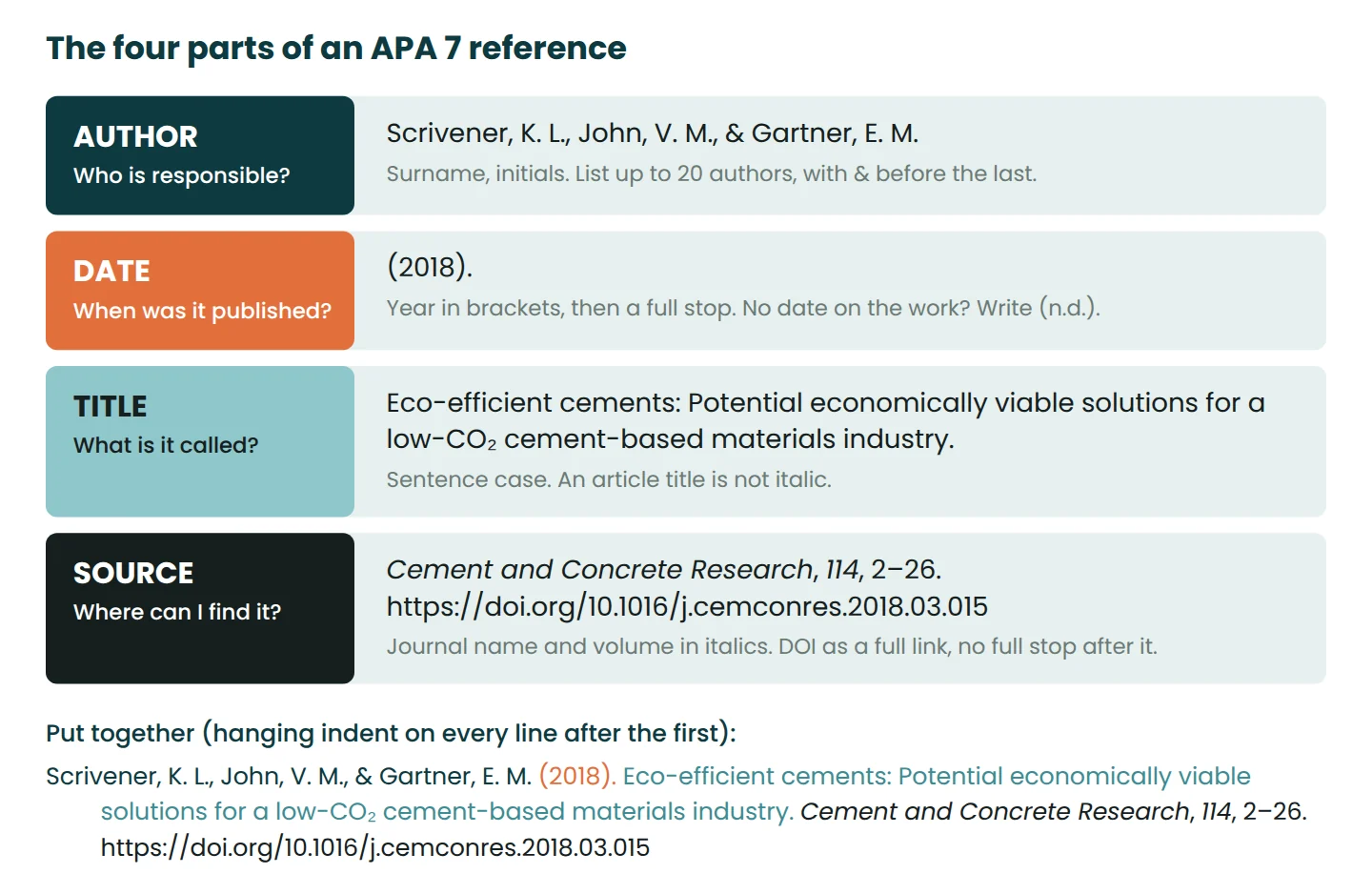
| Element | What to write | Watch for |
|---|---|---|
| Author | Surname, then initials: Gartner, E. M. Group authors in full: Standards Australia. | Never abbreviate a group author in the reference list. |
| Date | Year in brackets: (2018). Webpages, videos and AI chats take the full date: (2024, June 18). | No date on the work: write (n.d.). |
| Title | Sentence case: capitals only for the first word, the first word after a colon, and proper nouns. | Italicise stand-alone works (books, reports, webpages, videos, data sets). Article and chapter titles stay plain. |
| Source | Journal, volume, issue and pages; or publisher; or website name. Then the DOI or URL. | Leave out the publisher when it is the same as the author. |
Some types add a description in square brackets after the title, not in italics: [Video], [Data set], [Computer software], [Large language model] or [Generative AI chat].
How to format the reference list
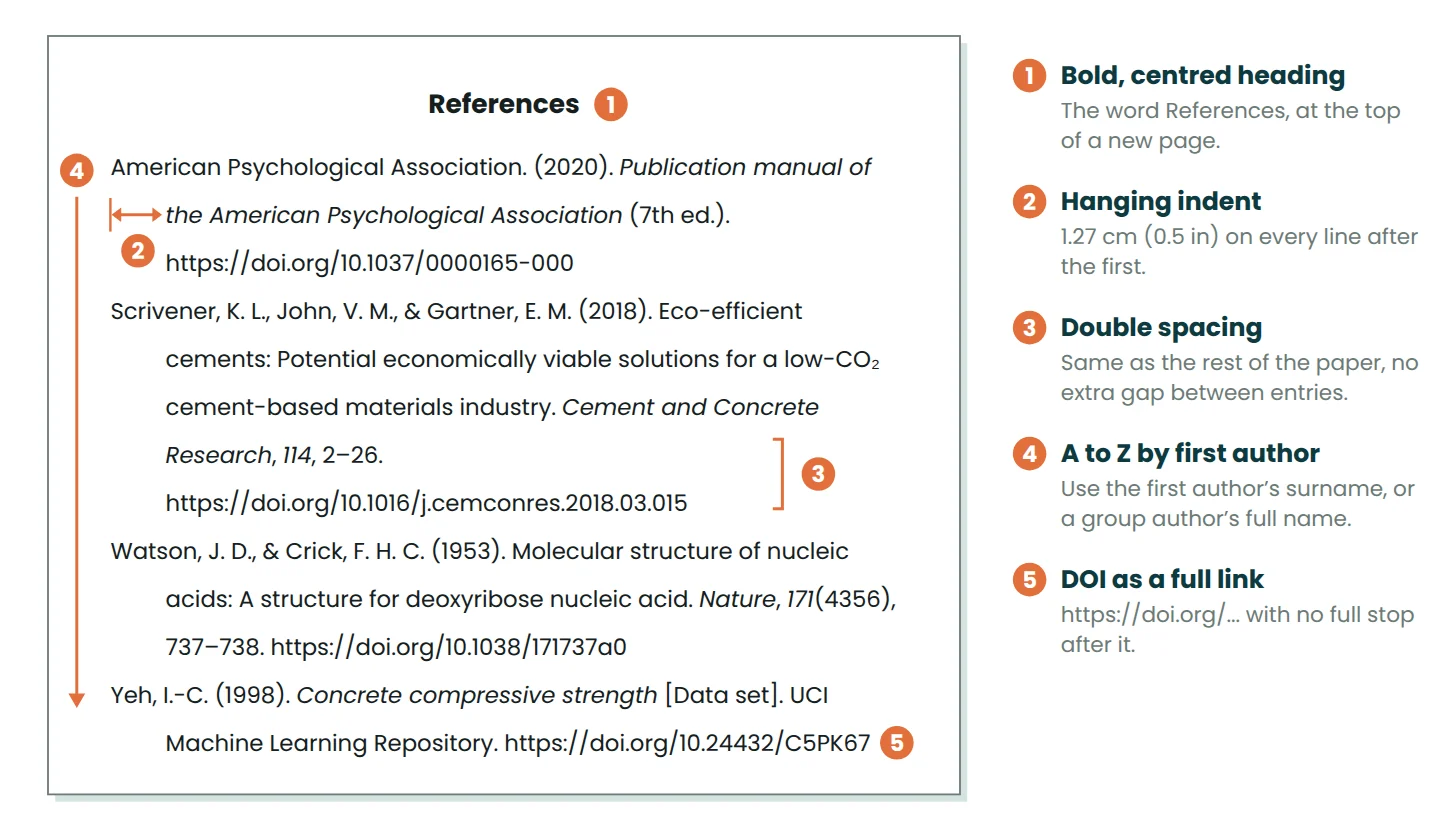
- Start on a new page under the heading References, bold and centred.
- Double-space the list, with no extra blank line between entries.
- Use a 1.27 cm (0.5 in) hanging indent. In Microsoft Word, select the list, open Paragraph settings and set Special to Hanging, By 1.27 cm.
- Sort A to Z by the first author’s surname. A group author is filed under its full name.
- For several works by one author, put the oldest first, with undated (n.d.) works ahead of dated ones. Two works from the same year become 2021a and 2021b, ordered by title, and the letters carry into your citations.
- Name every author up to 20. For 21 or more, list the first 19, an ellipsis, then the final author.
- Write a DOI as a full link (https://doi.org/ plus the DOI), with no full stop after it or after a URL. Drop “Retrieved from” unless you add a retrieval date for a page designed to change.
In-text citations: parenthetical and narrative
A parenthetical citation puts the author and year in brackets, usually at the end of the clause: Blended cements are one route to a lower-carbon cement industry (Scrivener et al., 2018). A narrative citation makes the author part of the sentence: Scrivener et al. (2018) describe blended cements as one route to a lower-carbon industry.
Inside brackets, join two authors with an ampersand (Watson & Crick, 1953). In a sentence, write “and”: Watson and Crick (1953). If the same narrative citation comes up again in one paragraph, leave the year off the repeat.
Quotes and page numbers
Give a page number for every direct quote: (Brennan, 2022, p. 14), or (Brennan, 2022, pp. 14–15) for a range. Webpages have no pages, so use a paragraph number (para. 3) or a section heading; videos take a timestamp. In engineering and science you will paraphrase far more than you quote, so save quotes for wording that matters, such as a definition.
Group authors, secondary sources and multiple sources
Give a group’s full name the first time with its abbreviation in square brackets, then use the abbreviation: (National Transportation Safety Board [NTSB], 2025), then (NTSB, 2025). The reference list always uses the full name.
If you only read about a study in someone else’s work, name the original and cite what you read: (Ahmed, 2009, as cited in Brennan, 2022). Only Brennan goes in the reference list, and if you can get the original, read and cite it instead. Several sources in one citation go in alphabetical order with semicolons: (Scrivener et al., 2018; Yeh, 1998).
The et al. and n.d. rules at a glance
For three or more authors, APA 7 uses “et al.” from the very first citation.
| Situation | Parenthetical | Narrative | Reference list |
|---|---|---|---|
| One author | (Yeh, 1998) | Yeh (1998) | Yeh, I.-C. (1998). |
| Two authors | (Watson & Crick, 1953) | Watson and Crick (1953) | Watson, J. D., & Crick, F. H. C. (1953). |
| Three to 20 authors | (Scrivener et al., 2018) | Scrivener et al. (2018) | All authors, & before the last |
| 21 or more authors | (First author et al., year) | First author et al. (year) | First 19, an ellipsis, the last |
| Group author, first use | (National Transportation Safety Board [NTSB], 2025) | National Transportation Safety Board (NTSB, 2025) | Full name |
| Group author, later | (NTSB, 2025) | NTSB (2025) | Full name |
| No date | (Riverbend City Council, n.d.) | Riverbend City Council (n.d.) | (n.d.). |
| Two undated works, one author | (Riverbend City Council, n.d.-a) | Riverbend City Council (n.d.-b) | (n.d.-a). and (n.d.-b). by title |
| No author | (Bolt Torque Reference Chart, n.d.) | Bolt Torque Reference Chart (n.d.) | Title moves to the front |
APA 7 referencing examples by source type
Real sources are used wherever an identifier matters (a DOI, report number or standard number), so you can check every detail. The chapter, webpage and video examples are invented to show the pattern: their addresses use example.org, a domain reserved for examples, and the video example stops where its URL would go.
1. Book
Reference list: American Psychological Association. (2020). Publication manual of the American Psychological Association (7th ed.). https://doi.org/10.1037/0000165-000
In-text: (American Psychological Association [APA], 2020), then (APA, 2020).
The edition sits in plain brackets after the italic title. There is no publisher because the publisher is also the author. A print book without a DOI ends with the publisher’s name.
2. Chapter in an edited book
Reference list: Okafor, C. N., & Lindqvist, M. (2021). Moisture control in timber-framed walls. In H. R. Patel & S. J. Moore (Eds.), Building science for designers (2nd ed., pp. 112–139). Harbourside Academic.
In-text: (Okafor & Lindqvist, 2021) or Okafor and Lindqvist (2021).
Cite the chapter’s authors, not the editors. Editors’ initials go before their surnames, then (Ed.) or (Eds.). Edition and page range share one set of brackets.
3. Journal article with a DOI
Reference list: Scrivener, K. L., John, V. M., & Gartner, E. M. (2018). Eco-efficient cements: Potential economically viable solutions for a low-CO2 cement-based materials industry. Cement and Concrete Research, 114, 2–26. https://doi.org/10.1016/j.cemconres.2018.03.015
In-text: (Scrivener et al., 2018) or Scrivener et al. (2018).
Italicise the journal name and volume. This journal has no issue numbers; when one does, the issue follows the volume in plain brackets, as in Nature, 171(4356), 737–738. Don’t name the database where you found the article.
4. Webpage with an author
Reference list: Marsh, K. (2024, June 18). How to read a concrete test certificate. Site Practice Notes. https://www.example.org/concrete-test-certificate
In-text: (Marsh, 2024) or Marsh (2024).
The page title is italic and the website name is plain. If the author and the website are the same organisation, leave the website name out.
5. Webpage with no author or no date
When no person is named, the organisation behind the page is usually the author. If the page shows no publication or last-updated date, write n.d. Don’t use the copyright year in the site footer: it says nothing about when that page was written.
Reference list: Riverbend City Council. (n.d.). Building over or near council stormwater pipes. https://www.example.org/stormwater-build-over
In-text: (Riverbend City Council, n.d.).
Only when there is no identifiable author at all does the title move to the front, followed by the date:
Reference list: Bolt torque reference chart. (n.d.). Fastener Facts. https://www.example.org/bolt-torque-chart
In-text: (Bolt Torque Reference Chart, n.d.).
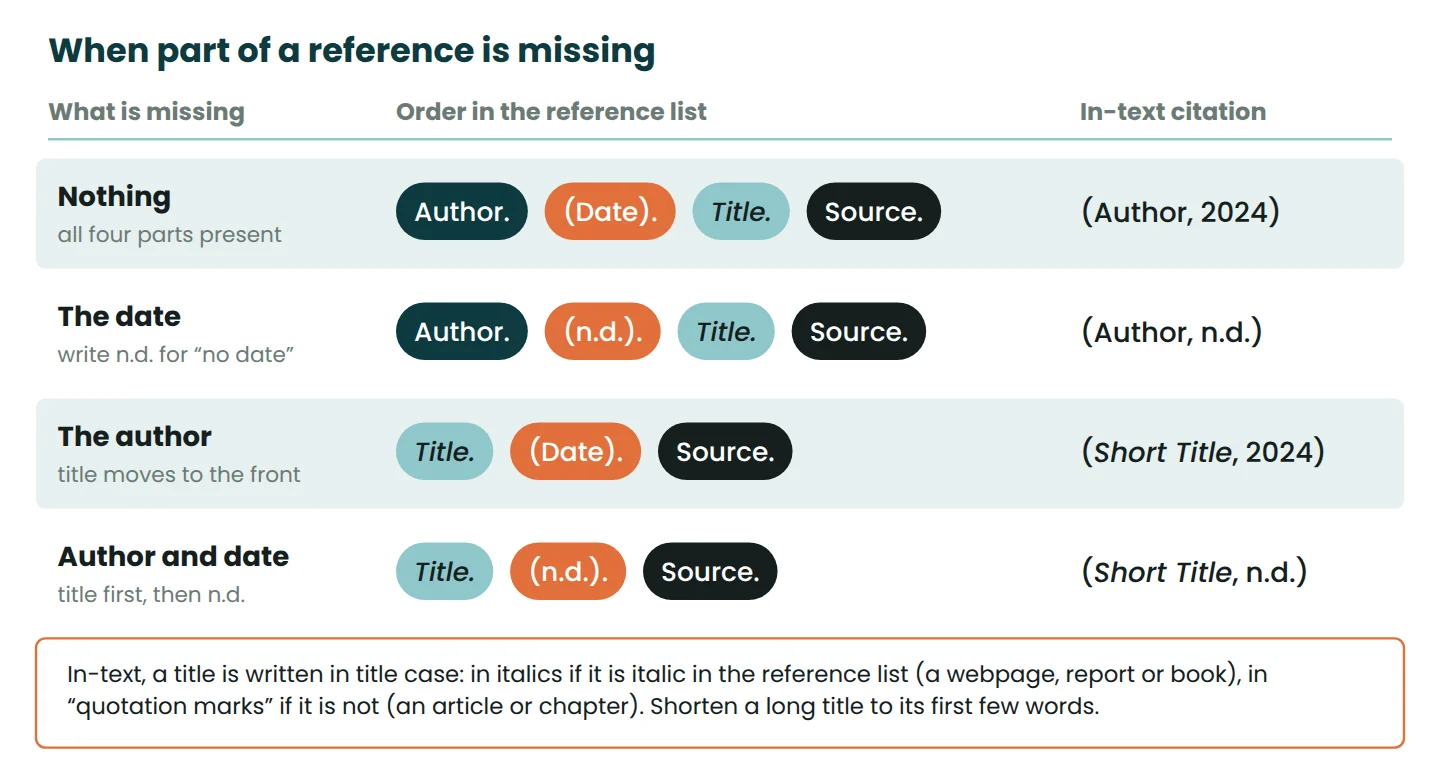
In the citation the title switches to title case and stays italic, because it is italic in the list. Shorten long titles to the first few words. A page with no author and no date is often a weak source, so look for a better one first.
6. Government or organisation report
Reference list: National Transportation Safety Board. (2025). Contact of containership Dali with Francis Scott Key Bridge and subsequent bridge collapse, Patapsco River, Baltimore, Maryland, March 26, 2024 (Marine Investigation Report MIR-25-40). https://www.ntsb.gov/investigations/AccidentReports/Reports/MIR2540.pdf
In-text: (National Transportation Safety Board [NTSB], 2025), then (NTSB, 2025).
The report number goes in plain brackets after the italic title, and there is no separate publisher because the agency published its own report. For the engineering story behind it, see engineering lessons from the Key Bridge collapse.
7. Standard (Australian Standard and ASTM)
Treat a standard like a report: the standards body is the author, the title is italic, and the standard’s number goes in brackets after it. Use the year of the edition you actually used.
Reference list: Standards Australia. (2014). Methods of testing concrete: Compressive strength tests: Concrete, mortar and grout specimens (AS 1012.9:2014).
In-text: (Standards Australia, 2014).
Reference list: ASTM International. (2026). Standard test method for compressive strength of cylindrical concrete specimens (ASTM C39/C39M-26). https://doi.org/10.1520/C0039_C0039M-26
In-text: (ASTM International, 2026).
ASTM standards carry DOIs, so include one. Australian Standards usually come through a subscription database with no stable public link, and some university guides add the distributor’s name and home page at the end, so follow your faculty’s version. A joint standard has two group authors: Standards Australia & Standards New Zealand.
8. YouTube video
Reference list: Northfield Polytechnic Materials Lab. (2023, May 14). Concrete cylinder compression test, step by step [Video]. YouTube.
The entry then ends with the video’s full URL from your browser’s address bar.
In-text: (Northfield Polytechnic Materials Lab, 2023), or with a timestamp for a quote: (Northfield Polytechnic Materials Lab, 2023, 3:42).
The uploader is the author and the date is the upload date. If a person posts under a channel name that differs from their real name, give the real name, then the channel name in square brackets.
9. Data set or software
Reference list: Yeh, I.-C. (1998). Concrete compressive strength [Data set]. UCI Machine Learning Repository. https://doi.org/10.24432/C5PK67
In-text: (Yeh, 1998) or Yeh (1998).
The repository is the publisher, and a version number, if there is one, goes in brackets before [Data set]. Note the initials for a hyphenated name: I-Cheng becomes I.-C. Specialised software follows the same pattern with a version number and [Computer software]. Don’t reference Word, Excel or a programming language you simply used.
10. Generative AI output
APA updated its guidance in September 2025 (McAdoo et al., 2025). The company that makes the tool is the author. For a particular conversation, give the date of the chat, a chat title in italics, [Generative AI chat], the tool or model, and the chat’s share link:
Company. (Year, Month Day). Title of chat [Generative AI chat]. Tool or model. Share link
To cite the tool in general, for example in a method section that says what you used it for, reference the tool itself:
Reference list: OpenAI. (2026). ChatGPT [Large language model]. https://chatgpt.com/
In-text: (OpenAI, 2026) or OpenAI (2026).
A reference alone doesn’t show how you used AI. Say what you used it for, keep your prompts and outputs (many units want them in an appendix) and follow your unit’s AI rules. Never copy a reference an AI tool gives you without finding the source: these tools can invent convincing citations to papers that don’t exist.
Checking the citation generator’s output
The citation generator handles journal articles, books and webpages in APA 7. It gets the mechanics right: initials, the ampersand, up to 20 authors, italic journal names and volumes, bare DOIs turned into https://doi.org/ links, n.d. when the year is blank, and no website name when the author is the same organisation. Check these yourself:
- Titles come out exactly as typed, so type them in sentence case.
- An author line with no comma is read as an organisation, which is what you want for Standards Australia.
- It gives the parenthetical citation only. Write narrative citations yourself, and add abbreviations such as [NTSB] by hand.
- For a webpage with no author, the citation shows the whole title as typed. Shorten it, use title case and italicise it.
- For a report or standard, choose Book, enter the organisation as author, leave Publisher blank if it matches the author, then type the report or standard number in brackets after the title.
- Write chapters, videos, data sets and AI chats by hand, and apply the hanging indent after pasting the list into your document.
Common mistakes
- Et al. in the reference list. It belongs in citations only.
- “And” inside brackets, “&” in sentences. It is the other way round.
- Italicising the article title. For a journal article, the journal name and volume are italic, not the article title.
- Old DOI formats. Write https://doi.org/10.1016/j.cemconres.2018.03.015, not doi:10.1016/j.cemconres.2018.03.015.
- The standard number as author. (AS 1012.9, 2014) is wrong; the author is Standards Australia.
- Orphan citations. Every citation needs a list entry and every entry needs a citation. Check both directions.
- Trusting AI-made references. Find each source and reference what you actually read.
The same habits carry across assignments. A literature review leans on narrative citations to compare authors, while a lab report cites mostly in the introduction, theory and discussion. Before you submit, run your body text through the word counter and build any missing entries in the citation generator.
Frequently asked questions
Do I need page numbers in APA 7 citations?
You need them for direct quotes. For a paraphrase they are optional, but a page or section number helps the reader when you point to one part of a long book or report.
Does et al. go in the reference list?
No. Et al. is only for in-text citations of works with three or more authors. The reference list names up to 20 authors in full.
How do I cite a webpage with no author and no date in APA 7?
Check first whether an organisation is responsible for the page, because it then becomes the author. If there really is no author, start with the italic title, then (n.d.), the website name and the URL, and cite it as (Short Title, n.d.).
Is APA 7 the same as Harvard referencing?
No. Both are author-date styles, but the Cite Them Right version of Harvard writes “and” even inside brackets, puts article titles in quotation marks and adds “Available at:” before links. Use the style your unit asks for.
References
- American Psychological Association. (2020). Publication manual of the American Psychological Association (7th ed.). https://doi.org/10.1037/0000165-000
- Curtin University Library. (n.d.). APA 7th referencing guide. https://uniskills.library.curtin.edu.au/assets/docs/APA_7th_referencing_guide_47814322.pdf
- McAdoo, T., Denneny, S., & Lee, C. (2025, September 9). Citing generative AI in APA Style: Part 1: Reference formats. APA Style Blog. https://apastyle.apa.org/blog/cite-generative-ai-references
- Purdue Writing Lab. (n.d.). Reference list: Basic rules. Purdue OWL. https://owl.purdue.edu/owl/research_and_citation/apa_style/apa_formatting_and_style_guide/reference_list_basic_rules.html
- Victoria University Library. (n.d.). APA 7th referencing: Standards & patents. https://libraryguides.vu.edu.au/apa-referencing/7StandardsPatents
This article is general information for learning. Always check your unit outline and your university library’s referencing guide, because some faculties set their own variations on APA 7.
Leave a Reply