
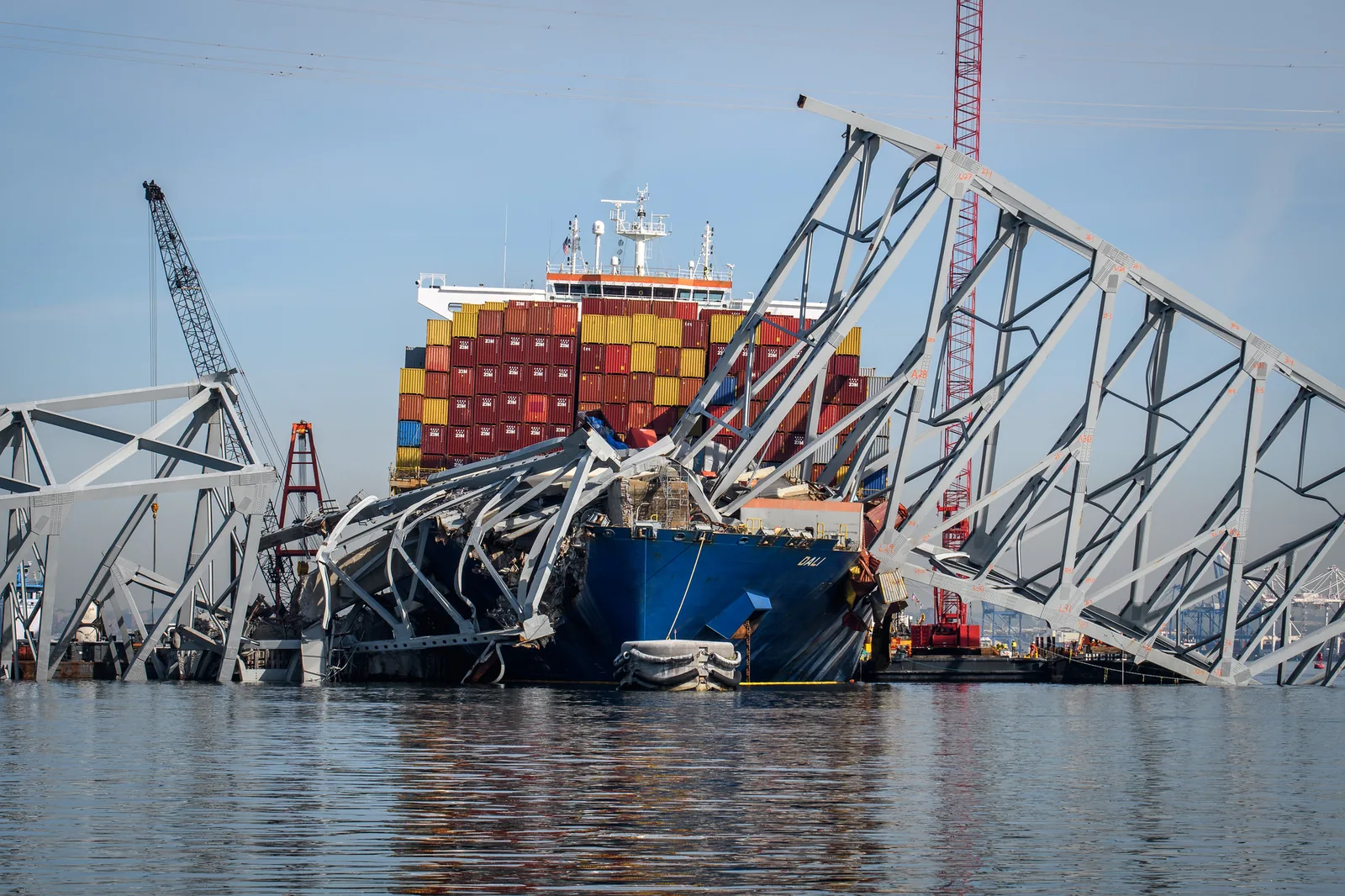
The Key Bridge collapse happened at 1:29 am on 26 March 2024, when the container ship Dali lost electrical power, swung off its line and struck Pier 17 of Baltimore’s Francis Scott Key Bridge at 6.4 knots. The pier failed within 13 seconds. The main spans were one continuous steel truss, so losing a single main pier brought down the whole three-span truss and several approach spans to the north.
Six members of a road maintenance crew working on the deck died. Police had stopped vehicles entering the bridge 48 seconds before the impact, but the warning never reached the workers.
The NTSB traced the blackout to one loose wire. Its bigger finding was about the bridge: designed before US vessel collision guidance existed and never assessed against it, the bridge carried a risk of collapse from ship impact almost 30 times the accepted limit. This article sets out the verified facts, explains the structural behaviour, and draws out the lessons for owners and designers.
The bridge: a 1977 continuous steel truss
The Key Bridge opened to traffic on 23 March 1977 and carried four lanes of Maryland Route 695 across the Patapsco River at the entrance to the Port of Baltimore. Over the shipping channel it used a three-span steel continuous through truss, arch-shaped in elevation and supported on Piers 16, 17, 18 and 19. Ships passed between Pier 17 on the south side and Pier 18 on the north.
| Item | Value |
|---|---|
| Opened | 23 March 1977 |
| Overall length | About 2,769 m (9,086 ft) between abutments |
| Continuous truss spans | 219 m + 366 m + 219 m (720 + 1,200 + 720 ft) |
| Vertical clearance over the channel | 56 m (185 ft) |
| Channel | Fort McHenry Federal Channel, 213 m (700 ft) wide |
| Design code | AASHTO Standard Specifications for Highway Bridges, 1969 edition with 1970 and 1971 interims |
| Traffic | Over 34,000 vehicles a day, about 10 per cent trucks |
| Owner | Maryland Transportation Authority (MDTA) |
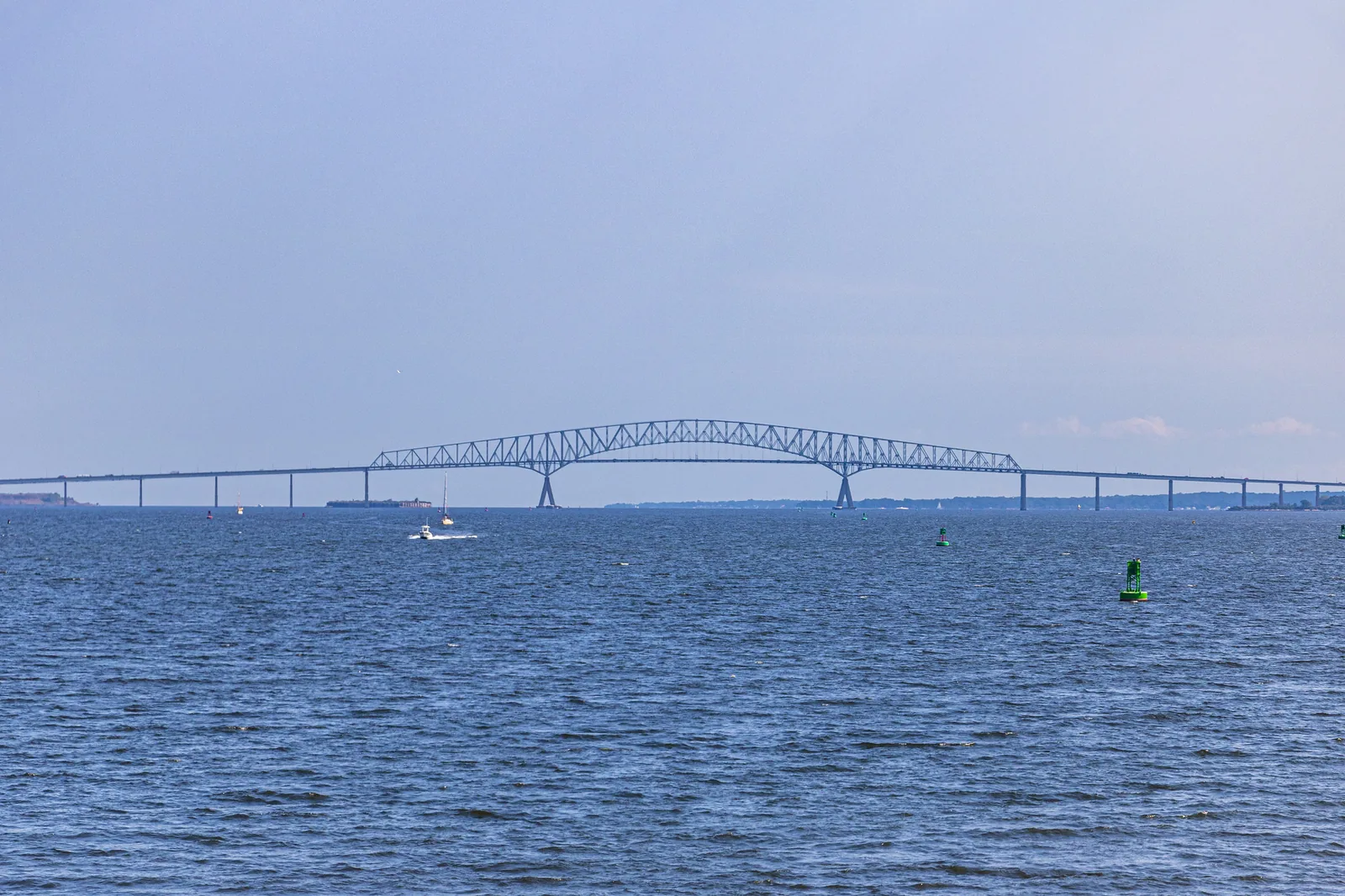
The 1969 design code did not mention ship collision. US vessel collision design arrived with the 1991 AASHTO Guide Specification, 14 years after the bridge opened. The original design still included physical protection, covered below.
The ship: the Dali
The Dali was a Singapore-flagged container ship built in 2015, 300 m (984 ft) long and 48 m wide, with a deadweight of 116,851 t and a capacity of about 10,000 TEU. It left the Seagirt Marine Terminal bound for Colombo, Sri Lanka, with 4,679 containers (8,544 TEU), a displacement of 112,383 t and a draught of 12.15 m.
Size is the point. In 1980 the 119 m (390 ft) container ship Blue Nagoya lost steering and struck the same Pier 17. The pier’s fender stopped it and the pier suffered only minor surface damage. The NTSB noted that the Blue Nagoya had about one-tenth of the Dali’s displacement.
Timeline of the Key Bridge collapse on 26 March 2024
Times are local and come from the NTSB final report, MIR-25-40, which supersedes the preliminary report DCA24MM031 of May 2024.
| Time | Event |
|---|---|
| About 00:36 | The Dali leaves its berth with a senior pilot and a pilot-in-training on board |
| 01:07 to 01:08 | The two assist tugs are released |
| 01:25:00 | Low-voltage blackout. The ship is doing 8.9 knots with its bow about 975 m (3,200 ft), or 3.3 ship lengths, from the bridge |
| 01:25:08 | The main engine shuts down and propulsion is lost |
| 01:25:59 | The senior pilot phones the pilots’ dispatcher and asks for the bridge to be shut |
| 01:26:10 | The emergency generator connects to the emergency switchboard |
| 01:26:38 | The senior pilot calls for tug assistance by radio |
| 01:26:44 | The dispatcher calls the MDTA duty officer to close the bridge |
| 01:27:02 | The senior pilot orders the port anchor let go |
| 01:27:04 | Second blackout, high and low voltage, as breakers HR1 and LR1 open |
| 01:27:23 | The ship is 14° off course. Seconds later a safety warning (a sécurité call) goes out on VHF radio |
| 01:27:36 | Low-voltage power is restored through the other transformer breakers, but the main engine needs a manual restart and stays off |
| 01:27:53 | The duty officer tells the officers at each end of the bridge to shut it |
| 01:28:21 | Officers block the northbound and southbound lanes |
| 01:29:09 | The starboard bow strikes the northwest column of Pier 17 at 6.4 knots |
| 01:29:22 | Pier 17 collapses. Within seconds the three truss spans and the approach spans and piers to the north fall |
News reports at the time spoke of a mayday. In the final report the alerts were a phone call to the pilots’ dispatcher, a radio request for tugs and a VHF sécurité warning.
From the first blackout to impact took 4 minutes 9 seconds. That was enough to stop vehicles, but not enough for the crew to restore propulsion, and nobody told the road crew to leave. The NTSB named the lack of effective and immediate communication to evacuate the workers as a contributing factor in the loss of life.
Why the continuous truss came down so quickly
A continuous truss is efficient because the spans help each other. Over each main pier the truss bends in hogging, with the top chord in tension and the bottom chord in compression, and that hogging reduces the sagging at midspan. Every member is sized for that pattern of forces.
When Pier 17 went, the truss had to span about 585 m (1,920 ft) from Pier 16 to Pier 18 under its own weight. In a simple beam model of the three spans, with uniform stiffness and self-weight:
- the bending at the old Pier 17 position flips from hogging to sagging and becomes about 2.9 times larger;
- the hogging over Pier 18 grows to about 3.4 times its original value;
- chords and diagonals designed as ties are pushed into compression, and members designed as struts are pulled into tension.
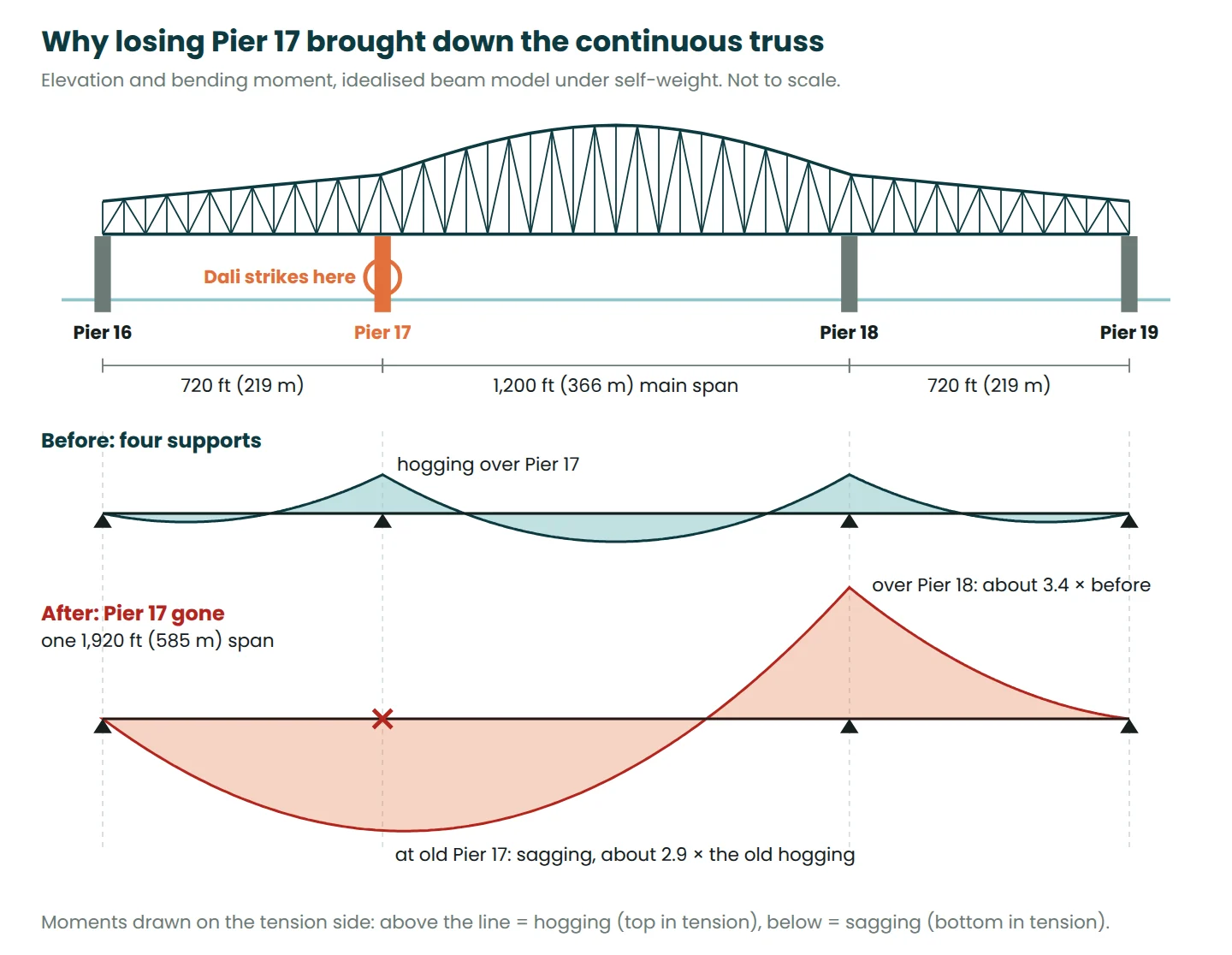
A steel truss can carry a modest overload, but not a reversal of that size in members never designed for it. Self-weight dominates a long steel span, and that load does not go away when traffic stops. The truss was not deficient for its original job. It had no other load path once a main support disappeared, which is why the failure took seconds.
You can see how span drives bending with the free beam calculator. For a uniform load the simple-span moment is M = wL² ÷ 8, so going from 366 m to 585 m multiplies it by (585 ÷ 366)² ≈ 2.6.
What protection the piers had
The bridge was not unprotected. The NTSB records four dolphins, each 8.5 m (28 ft) in diameter with rubber fenders, plus crushable concrete and timber fendering around Piers 17 and 18. Dolphins 1 and 2 stood about 149 m (489 ft) west of Piers 17 and 18, and all four were about 168 m (550 ft) from the channel centreline.
That layout covered a ship that strayed early and held a straight course. The Dali lost power close to the bridge and swung to starboard into the pier without touching any dolphin. The column was first struck about 6 m (20 ft) above the waterline, and the Pier 17 fender was likely hit at about the same moment. A timber and concrete fender is built for glancing blows, not the 600 MJ or so the Dali carried. The NTSB concluded that the size and location of the dolphins did not fully protect the main piers from an off-course vessel. How modern fenders, dolphins and islands are laid out is covered in our guide to bridge pier protection.
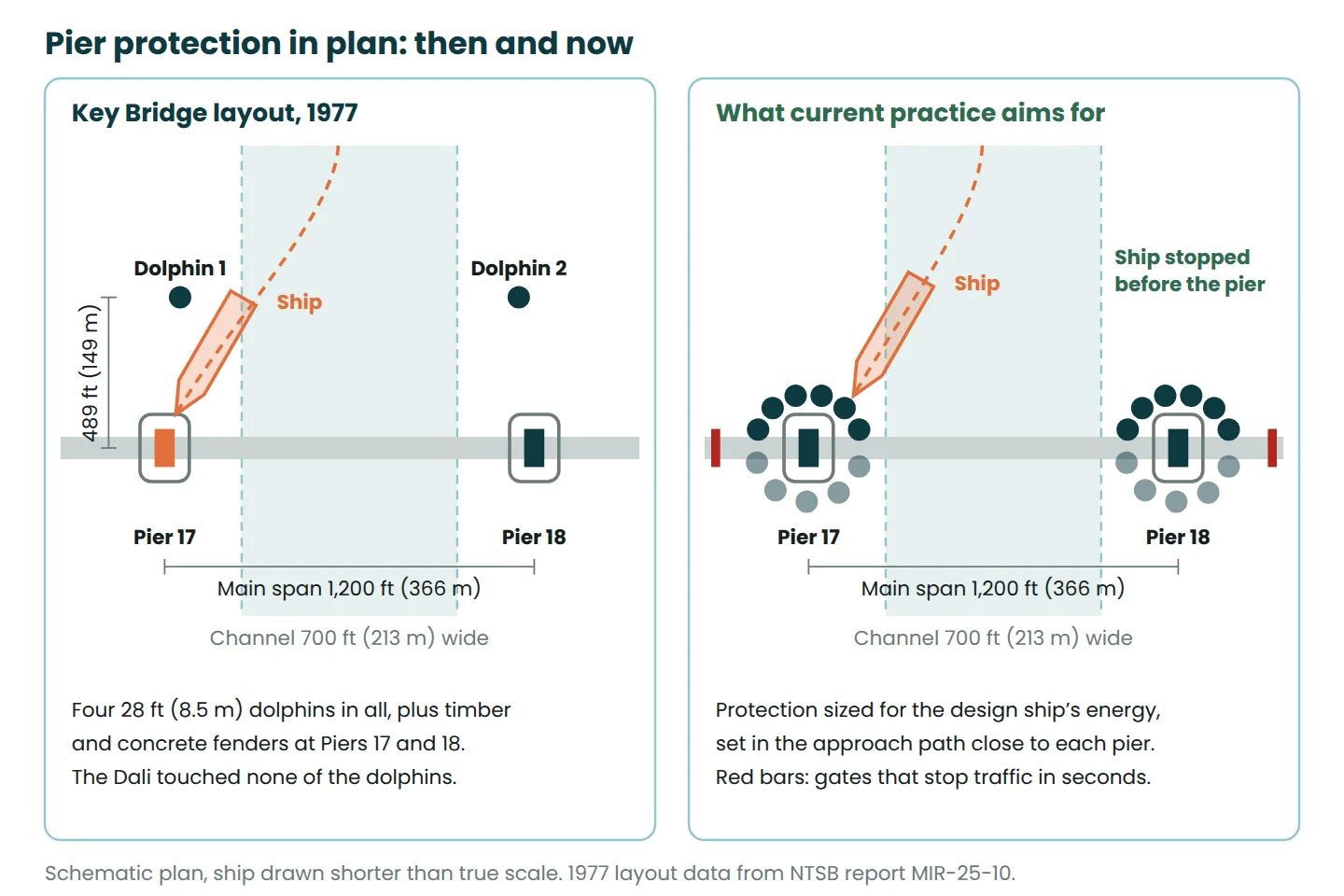
For scale, the AASHTO equivalent static force for the Dali at 6.4 knots is about 135 MN. The FHWA calculated Pier 17’s lateral capacity as 5,509 kips (24.5 MN), and the NTSB put the Dali’s force at over four times that. Our article on why ships hit bridges works through both calculations step by step.
What the NTSB found and recommended
The ship: one loose wire
The probable cause was a blackout caused by a loose signal wire. Wire-label banding stopped the wire from seating fully in a spring-clamp terminal block, so a breaker opened unexpectedly. The NTSB also found that the running generators were being fed fuel by a flushing pump meant for maintenance, which had no redundancy and was powered from the low-voltage switchboard that had just blacked out.
The bridge: a risk nobody had calculated
The probable cause names the bridge too. The NTSB found that the lack of countermeasures against impact by ocean-going ships contributed to the collapse and the loss of life, and that those measures could have been in place if the MDTA had carried out the vulnerability assessment AASHTO recommended. The MDTA had not done one and was not required to.
Using AASHTO Method II, the NTSB put the bridge’s annual frequency of collapse at 0.002921, almost 30 times the 0.0001 limit for a critical or essential bridge. That is roughly one collapse in 340 years, against a target of one in 10,000.
68 more bridges and a warning gap
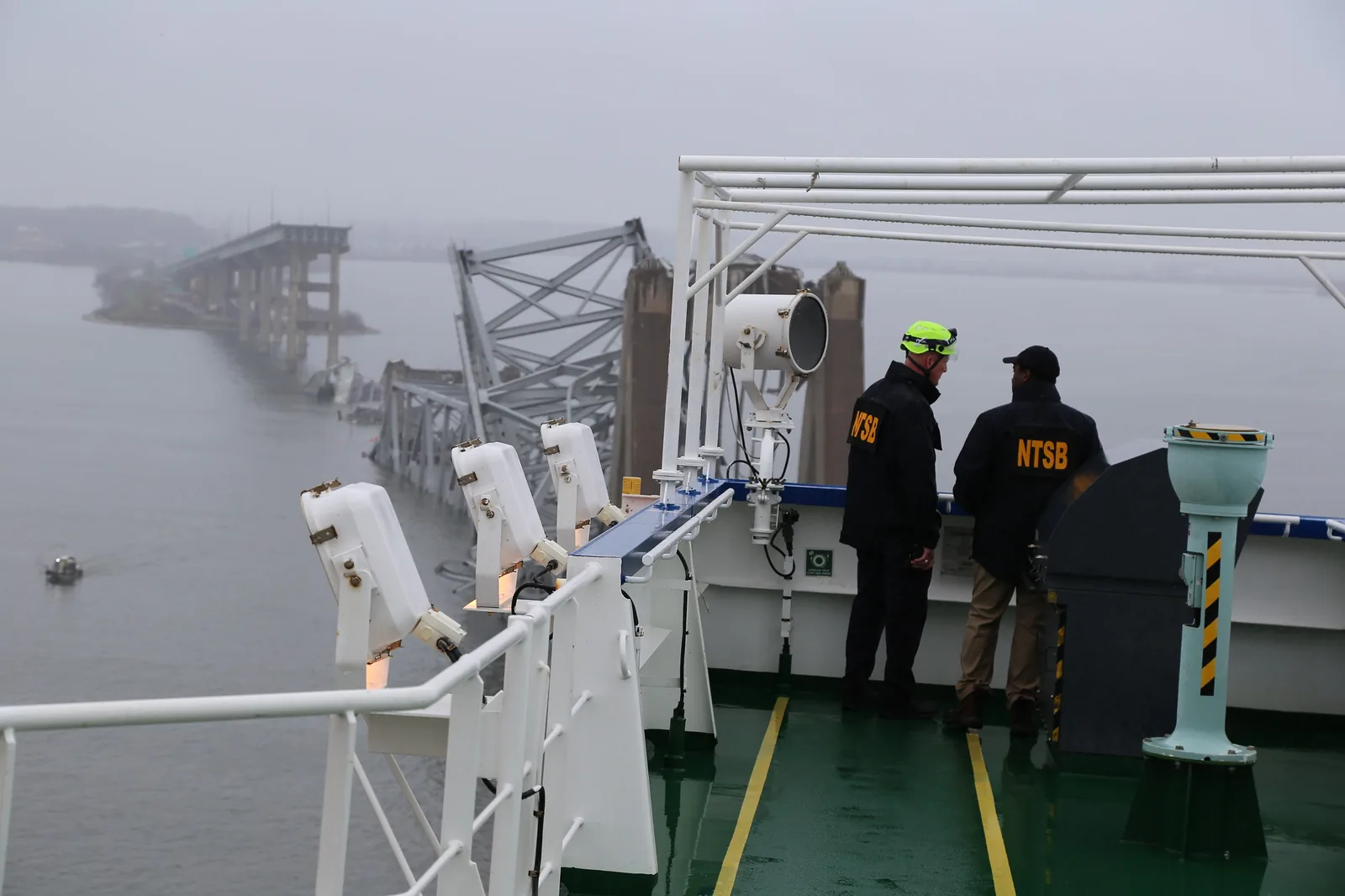
In March 2025 the NTSB issued urgent recommendations (report MIR-25-10). It identified 68 bridges in 19 states, owned by 30 bodies, designed before the AASHTO guidance and without a current vulnerability assessment. It asked those owners to calculate their annual frequency of collapse with Method II and, where the result exceeds the threshold, to develop and carry out a risk reduction plan. It also asked the FHWA, the Coast Guard and the Army Corps of Engineers to form a team to help them. By November 2025 all 30 owners had responded.
The final report adds that the bridge, like many others, had no system to stop motorists driving onto it in an emergency, and calls motorist warning systems a critical countermeasure. Its recommendations went to the FHWA, AASHTO, the Coast Guard, the ship’s manager and builder, the classification society and the terminal block maker, among others.
The rebuild
As reported in May 2026, the replacement designed for the MDTA is a cable-stayed bridge with a 507 m (1,665 ft) main span, a 1,026 m (3,365 ft) main bridge and at least 70 m (230 ft) of clearance over the federal channel, with a vessel collision protection system at the main pylon piers. The MDTA has described the new pier protection as larger than a football field.
In November 2025 the MDTA put the cost at US$4.3 to 5.2 billion with opening in late 2030, citing higher material costs, the longer main span and the far larger pier protection (MDTA release). In May 2026 it split the remaining work into four contracts: demolition, the two land approaches and the main span, with the main span estimated at US$3.5 to 4 billion. The original contractor was to finish foundation piling and the work trestle through at least the end of 2026. As reported in August 2026, the state still aims to finish by the end of 2030.
Engineering lessons for owners and designers
- Assess against today’s fleet. Method II is an asset management tool, not just a design check. Repeat it when traffic changes.
- Protect against the ship that is already out of control. Dolphins placed for a ship holding its course may not help when a ship loses steering close in.
- Treat continuity as part of collision design. A continuous main span over vulnerable piers turns one failed support into a multi-span collapse.
- Size protection by energy. A modern container ship can bring 600 MJ or more. Fenders and dolphins must absorb or redirect that across every approach angle a drifting ship can take.
- Close the bridge for everyone, fast. Gates, signals and direct alerts to work crews cost little compared with any structural fix.
- Test the communication chain. The message went from pilot to dispatcher to duty officer to the officers on the bridge. Every handover took time.
Common mistakes when reading about the Key Bridge collapse
- “The bridge was badly built.” It was designed to the code of its day, which ignored ship collision. The failure was never reassessing it as ships grew.
- “The dolphins failed.” They were never touched. Their layout did not cover this ship’s path.
- “A loose wire brought down the bridge.” The wire explains why the ship lost power. The bridge’s vulnerability explains why it fell.
- Quoting preliminary times as final. Use the November 2025 final report.
- Mixing deadweight and displacement. DWT (116,851 t) is carrying capacity; displacement (112,383 t on departure) is actual mass.
Frequently asked questions
What caused the Key Bridge collapse?
A blackout on the Dali, caused by a loose signal wire, left the ship without propulsion or steering close to the bridge, and it struck Pier 17. The NTSB also found that the bridge’s lack of protection against large ships contributed to the collapse.
How many people died in the Key Bridge collapse?
Six highway workers died. They were part of a seven-person road maintenance crew on the deck; one crew member survived with serious injuries and an inspector with them was unhurt.
Why did the whole bridge fall when only one pier was hit?
Because the main spans were one continuous truss. Losing Pier 17 left about 585 m unsupported and reversed the forces in many members, so the truss failed within seconds. Check how span length drives bending with the beam calculator.
When will the new Key Bridge open?
The target, as reported in August 2026, is the end of 2030. The MDTA’s latest published estimate is US$4.3 to 5.2 billion.
References
- National Transportation Safety Board (2025). Contact of Containership Dali with the Francis Scott Key Bridge and Subsequent Bridge Collapse, MIR-25-40.
- National Transportation Safety Board (2024). Marine Investigation Preliminary Report DCA24MM031 and investigation page.
- National Transportation Safety Board (2025). Safeguarding Bridges from Vessel Strikes: Need for Vulnerability Assessment and Risk Reduction Strategies, MIR-25-10.
- National Transportation Safety Board (2025). Loose Wire on Containership Dali Leads to Blackouts and Contact with Baltimore’s Francis Scott Key Bridge, press release, 18 November.
- AASHTO (1991). Guide Specification and Commentary for Vessel Collision Design of Highway Bridges.
- Maryland Transportation Authority (2025). Updated Estimates for Cost Range and Schedule for Francis Scott Key Bridge Rebuild, 17 November.
- Maryland Transportation Authority (2026). Four Separate Procurements for Key Bridge Rebuild Construction, 19 May.
This article is general information for learning and planning. Always follow your project specification, the current standard and the advice of the responsible engineer.



Leave a Reply