
This lap length calculator gives the tension lap and anchorage length of a reinforcing bar to EN 1992-1-1 (Eurocode 2), ACI 318-19, AS 3600-2018 or IS 456:2000. Choose the code, bar and concrete, and it shows each step in mm and as a multiple of bar diameter.
The default example is a 16 mm bar with fyk = 500 MPa in C30/37 concrete, good bond, with more than 50% of bars lapped at one section. Eurocode 2 gives a basic anchorage length of 572 mm (35.7d) and a lap of 858 mm (53.6d).
How to use it
- Select the Design code.
- Enter the Bar diameter and Steel yield strength fy. The tool changes 500 MPa to 420 MPa when you switch to ACI 318.
- For Eurocode 2, choose the Concrete class, Bond condition and Bars lapped at one section, and check γc (concrete partial factor) and γs (steel partial factor) against your National Annex.
- For ACI 318 or AS 3600, enter Concrete strength f’c and the other options shown. For IS 456, pick the Concrete grade and tick Deformed (ribbed) bars if they are.
- Read the bold lap length in the results, which update as you type.
How the lap length is calculated
For Eurocode 2 the tool follows EN 1992-1-1 cl. 8.4 for anchorage and cl. 8.7.3 for laps:
fctm = 0.30 fck2/3(classes up to C50/60)fctd = αct × 0.7 fctm / γc, with αct = 1.0fbd = 2.25 η1 η2 fctd; η1 = 1.0 for good bond or 0.7 for poor; η2 = 1.0 for bars up to 32 mmlb,rqd = (φ / 4)(σsd / fbd), with σsd = fyk / γsl0 = α6 lb,rqd ≥ l0,min, where α6 = √(ρ1 / 25) kept between 1.0 and 1.5, and l0,min = max(0.3 α6 lb,rqd, 15φ, 200 mm)
The tool takes α1 to α5 as 1.0 and assumes the bar is fully stressed, so the result is on the safe side. The other options use the simplified ACI 318-19 expressions with a Class B splice of 1.3 ld, the AS 3600-2018 basic development length with k7 = 1.25, and IS 456:2000 cl. 26.2.1, Ld = φσs / 4τbd with σs = 0.87 fy. The IS 456 laps are max(Ld, 30φ) in flexural tension, max(2Ld, 30φ) in direct tension and max(Ldc, 24φ) in compression.
Worked example: 16 mm bar, C30/37, Eurocode 2
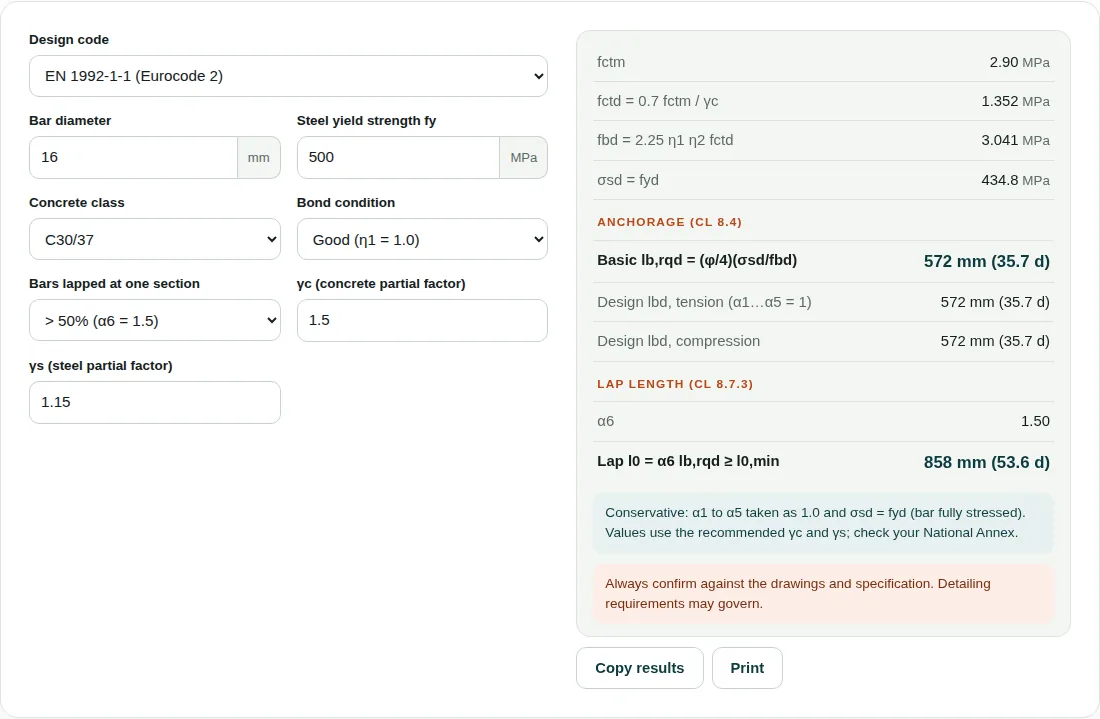
- fctm = 0.30 × 302/3 = 2.90 MPa.
- fctd = 0.7 × 2.896 / 1.5 = 1.352 MPa.
- fbd = 2.25 × 1.0 × 1.0 × 1.352 = 3.041 MPa.
- σsd = fyd = 500 / 1.15 = 434.8 MPa.
- lb,rqd = (16 / 4) × (434.8 / 3.041) = 572 mm (35.7d). The minimum anchorage lengths (172 mm in tension, 343 mm in compression) do not govern, so lbd = 572 mm both ways.
- More than 50% lapped gives α6 = 1.5, so l0 = 1.5 × 571.8 = 858 mm (53.6d). This is above l0,min = max(257, 240, 200) = 257 mm.
Limits of this calculator
- Extra cover, confining links and transverse pressure can shorten a Eurocode 2 lap through α1 to α5. The tool ignores these reductions.
- Top bars in pours deeper than 250 mm are often in poor bond conditions. Setting η1 = 0.7 raises the default lap from 858 mm to 1,225 mm.
- γc and γs are editable, but αct is fixed at 1.0. Check all three against your National Annex.
- IS 456 does not allow lap splices for bars larger than 36 mm, and the tool warns you if you enter one.
Questions people ask
What is the lap length for a 16 mm bar?
It depends on the code and the concrete. To Eurocode 2 with C30/37 concrete, fyk = 500 MPa, good bond and more than 50% of bars lapped, the tool gives 858 mm (53.6d). To IS 456 with Fe 500 bars in M20 concrete, the flexural tension lap is 906 mm (56.6d).
What is the difference between development length and lap length?
Development (anchorage) length is how far a bar must extend into concrete to transfer its full force by bond. Lap length is the overlap needed when one bar passes its force to another, and it is usually longer. Eurocode 2 multiplies the anchorage length by α6, from 1.0 to 1.5, depending on how many bars are lapped at the same section.
How many times the bar diameter is a lap length?
There is no single multiple. For a 16 mm bar in C30/37 to Eurocode 2, the tool gives 53.6d with more than 50% lapped, 50.5d with 50% lapped and 76.6d in poor bond. Use the calculated value or the one on your drawings.
Related tools
- Stirrup & Bar Cutting Length: Cutting length of stirrups, L-bars and cranked bars with bend deductions.
- Rebar Weight: Weight of reinforcing steel in kg, tonnes or lb, metric and US bars.
- Beam Calculator: Reactions, shear force, bending moment and deflection diagrams.
Results are for estimating, checking and learning. Design work should be checked against the current code and your project specification, and signed off by a qualified engineer. See all 20 engineering calculators.