
This bar cutting length calculator works out how long to cut a stirrup, L-bar, U-bar or cranked bar before it is bent. It adds the hooks, takes off the bend deductions and gives the weight of each bar for your bar bending schedule.
The default example is an 8 mm stirrup for a 230 × 450 mm beam with 25 mm clear cover. The stirrup is 180 × 400 mm out-to-out and needs a cutting length of 1,224 mm, weighing 0.483 kg.

Site Engineer Pocket Reference
A free 7-page PDF with the site numbers you use most.
Useful for this job
We may earn a commission if you buy through these links, at no extra cost to you. As an Amazon Associate, EducateLink earns from qualifying purchases. Disclosure
How to use it
- Choose the Bar shape: Rectangular stirrup / link (135° hooks), L-bar, U-bar or any bent bar, or Cranked (bent-up) bar.
- Enter the Bar diameter in mm.
- For a stirrup, enter Beam / column width, Beam depth / column depth, Clear cover to stirrup and Hook length (× bar dia). For a bent bar, type the Straight segments, out-to-out (mm, comma separated) and the number of bends at each angle.
- Check the four values under Bend deductions (× bar diameter) against your standard.
- Set Number of bars to get a total length and weight. Results update as you type.
How the cutting length is calculated
Bar dimensions are measured to the outside of each bend, so the tool subtracts a bend deduction for every bend, in multiples of bar diameter d: by default 1d for 45°, 2d for 90°, 3d for 135° and 4d for 180°.
Stirrup with two 135° hooks
- a = width − 2 × cover and b = depth − 2 × cover (out-to-out of the stirrup)
- hook = the larger of (hook factor × d) and 75 mm
L = 2(a + b) + 2 × hook − 3 × 2d − 2 × 3d, for three 90° corners and two 135° hook bends
Bent bar: L = sum of segments − bend deductions.
Cranked bar at 45°: each crank of height D adds (1 / sin 45° − 1) × D = 0.414 D and has two 45° bends, so L = straight length + n × 0.414 D − n × 2 × 1d.
Weight per bar = cutting length × 7850 × π d² / 4 × 10⁻⁶ kg/m.
Worked example: 8 mm stirrup in a 230 × 450 mm beam
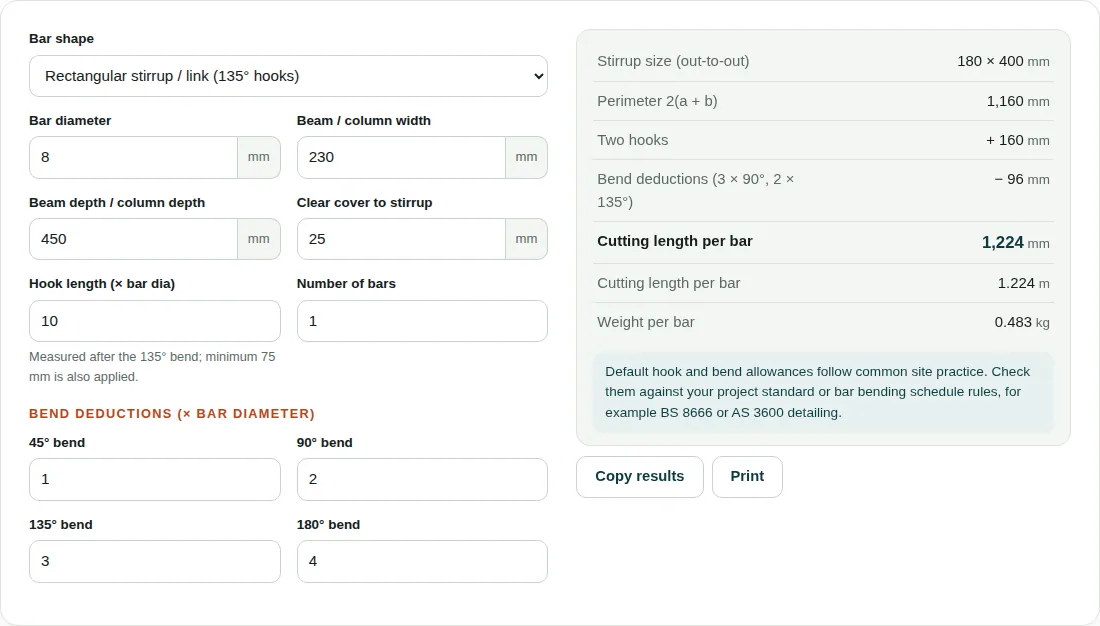
- Stirrup size: a = 230 − 2 × 25 = 180 mm and b = 450 − 2 × 25 = 400 mm.
- Perimeter: 2 × (180 + 400) = 1,160 mm.
- Hook: 10 × 8 = 80 mm, which beats the 75 mm minimum. Two hooks add 160 mm.
- Bend deductions: 3 × 2 × 8 + 2 × 3 × 8 = 48 + 48 = 96 mm.
- Cutting length: 1,160 + 160 − 96 = 1,224 mm (1.224 m).
- Weight: an 8 mm bar is 0.3946 kg/m, so 1.224 × 0.3946 = 0.483 kg per stirrup.
Check these against your drawings
- Hook length depends on the design code and on seismic detailing. The default of 10d with a 75 mm minimum is site practice; enter what your drawings call for.
- Bend deductions of 1d, 2d, 3d and 4d are rules of thumb. The true allowance depends on the bending former diameter, so a fabricator working to BS 8666 may use other figures.
- The cover you enter is the clear cover to the stirrup, not to the main bars.
- For a cranked bar, the crank height is the vertical offset of the bar, not the overall beam depth. Take off the top and bottom cover first.
Questions people ask
What is the formula for stirrup cutting length?
Cutting length = 2(a + b) + 2 hooks − bend deductions, where a and b are the out-to-out sizes of the stirrup. For an 8 mm stirrup in a 230 × 450 mm beam with 25 mm cover that is 2(180 + 400) + 2 × 80 − 96 = 1,224 mm. The tool uses 10d hooks and deducts 2d per 90° bend and 3d per 135° bend by default.
Why are bend deductions subtracted from the cutting length?
Schedule dimensions are measured to the outside of each bend, but the bar goes round a curve, so adding the outside dimensions overstates the length. The deduction corrects this. With the default values, a 90° bend removes 2 bar diameters, which is 16 mm for an 8 mm bar.
How do you calculate the cutting length of a cranked bar?
Add 0.414 × crank height for each 45° crank to the straight length, then subtract two 45° bend deductions per crank. For the tool’s default 8 mm bar, 4,000 mm long with two 300 mm cranks, that is 4,000 + 2 × 124.3 − 2 × 2 × 8 = 4,217 mm.
Related tools
- Rebar Weight: Weight of reinforcing steel in kg, tonnes or lb, metric and US bars.
- Lap & Development Length: Lap and anchorage lengths to Eurocode 2, ACI 318, AS 3600 or IS 456.
- Concrete Volume: Slabs, footings, columns, beams, walls and stairs in m³ or yd³.
Results are for estimating, checking and learning. Design work should be checked against the current code and your project specification, and signed off by a qualified engineer. See all 20 engineering calculators.