
This rebar weight calculator gives the weight of reinforcing steel from the bar size, the length of each bar and the number of bars. It covers metric bars from 6 mm to 40 mm and US bars #3 to #18, and shows the total in kilograms, tonnes and pounds.
Add one row per bar size. The default example has ten 16 mm bars and twenty 10 mm bars, all 12 m long. That is 360 m of steel weighing 337.37 kg, handy for checking a bar bending schedule or a steel order.

Site Engineer Pocket Reference
A free 7-page PDF with the site numbers you use most.
Useful for this job
We may earn a commission if you buy through these links, at no extra cost to you. As an Amazon Associate, EducateLink earns from qualifying purchases. Disclosure
How to use it
- Choose Bar sizes: Metric bars (mm) or the US bar option.
- Leave Steel density at 7850 kg/m³ unless your specification gives another value.
- In each row, pick the Bar size and enter Length each (m) and No. of bars.
- Click + Add bar size for another diameter, or the × button to remove a row.
- Read the weight of each row and the Total weight in kg, t and lb. The totals update as you type.
How rebar weight is calculated
Weight per metre is the cross-section area of the bar times the density of steel:
kg/m = ρ × π d² / 4 × 10⁻⁶, with d in mm and ρ in kg/m³.
For ρ = 7850 kg/m³ this reduces to d² / 162.2, which is usually rounded to d² / 162. The tool uses the exact expression, so a 16 mm bar comes out at 1.578 kg/m rather than the 1.580 kg/m the shortcut gives.
US bars use their nominal diameters, for example #4 = 0.5 in (12.7 mm) and #8 = 1.0 in (25.4 mm). For US bars the tool also shows lb/ft, using 1 lb/ft = 1.48816 kg/m.
Row weight = kg/m × length each × number of bars.
Worked example: 10 × 16 mm and 20 × 10 mm bars, 12 m long
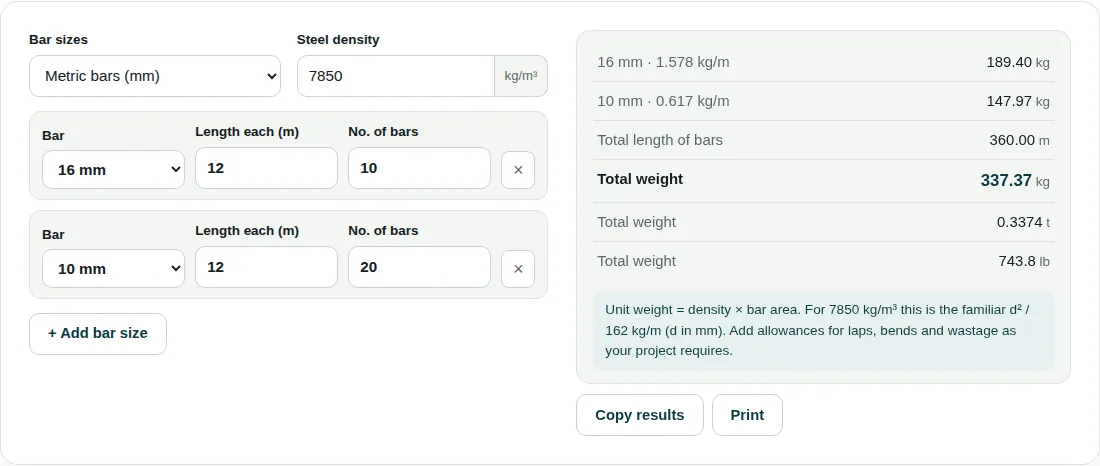
- 16 mm bar: area = π × 16² / 4 = 201.06 mm²; 7850 × 201.06 × 10⁻⁶ = 1.578 kg/m.
- 16 mm row: 10 × 12 m = 120 m; 120 × 1.5783 = 189.40 kg.
- 10 mm bar: area = 78.54 mm²; 7850 × 78.54 × 10⁻⁶ = 0.617 kg/m.
- 10 mm row: 20 × 12 m = 240 m; 240 × 0.6165 = 147.97 kg.
- Totals: 120 + 240 = 360.00 m of bar and 189.40 + 147.97 = 337.37 kg, which is 0.3374 t or 743.8 lb.
Before you use the total for an order
- Enter the cutting length of each bar, including hooks and laps, not the clear span. The bar cutting length calculator gives this for stirrups and bent bars.
- The tool adds nothing for laps, offcuts or wastage. Put your own allowance on top of the total.
- Stock bars come in fixed lengths. Check what your supplier stocks and plan the cuts so offcuts can be used elsewhere.
- Actual bar mass can differ from nominal within the rolling tolerance of the bar standard. Ask whether your supplier invoices on nominal or weighed mass.
Questions people ask
What is the weight of a 12 mm bar per metre?
A 12 mm bar weighs 0.888 kg per metre at a steel density of 7850 kg/m³. The d²/162 shortcut gives 0.889 kg/m. A 12 m length weighs about 10.65 kg.
What is the d²/162 formula for steel?
It gives the weight of a round steel bar in kg per metre, with d in millimetres. It comes from 7850 kg/m³ × π d²/4 × 10⁻⁶, which equals d²/162.2. A 10 mm bar is 100/162 = 0.617 kg/m and a 20 mm bar is 400/162 = 2.47 kg/m.
How much does #4 rebar weigh?
A #4 bar (0.5 in or 12.7 mm nominal diameter) weighs 0.668 lb/ft, which is 0.994 kg/m. Choose the US option under Bar sizes and pick #4 to include it in a total.
Related tools
- Stirrup & Bar Cutting Length: Cutting length of stirrups, L-bars and cranked bars with bend deductions.
- Lap & Development Length: Lap and anchorage lengths to Eurocode 2, ACI 318, AS 3600 or IS 456.
- Concrete Volume: Slabs, footings, columns, beams, walls and stairs in m³ or yd³.
Results are for estimating, checking and learning. Design work should be checked against the current code and your project specification, and signed off by a qualified engineer. See all 20 engineering calculators.