
This section properties calculator gives the area, centroid, second moment of area (moment of inertia), elastic and plastic section modulus and radius of gyration for eight shapes: rectangle, box (RHS/SHS), solid circle, pipe (CHS), I or H-section, T-section, channel and angle.
Enter dimensions in millimetres. Results are in mm², ×10⁶ mm⁴ and ×10³ mm³, the units steel section tables use, and a sketch marks the centroid. Angles also get the principal axes and the minimum radius of gyration.
How to use it
- Choose the shape in Section shape. Only the fields that shape needs are shown.
- For I, T and channel sections, enter Flange width bf, Flange thickness tf, Overall depth d and Web thickness tw in mm.
- Other shapes use Width b, Depth h, Wall / leg thickness t or Outside diameter D.
- Check the sketch. The dot is the centroid and the dashed lines are the axes through it.
- Read the results. I is given in ×10⁶ mm⁴, the unit the beam calculator takes. The same number is I in ×10⁻⁶ m⁴, so 75.905 ×10⁶ mm⁴ = 75.905 ×10⁻⁶ m⁴.
How the section properties are calculated
Every shape except the circle and pipe is split into rectangles; a box is an outer rectangle minus an inner one. Measuring from the bottom-left corner:
- Area A = Σa. Centroid x̄ = Σ(a·x)/A and ȳ = Σ(a·y)/A.
- Parallel axis theorem: Ix = Σ(bh³/12 + a·d²), where d is the distance from each rectangle’s centroid to ȳ. Iy is found the same way about x̄.
- Elastic modulus Z = I / distance to the extreme fibre, given for each face, so T-sections, channels and angles show two values.
- Plastic modulus S: the tool finds the equal-area axis by bisection and sums the first moments of area about it.
- Radius of gyration r = √(I/A). For angles, Iu and Iv = (Ix + Iy)/2 ± √[((Ix − Iy)/2)² + Ixy²].
Circles and pipes use exact formulas: I = π(D⁴ − d⁴)/64, S = (D³ − d³)/6 and J = 2I, where d is the bore.
Worked example: 300 mm I-section, 150 × 10 mm flanges, 7 mm web
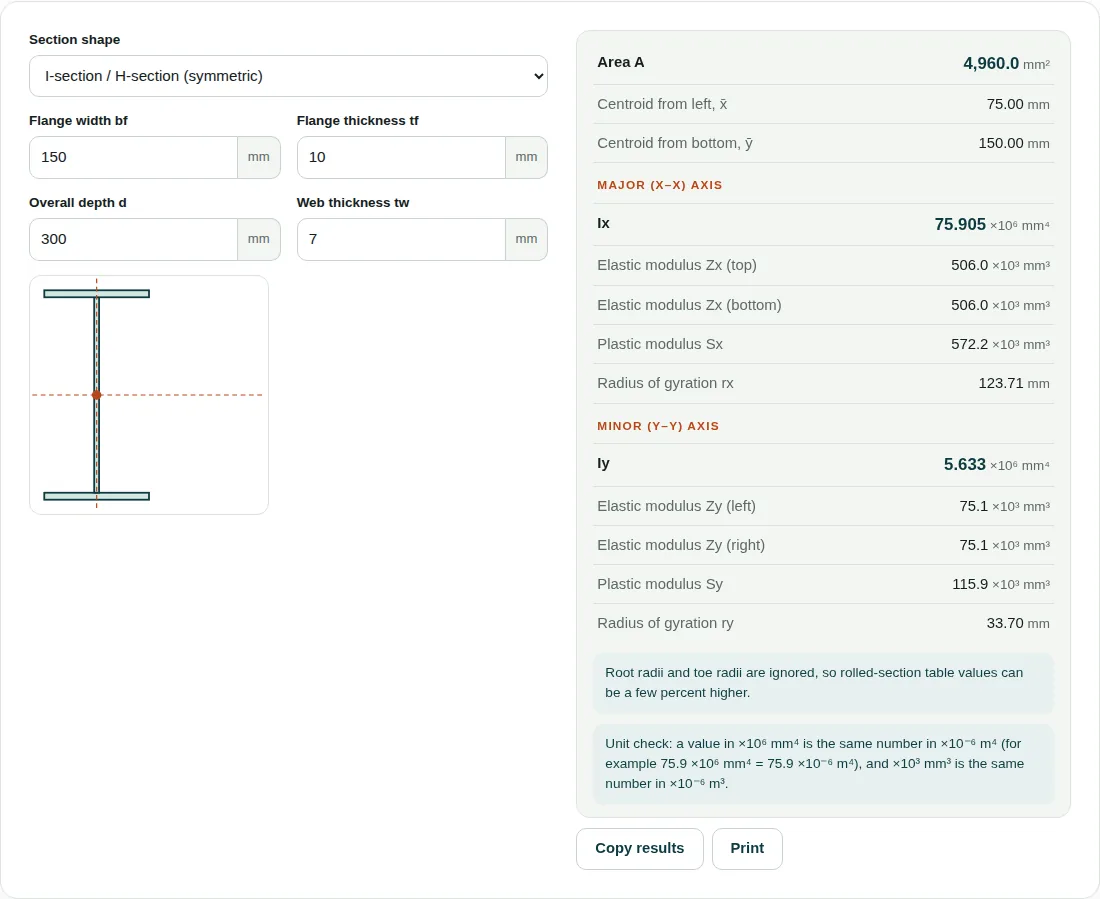
The section splits into two 150 × 10 mm flanges and a 7 × 280 mm web (300 − 2 × 10 = 280 mm). By symmetry x̄ = 75.00 mm and ȳ = 150.00 mm.
- Area A = 2 × 150 × 10 + 7 × 280 = 3,000 + 1,960 = 4,960 mm².
- Each flange about the x axis: 150 × 10³/12 + 1,500 × 145² = 12,500 + 31,537,500 mm⁴, so both flanges give 63,100,000 mm⁴. The web adds 7 × 280³/12 = 12,805,333 mm⁴. Ix = 75.905 × 10⁶ mm⁴.
- Zx = 75,905,333 / 150 = 506.0 × 10³ mm³, the same top and bottom.
- Sx = 2 × 1,500 × 145 + 2 × (7 × 140) × 70 = 435,000 + 137,200 = 572.2 × 10³ mm³, a shape factor S/Z of 1.13.
- rx = √(75,905,333 / 4,960) = 123.71 mm.
- Minor axis: Iy = 2 × 10 × 150³/12 + 280 × 7³/12 = 5,625,000 + 8,003 = 5.633 × 10⁶ mm⁴. Then Zy = 5,633,003 / 75 = 75.1 × 10³ mm³, Sy = 112,500 + 3,430 = 115.9 × 10³ mm³ and ry = 33.70 mm.
Before you use the numbers
- Root and toe radii are ignored, so tabulated values for rolled I-sections and channels can be a few percent higher. Design from the manufacturer’s table.
- The box has sharp corners. Real hollow sections have rounded corners and a slightly lower tabulated area.
- Symbols vary. Here Z is elastic and S plastic, as in UK and Australian practice. AISC swaps the two letters, and Eurocode 3 uses Wel and Wpl.
- A single angle strut buckles about its weakest axis, so use the minimum radius rv.
Questions people ask
How do you calculate the moment of inertia of an I-beam?
Split it into two flanges and a web, take bh³/12 for each, and add area × distance² for the flanges. For a symmetric I-section the short route is BD³/12 − (B − tw)(D − 2tf)³/12. For the default section that gives 337.500 × 10⁶ − 261.595 × 10⁶ = 75.905 × 10⁶ mm⁴.
What is the difference between elastic and plastic section modulus?
The elastic modulus Z = I/y gives the moment at first yield, fy × Z. The plastic modulus S gives the moment when the whole section has yielded, fy × S. Their ratio is the shape factor: 1.13 for the default I-section and 1.5 for a solid rectangle.
How do I find the weight per metre of a steel section?
Multiply the area by the density of steel, 7,850 kg/m³. The default I-section has A = 4,960 mm² = 0.00496 m², so it weighs 0.00496 × 7,850 = 38.9 kg/m. A rolled section with root radii weighs a little more.
Related tools
- Beam Calculator: Reactions, shear force, bending moment and deflection diagrams.
- Engineering Unit Converter: Stress, force, moment, flow, land area (incl. ropani and bigha) and more.
- Rebar Weight: Weight of reinforcing steel in kg, tonnes or lb, metric and US bars.
Results are for estimating, checking and learning. Design work should be checked against the current code and your project specification, and signed off by a qualified engineer. See all 20 engineering calculators.