
Learning how to write a literature review comes down to one shift: you stop reporting what each source says and start explaining what the sources say together. A good review maps what is already known about your research question, shows where studies agree and disagree, judges how strong the evidence is, and ends at the gap your own project will fill.
For engineering and science students the review usually sits early in a thesis, project report or research proposal. It has a practical job: it justifies your method and shows the examiner you know the field. The eight steps below take you from a broad topic to a finished, referenced chapter, with a worked database search, a synthesis matrix and a before-and-after paragraph.
Start your reference list on day one. The free citation generator formats journal articles, books and web pages in APA 7, MLA 9 or Harvard, so you are not rebuilding entries the night before submission.
What a literature review is for
A literature review does four things. It sets out what is known, it evaluates the quality of that knowledge, it identifies what is missing or disputed, and it explains why your study is worth doing. Students often leave out the last point, yet it is what ties the review to the rest of the thesis.
It is not an annotated bibliography. An annotated bibliography takes sources one at a time. A literature review is organised around ideas, so a single paragraph may draw on five sources, and a single source may appear in three different sections.
| Annotated bibliography | Literature review | |
|---|---|---|
| Organised by | Source, usually alphabetical | Theme, method or time period |
| Each unit is | One source with a short summary and comment | One idea, supported by several sources |
| Main job | Describe and assess individual sources | Connect sources and argue toward a gap |
| Your voice | Brief evaluation of each item | Runs through the whole text |
How to write a literature review in eight steps
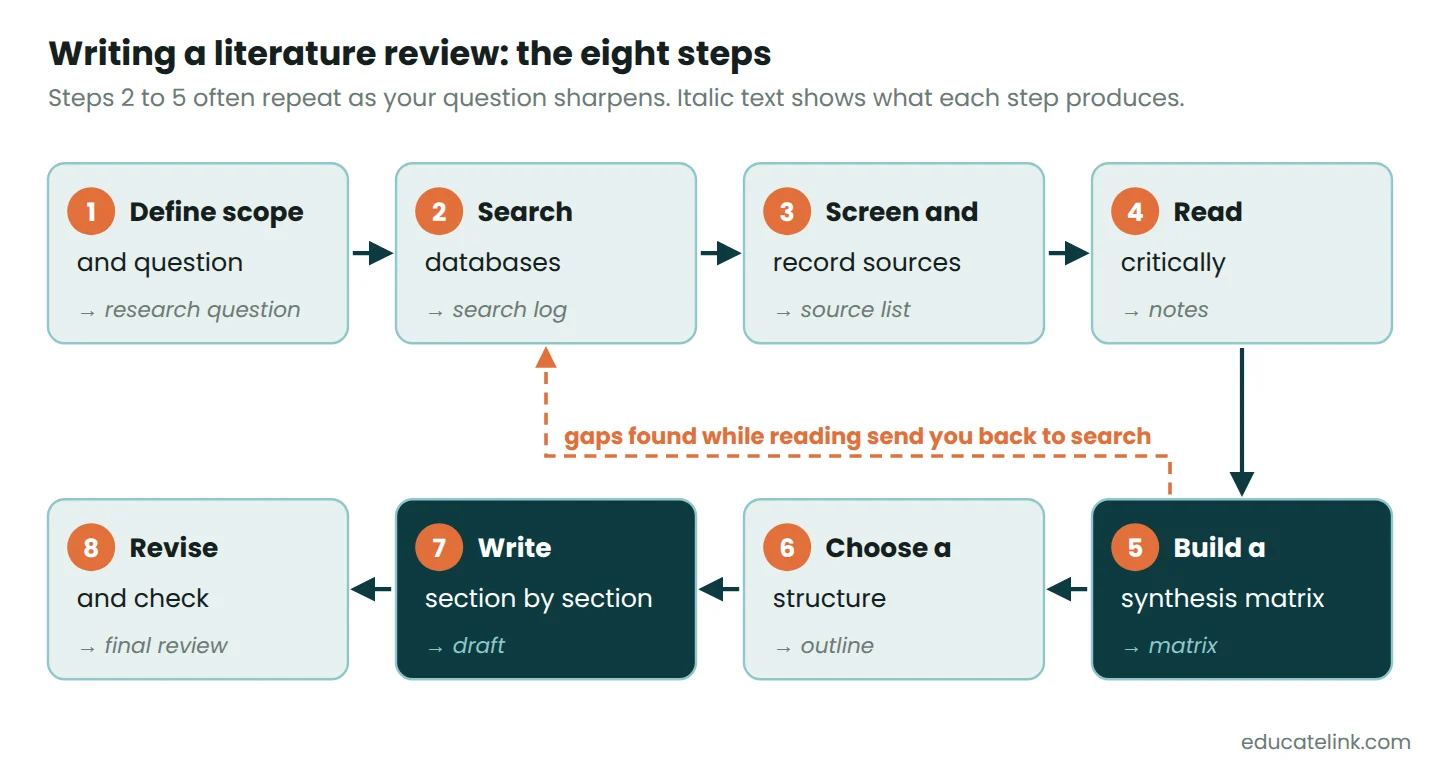
Step 1: Define the scope and question
A topic is too broad to review. “Recycled materials in roads” could fill a book. A question gives you a boundary: “How does recycled concrete aggregate (RCA) perform as an unbound road base compared with crushed rock, and what limits its use?” Now you know what to search for and, just as useful, what to leave out.
Write down your inclusion criteria before you search: date range, document types (journal papers, conference papers, standards, government reports), language, and whether lab-only studies count. These rules keep the review consistent and give you a sentence for your introduction explaining how sources were chosen.
Step 2: Search the databases
Use your library’s databases, not just a web search. For engineering, Scopus, Web of Science and Engineering Village (which includes Compendex) cover most engineering fields. IEEE Xplore suits electrical and computing topics, and the ASCE Library suits civil. Google Scholar is handy for finding a known paper and following “Cited by” links, but it gives you less control over fields and filters.
Build the search string one concept at a time. List synonyms for each concept and join them with OR, then join the concepts with AND. The MIT Libraries guide to Boolean operators explains the logic well. For the RCA question:
("recycled concrete aggregate" OR "crushed concrete" OR RCA) AND (pavement* OR "road base" OR subbase OR "base course") AND ("resilient modulus" OR stiffness OR "permanent deformation")
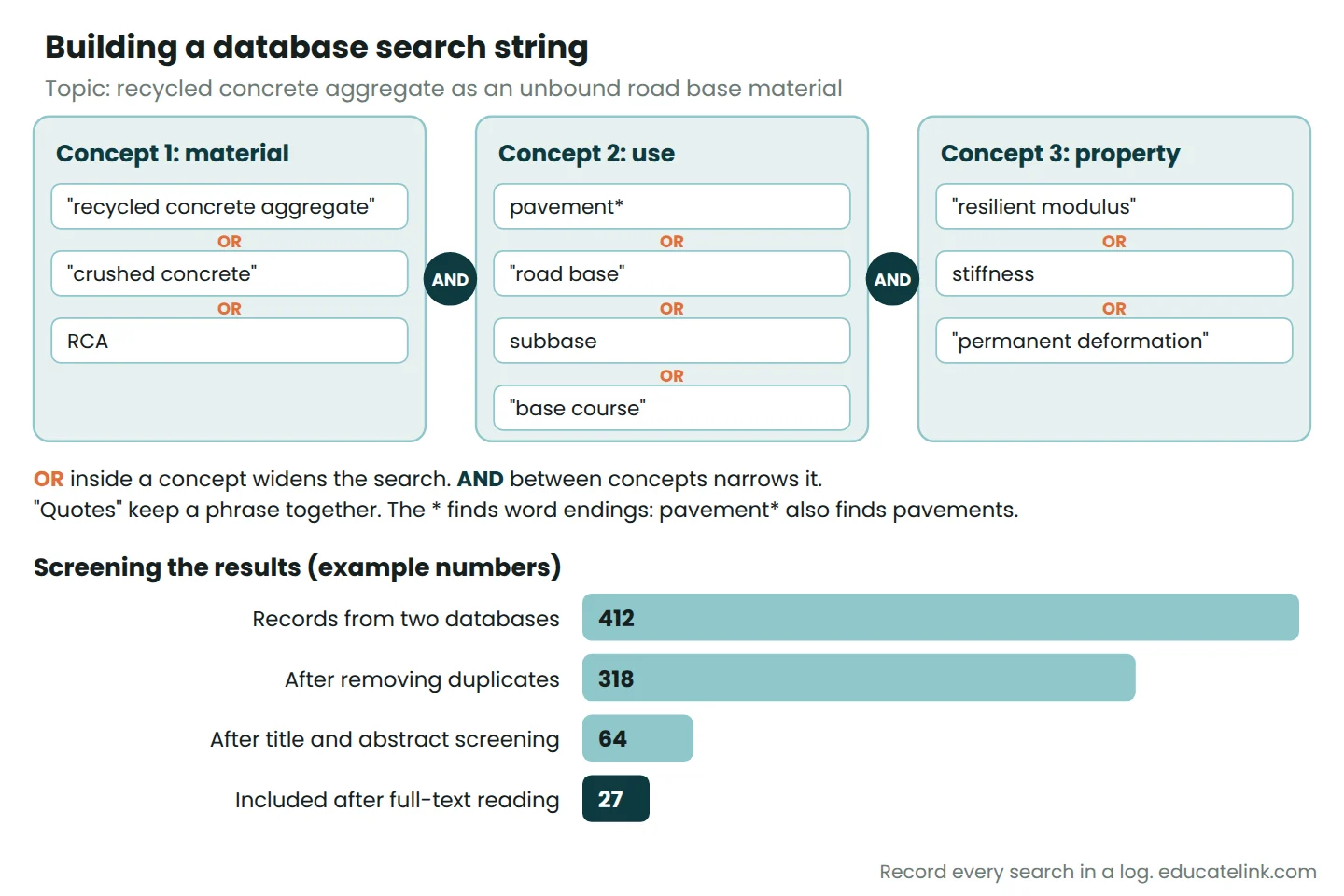
In Scopus you would wrap this in TITLE-ABS-KEY( ) so it searches titles, abstracts and keywords. Syntax differs between databases, so check each one’s help page. Then look at the first page of results and adjust. Here, “RCA” on its own also picks up papers on root cause analysis, so you might keep it only alongside “aggregate”.
Keep a search log: database, date, exact string, filters and number of results. It takes two minutes per search and lets you repeat or update the search months later. Then follow the citations: check the reference lists of your best papers (backward) and the papers that have since cited them (forward).
Step 3: Screen and record sources
Remove duplicates, then screen titles and abstracts against your criteria. Read the full text of the survivors before deciding what to include, and note why anything was excluded. Put every kept source straight into a reference manager such as Zotero, EndNote or Mendeley. If your project is a formal systematic review, follow the PRISMA 2020 reporting guideline and its flow diagram.
Step 4: Read critically
Read the abstract, then the method and results, before you trust the conclusion. For each engineering or science paper, ask:
- What exactly was tested, and was it lab, field or modelling work?
- How many samples or sites, and under what conditions? Are they like the ones your project cares about?
- Which test standard or method was used, and can results be compared with other studies?
- What limitations do the authors admit, and what did they not mention?
- Is it peer reviewed, and has later work confirmed, extended or contradicted it?
Keep two kinds of note for every source: what it says, and what you think about it. Mark the second kind clearly. Those comments become the evaluation in your review.
Step 5: Build a synthesis matrix
A synthesis matrix is a table with sources as rows and themes as columns. Monash University’s guide recommends organising it by theme rather than by study, because a study-by-study table tends to produce a list rather than an argument. A spreadsheet works well since you can sort and filter. Here is a small example. The studies are invented to show the technique.
| Source | Method | Stiffness | Moisture | Long-term |
|---|---|---|---|---|
| Study A (2019) | Lab tests | Higher than crushed rock | Not reported | Not studied |
| Study B (2020) | Lab tests | Similar to crushed rock | Absorbs more water | Not studied |
| Study C (2021) | Field trial | Similar to control section | Softer after wet season | 2 years only |
| Study D (2022) | Lab tests | Falls as brick content rises | Not reported | Not studied |
| Study E (2023) | Review | Summarises lab work | Flags it as a risk | Calls for field data |
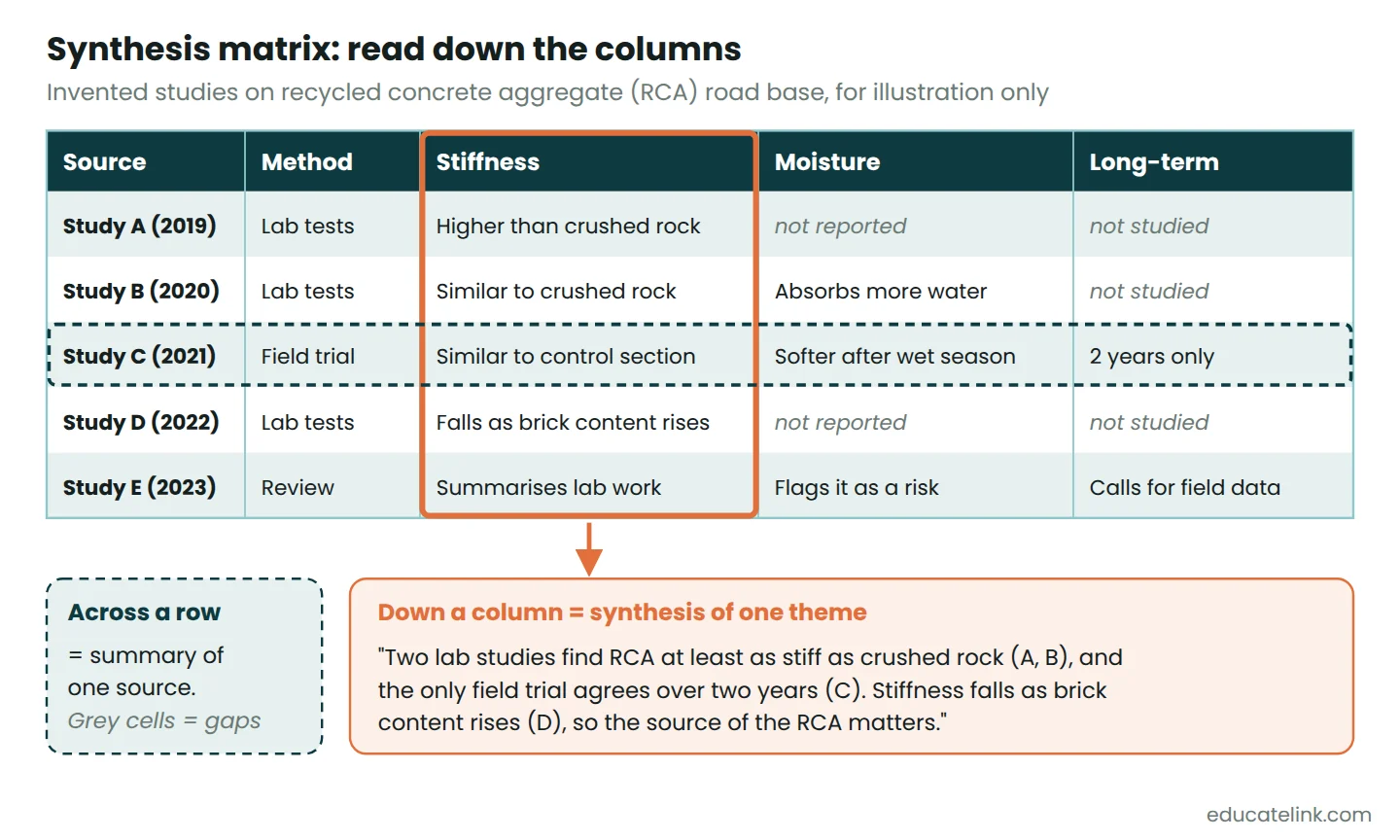
Reading across a row tells you about one source. Reading down a column tells you what the field knows about one theme, and that is what you write. The gap cells are useful too: the “Long-term” column shows at a glance that the field evidence is thin.
Step 6: Choose a structure
| Structure | Organise by | Use it when | Example headings (RCA topic) |
|---|---|---|---|
| Thematic | Issues or themes | Most theses and project reports; your matrix columns become sections | Stiffness; moisture sensitivity; long-term performance |
| Chronological | Time period | The field changed in clear stages, for example after a new standard or test method | Early trials; specification changes; recent field studies |
| Methodological | Research method | Different methods give different answers and that matters to your study | Laboratory testing; field trials; numerical modelling |
You can combine them, for example thematic sections with a chronological thread inside one theme. Pick the structure that best leads the reader to your gap, and agree it with your supervisor early.
Step 7: Write
The introduction states the question, the scope and how sources were chosen, and previews the structure. Each body section makes a point about one theme. The conclusion pulls the themes together, names the gap and says how your project addresses it. Within each paragraph, a reliable order is: your claim, the evidence from several sources, where they agree or differ and why, your judgement of the evidence, and what it means for your study.
Step 8: Revise
Check that each paragraph opens with your point, not with an author’s name. Check that every claim has a citation and every citation is in the reference list. Paste each section into the readability checker to find sentences over 25 words and stacks of passive voice, then run the grammar checker with English (Australia) selected. Finally, mark your draft against the rubric as if you were the examiner.
Synthesis versus summary: a before-and-after example
Here is a typical first draft built from the matrix above. It is accurate, but it is a summary: one source per sentence, no comparison and no judgement.
Weak: Study A (2019) tested recycled concrete aggregate (RCA) in the laboratory and found that its stiffness was higher than that of crushed rock. Study B (2020) also carried out laboratory tests and reported that RCA had similar stiffness to crushed rock but absorbed more water. Study C (2021) built a trial road with an RCA base and monitored it for two years. Study D (2022) tested RCA samples with different amounts of crushed brick.
The rewrite uses the same four sources but reads down the matrix columns:
Strong: Laboratory evidence suggests RCA can perform at least as well as crushed rock as an unbound base, with one study measuring higher stiffness (Study A, 2019) and another comparable values (Study B, 2020). The only field trial supports this over two years (Study C, 2021), but that period is too short to show long-term behaviour, and the trial section softened after a wet season, which fits the higher water absorption reported by Study B. Composition also matters, since stiffness fell as brick content rose (Study D, 2022). The literature therefore supports RCA in principle but gives little guidance on moisture control or acceptable brick content in service, which is the gap this project addresses.
What changed: the paragraph opens with a claim, groups sources by what they show, judges the evidence (two years is short), connects findings across studies (softening and water absorption), and finishes by pointing to the gap. With real sources, each citation would follow your referencing style.
How long should a literature review be?
As a typical range, the UNSW literature review guide suggests about 15 to 30% of a thesis, and warns that more than 40% is probably too long. Monash notes that reviews in coursework are often 500 to 1,000 words. Your course guide and supervisor have the final say.
| Document | Example total length | Typical review length (15 to 30%) |
|---|---|---|
| Honours or final-year thesis | 10,000 words | 1,500 to 3,000 words |
| Research master’s thesis | 30,000 words | 4,500 to 9,000 words |
| Coursework literature review task | Set by the task | Often 500 to 1,000 words |
Give each theme a word budget before you write, then track it with the word counter. A theme that runs far over budget usually means you are summarising rather than synthesising.
Citing and referencing
Use the style your school requires and use it consistently. APA 7 and Harvard are author-date styles. IEEE, common in engineering, uses numbers in square brackets that match a numbered reference list. Cite every idea, figure and finding that is not yours, including paraphrased ones. Cite the source you actually read: if you only saw a study quoted in a review paper, cite it as a secondary source or, better, find the original. For worked APA 7 entries, see the APA 7 referencing examples, and the citation generator builds APA 7, MLA 9 and Harvard entries you can paste in and check.
Using AI tools responsibly
Rules on generative AI differ between universities and even between courses in the same faculty, so read your course outline before you use any tool. Where use is allowed, you will usually need to acknowledge it. UNSW, for example, asks students to clearly acknowledge any AI use and warns that these tools can produce fabricated or unreliable information.
That warning matters most for references. Never cite a paper because an AI tool suggested it. Find it in a database, read it and record it yourself. If your course allows it, AI can help with low-risk tasks such as listing synonyms for a search string or explaining an unfamiliar term, which you then check. The synthesis, judgement and argument are what you are being assessed on, so they need to be yours. Do not paste unpublished data, confidential industry information or other people’s work into a public tool.
Common mistakes
- Source-by-source summaries. Paragraphs that each start “Study A (2019) found…” read as a list. Lead with the idea.
- No clear question. Without one, the review drifts and the gap never appears.
- Too much quoting. Paraphrase and compare. Save quotations for definitions or wording that matters.
- Uncritical reporting. Treating a small lab study and a multi-year field trial as equal evidence.
- A one-database search. Using only Google Scholar’s first page misses key papers and is hard to repeat.
- No link to your project. Every section should end by showing why it matters for your study.
- Reference errors. Mixed styles, missing entries, and AI-invented papers that do not exist.
- Writing it once. New papers appear while you work. Rerun your logged searches before you submit.
If your project includes experiments, the same habits carry into the discussion section of your report; see how to write a lab report.
Frequently asked questions
What is the difference between a literature review and an annotated bibliography?
An annotated bibliography summarises and comments on sources one at a time, while a literature review is organised by ideas and connects many sources into an argument that leads to a research gap.
How many sources should a literature review have?
There is no fixed number. Use enough good sources to cover every theme in your question fairly, and check your course guide or supervisor for any expectation at your level.
Should a literature review include my own opinion?
Yes, in the form of evaluation backed by evidence. Judge which studies are stronger and why, and where the gaps are, rather than giving personal preferences.
Can I write the literature review before collecting data?
Yes, and you usually should, because the review shapes your method. Treat it as a living draft and update it before you submit.
References
- UNSW Sydney. Literature review. Academic Skills.
- Monash University. Literature review and The process of writing a literature review. Student Academic Success.
- Purdue Online Writing Lab. Writing a literature review.
- The Writing Center, University of North Carolina at Chapel Hill. Literature reviews.
- MIT Libraries. Database search tips: Boolean operators.
- UNSW Sydney. Using artificial intelligence (AI) in university.
- PRISMA. PRISMA 2020 statement and flow diagram.
This article is general guidance for learning. Check your course guide, marking rubric and supervisor’s advice, and follow your university’s rules on referencing and the use of AI tools.

Leave a Reply