
This readability checker scores your essay or report with six formulas: Flesch Reading Ease, Flesch–Kincaid grade, Gunning Fog, SMOG, Coleman–Liau and the Automated Readability Index, then averages the five grade scores.
It also highlights sentences over 25 words, possible passive voice and adverbs ending in -ly, so you can see which sentences to rework. It runs in your browser and needs at least 30 words.
Referencing & Report Cheat-Sheet
A free 4-page PDF: APA 7, Harvard and IEEE at a glance, plus a lab report checklist.
Useful for this job
We may earn a commission if you buy through these links, at no extra cost to you. As an Amazon Associate, EducateLink earns from qualifying purchases. Disclosure
How to use it
- Paste into Paste your essay or report, or use Or upload a file. Scores appear at 30 words.
- Read Flesch Reading Ease (higher is easier) and Average grade level (lower is easier).
- Under Your writing, check Long sentences (> 25 words) and Passive voice (possible).
- In the highlighted copy, amber marks long sentences, red over 35 words, blue possible passive voice and purple -ly adverbs.
The readability formulas
W = words, S = sentences, Syl = syllables, C = letters and digits.
| Score | Formula |
|---|---|
| Flesch Reading Ease | 206.835 − 1.015(W/S) − 84.6(Syl/W) |
| Flesch–Kincaid | 0.39(W/S) + 11.8(Syl/W) − 15.59 |
| Gunning Fog | 0.4[(W/S) + 100(complex/W)] |
| SMOG | 1.043√(poly × 30/S) + 3.1291 |
| Coleman–Liau | 0.0588L − 0.296S100 − 15.8, with L and S100 per 100 words |
| ARI | 4.71(C/W) + 0.5(W/S) − 21.43 |
Syllables come from a spelling rule, not a dictionary: drop a final -e or -es (and -ed, unless it follows t or d), then count vowel groups (y included); words of three letters or fewer are one syllable. Poly means three or more syllables. Complex words are polysyllables not ending in -es, -ed or -ing. Reading Ease labels follow Flesch’s own bands: 90+ Very easy, 80–89 Easy, 70–79 Fairly easy, 60–69 Standard / plain English, 50–59 Fairly difficult, 30–49 Difficult (university level), below 30 Very difficult (graduate level).
Worked example: 75 words on curing concrete
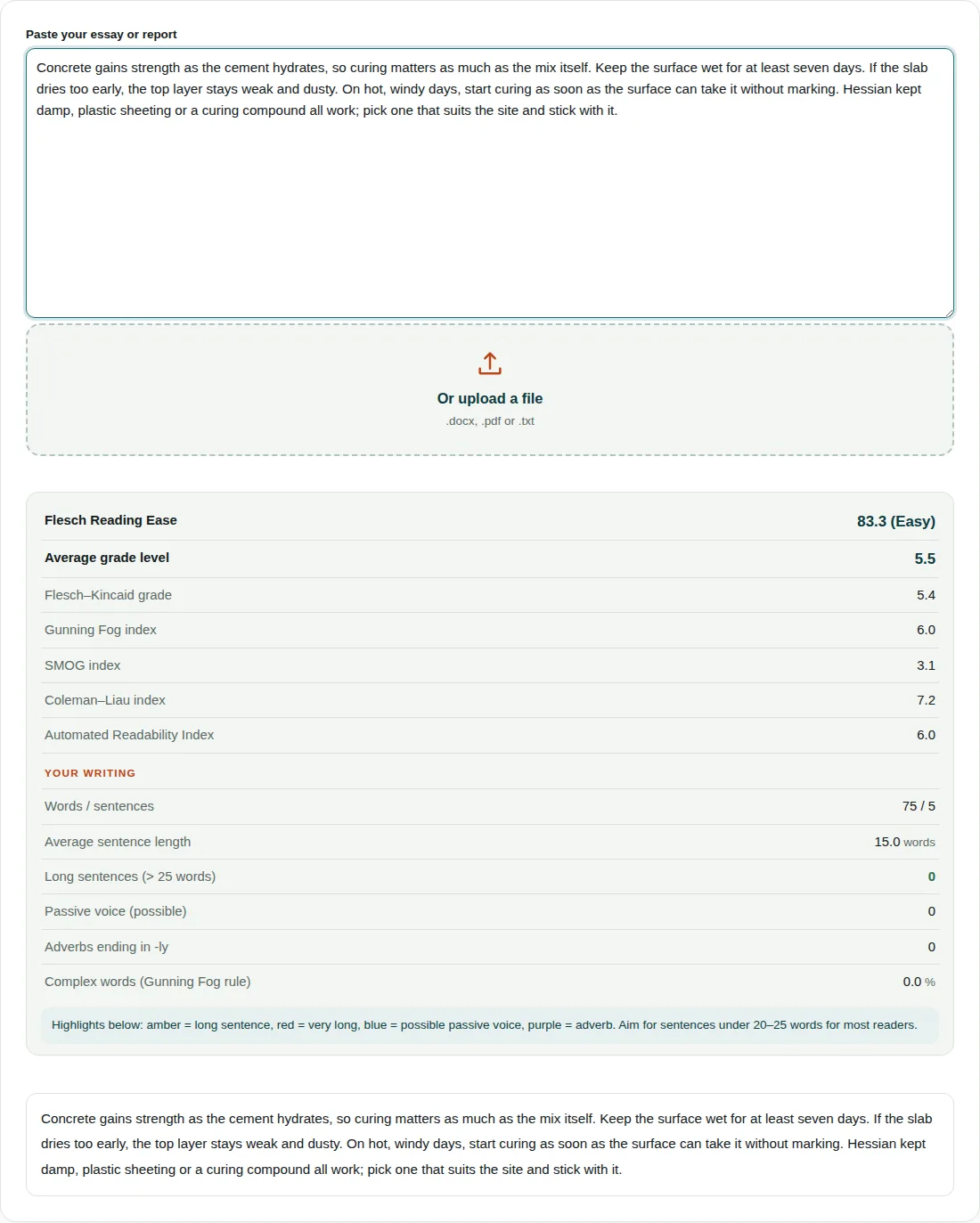
The screenshot paragraph has W = 75, S = 5, Syl = 96, C = 318 and no polysyllables, so W/S = 15, Syl/W = 1.28 and C/W = 4.24.
- Reading Ease = 206.835 − 15.225 − 108.288 = 83.3 (Easy).
- Flesch–Kincaid = 5.850 + 15.104 − 15.59 = 5.4.
- Fog = 0.4 × (15 + 0) = 6.0.
- SMOG = 1.043 × √0 + 3.1291 = 3.1.
- Coleman–Liau: L = 424, S100 = 6.67, so 24.93 − 1.97 − 15.8 = 7.2.
- ARI = 19.97 + 7.50 − 21.43 = 6.0.
- Average grade = (5.364 + 6.000 + 3.129 + 7.158 + 6.040) ÷ 5 = 5.5.
The longest sentence has 21 words; no passive voice or -ly adverb is found.
Reading the scores sensibly
- The syllable rule misjudges some words: created counts as two syllables and being as one.
- SMOG was designed for 30-sentence samples; short extracts with no long words sit at 3.1.
- Passive voice is matched by pattern, so “the slab is cracked” is flagged too.
- Headings and bullets without full stops merge into one long sentence.
Questions people ask
What is a good Flesch Reading Ease score?
Higher is easier, usually on a 0–100 scale. Flesch called 60–69 standard or plain English, 70–79 fairly easy, 80–89 easy and 90 or more very easy. Long technical words pull the score down, because each extra syllable per word costs 84.6 points.
What is the difference between Flesch Reading Ease and Flesch–Kincaid?
Both use words per sentence and syllables per word, weighted differently. Higher Reading Ease means easier; Flesch–Kincaid gives a US school grade, where lower is easier.
How do I improve my readability score?
Shorten sentences first. In the Flesch–Kincaid formula each word cut from the average sentence lowers the grade by 0.39, so going from 25 to 15 words takes off 3.9 grades.
Related tools
- Grammar & Spelling Checker: Find grammar, spelling and punctuation mistakes.
- Word Counter: Words, characters, sentences, reading time and keywords.
- AI Writing Checker: Estimate whether text reads as AI-generated. Up to 5,000 words.