
This concrete volume calculator gives the volume of a slab, footing, wall, column, beam, pipe ring or stair flight, then adds a wastage allowance so you have an order quantity. Enter sizes in metres, millimetres, feet or inches. The answer comes out in m³, yd³, ft³ and litres.
The default example is a 5 m × 4 m slab, 150 mm thick: 3.000 m³ net, or 3.150 m³ to order with 5% wastage. For a run of identical items, such as 12 pad footings, set the quantity instead of multiplying by hand.

Site Engineer Pocket Reference
A free 7-page PDF with the site numbers you use most.
Useful for this job
- Concrete slump test setCheck workability at the truck
- 30 m fibreglass tapeFor take-off checks on site
- Reinforced concrete design textbookBackground for beam and lap checks
We may earn a commission if you buy through these links, at no extra cost to you. As an Amazon Associate, EducateLink earns from qualifying purchases. Disclosure
How to use it
- Pick the Shape, for example Slab / footing / raft, Round column / pier / pile or Staircase flight.
- Set Dimensions in to the unit on your drawing: metres, millimetres, feet or inches.
- Fill in the size boxes that appear for that shape, such as Length, Width and Thickness for a slab.
- Enter the Quantity (number of identical items) and a Wastage allowance in percent.
- Read the results as you type. The bold Order volume line is the figure to give the supplier.
How the concrete volume is calculated
Every size is converted to metres first (mm × 0.001, ft × 0.3048, in × 0.0254). The tool then uses:
- Slab, footing, raft or wall:
V = L × W × T(for a wall, W is the height) - Rectangular column:
V = a × b × h; beam:V = width × depth × length - Round column or pile:
V = π D² / 4 × h - Hollow round section:
V = π (D² − Di²) / 4 × h - Stair flight with n risers:
V = W × [n × R × G / 2 + t × √((nR)² + (nG)²)], which is the triangular steps plus a waist slab of thickness t measured square to the soffit
Order volume = V × quantity × (1 + wastage / 100). Conversions use 1 m³ = 1.30795 yd³ = 35.3147 ft³ = 1,000 L.
Worked example: 5 m × 4 m slab, 150 mm thick
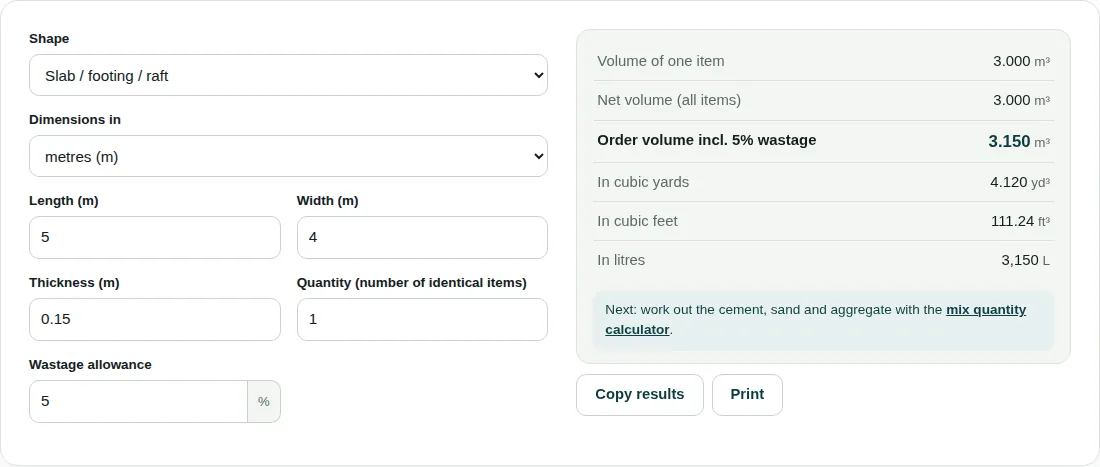
- Volume of one slab: 5 × 4 × 0.15 = 3.000 m³.
- Quantity is 1, so the net volume is also 3.000 m³.
- Add 5% wastage: 3.000 × 1.05 = 3.150 m³.
- Other units: 3.150 × 1.30795 = 4.120 yd³; 3.150 × 35.3147 = 111.24 ft³; 3.150 × 1,000 = 3,150 L.
Round up to the increment your supplier sells. If they deliver in 0.2 m³ steps, order 3.2 m³.
Check these before you order
- Measure the real depth of the formwork. If the sub-base is low and the 150 mm slab averages 160 mm, the same 5 m × 4 m area takes 3.2 m³, not 3.0 m³.
- The staircase option counts one going per riser and leaves out landings. Work out each landing as a slab and add it.
- For a thickened slab edge or a stepped footing, split the shape into rectangles and add the volumes.
- Use a higher wastage figure for thin toppings, hand mixing or pumping, where spillage and concrete left in the line are a bigger share of the pour.
- The result is the wet, compacted volume. The mix calculator applies a dry volume factor to turn it into cement, sand and aggregate.
Questions people ask
How do I calculate concrete for a slab in cubic metres?
Multiply length × width × thickness, with all three in metres. A 5 m × 4 m slab 150 mm thick is 5 × 4 × 0.15 = 3.0 m³. Add wastage on top; the tool’s default of 5% gives 3.15 m³ to order.
How many cubic yards are in 1 cubic metre of concrete?
One cubic metre is 1.308 cubic yards, and one cubic yard is 0.765 m³. The calculator shows the order volume in both units, plus cubic feet (35.31 ft³ per m³) and litres.
How much concrete do I need for a round column?
Use π × D² / 4 × height. A 450 mm diameter column 3 m high holds 0.477 m³, or 0.501 m³ with 5% wastage. Choose Round column / pier / pile in the Shape list and the tool does the sum for you.
Related tools
- Cement, Sand & Aggregate: Cement bags, sand and aggregate for nominal mixes like 1:2:4 and 1:1.5:3.
- Rebar Weight: Weight of reinforcing steel in kg, tonnes or lb, metric and US bars.
- Earthwork & Excavation: Pit and trench volumes, and cut and fill from cross-sections.
Results are for estimating, checking and learning. Design work should be checked against the current code and your project specification, and signed off by a qualified engineer. See all 20 engineering calculators.