
This bearing capacity calculator works out the ultimate bearing capacity qult and the allowable bearing pressure for strip, square, rectangular and circular footings. It uses Meyerhof (1963), Vesić/Hansen or EN 1997-1 Annex D, drained or undrained.
It also allows for a water table at any depth. The default 2 m square footing at 1.2 m in sand (φ’ = 30°) gives qult = 975.1 kPa by Meyerhof and 325.0 kPa allowable at FS 3.

Site Engineer Pocket Reference
A free 7-page PDF with the site numbers you use most.
Useful for this job
We may earn a commission if you buy through these links, at no extra cost to you. As an Amazon Associate, EducateLink earns from qualifying purchases. Disclosure
How to use it
- Choose the Method and Footing shape.
- Enter Width B (or diameter), Founding depth Df and, for a rectangle, Length L (the longer side).
- Enter Cohesion c’ and Friction angle φ’, or Undrained shear strength cu for the undrained option.
- Enter Soil unit weight γ (above water table), Saturated unit weight γsat and Depth to water table (blank if deep) from ground level.
- Set the Factor of safety and read the results.
Factor equations for each method
Drained options: qult = c’Ncscdc + q’Nqsqdq + 0.5γ’BNγsγdγ. All three use Nq = eπ tan φ’tan²(45° + φ’/2) and Nc = (Nq − 1)cot φ’ (π + 2 at φ’ = 0). B/L = 0 for a strip, 1 for a square or circle; Kp = tan²(45° + φ’/2).
| Method | Nγ | Shape factors | Depth factors |
|---|---|---|---|
| Meyerhof (1963) | (Nq − 1)tan(1.4φ’) | sc = 1 + 0.2KpB/L; sq = sγ = 1 + 0.1KpB/L | dc = 1 + 0.2√KpDf/B; dq = dγ = 1 + 0.1√KpDf/B |
| Vesić/Hansen | 2(Nq + 1)tan φ’ | sc = 1 + (B/L)(Nq/Nc); sq = 1 + (B/L)tan φ’; sγ = 1 − 0.4B/L | dq = 1 + 2tan φ'(1 − sin φ’)²k; dγ = 1; dc = dq − (1 − dq)/(Nctan φ’), or 1 + 0.4k at φ’ = 0 |
| Annex D, drained | 2(Nq − 1)tan φ’ | sq = 1 + (B/L)sin φ’; sγ = 1 − 0.3B/L; sc = (sqNq − 1)/(Nq − 1) | None |
Meyerhof’s sq, sγ, dq and dγ are 1.0 at φ’ = 0 and rise linearly to the full expressions above at φ’ = 10°; from 10° up the full values apply. In Vesić/Hansen, k = Df/B up to 1 and arctan(Df/B) beyond; the Nγ is Vesić’s, not Hansen’s 1.5(Nq − 1)tan φ’.
Undrained Annex D: qult = (π + 2)cusc + q, with sc = 1 + 0.2B/L. Here q is the total overburden stress at founding level, using γ above the water table and γsat below it.
Water above the base gives q’ = γDw + (γsat − 9.81)(Df − Dw) and γ’ = γsat − 9.81; γ’ is interpolated for water up to B below the base.
Worked example: 2 m square footing, Meyerhof
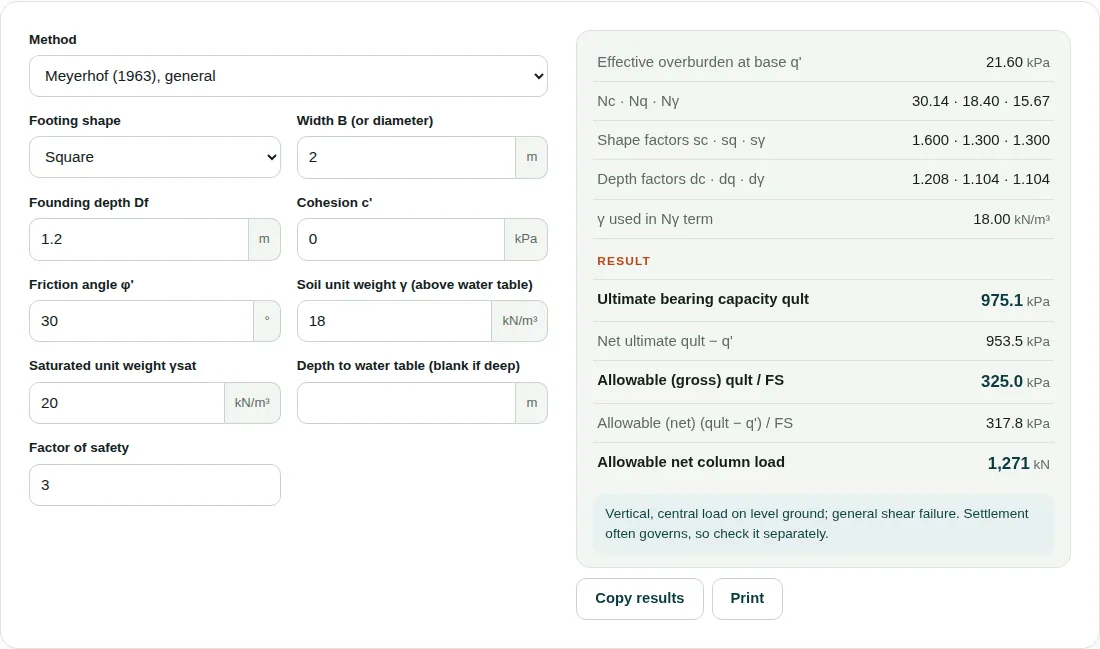
B = 2 m, Df = 1.2 m, c’ = 0, φ’ = 30°, γ = 18 kN/m³, no water table, FS = 3.
- q’ = 18 × 1.2 = 21.60 kPa; Kp = tan²60° = 3.000
- Nq = eπ tan 30° × 3.000 = 18.40; Nc = 17.40/tan 30° = 30.14; Nγ = 17.40 × tan 42° = 15.67
- sc = 1 + 0.2 × 3 = 1.600; sq = sγ = 1.300. With Df/B = 0.6, dc = 1.208 and dq = dγ = 1.104
- qult = 21.60 × 18.40 × 1.300 × 1.104 + 0.5 × 18 × 2 × 15.67 × 1.300 × 1.104 = 570.4 + 404.7 = 975.1 kPa
- Allowable: 975.1/3 = 325.0 kPa gross; (975.1 − 21.6)/3 = 317.8 kPa net
- Allowable net column load = 317.8 × 2 × 2 = 1,271 kN
Vesić/Hansen gives 977.5 kPa and Annex D drained 849.4 kPa for the same inputs.
Limits of this calculator
- Settlement often governs, so check it separately.
- Loads are vertical and central on level ground, with general shear failure and no inclination, tilt or slope factors.
- Results are sensitive to φ’: at 35° the example’s qult is 2,119.1 kPa.
- The Annex D options still use a global FS; Eurocode 7 design needs your National Annex partial factors.
Questions people ask
What is the difference between net and gross allowable bearing capacity?
Gross allowable pressure is qult/FS, while net allowable is (qult − q’)/FS, which removes the overburden already at founding level. For the default footing they are 325.0 and 317.8 kPa.
What factor of safety is used for bearing capacity?
The calculator defaults to FS = 3 on qult. Use the value from your code or geotechnical report; Eurocode 7 uses partial factors instead.
How does the water table affect bearing capacity?
Submerged soil weighs γsat − 9.81 kN/m³, so a high water table cuts both the overburden and the Nγ term. For the default footing, water at founding level reduces qult from 975.1 to 799.5 kPa.
Related tools
- Concrete Volume: Slabs, footings, columns, beams, walls and stairs in m³ or yd³.
- Retaining Wall Stability: Overturning, sliding and bearing checks for cantilever walls.
- Rebar Weight: Weight of reinforcing steel in kg, tonnes or lb, metric and US bars.
Results are for estimating, checking and learning. Design work should be checked against the current code and your project specification, and signed off by a qualified engineer. See all 20 engineering calculators.