
This brick calculator counts the bricks or concrete blocks in a wall and works out the cement and sand for the mortar. Enter the wall size, deduct doors and windows, pick a unit size and it adds the wastage for you.
The default example is a 10 m × 3 m wall with 2 m² of openings, half a brick thick in Australian standard bricks (230 × 110 × 76 mm) with 10 mm joints. It needs 48.4 bricks per m², 1,425 bricks with 5% wastage, 135 kg of cement and 0.564 m³ of sand.

Site Engineer Pocket Reference
A free 7-page PDF with the site numbers you use most.
Useful for this job
We may earn a commission if you buy through these links, at no extra cost to you. As an Amazon Associate, EducateLink earns from qualifying purchases. Disclosure
How to use it
- Enter the Wall length and Wall height in metres, and the total Openings to deduct (doors, windows) in m².
- Pick the Brick or block size. Choose Custom size to type the Unit length, Unit width and Unit height.
- Check the Mortar joint (the AAC block preset sets it to 3 mm) and choose the Wall thickness.
- Set the Wastage allowance, Mortar mix (cement : sand) and Cement bag size.
- Read the number of units and the mortar materials. The results update as you type.
How the bricks and mortar are calculated
Each unit plus its share of mortar takes up (L + j)(W + j)(H + j), where j is the joint. The number of units per m² of wall face is:
N = (t + j) / [(L + j)(W + j)(H + j)], all sizes in metres
For a half-brick wall t = W, so this reduces to 1 / [(L + j)(H + j)], the face-area count. A one-brick wall uses t = L and one and a half bricks uses t = L + W + j, which works for stretcher and header bonds.
- Units = N × net area × (1 + wastage / 100), rounded up
- Wet mortar = wall volume − volume of the units (before wastage)
- Dry mortar = wet × 1.33 × (1 + wastage / 100)
- For a 1 : n mix: cement = dry / (1 + n) × 1,440 kg/m³; sand = dry × n / (1 + n)
Worked example: 10 m × 3 m wall in Australian standard bricks
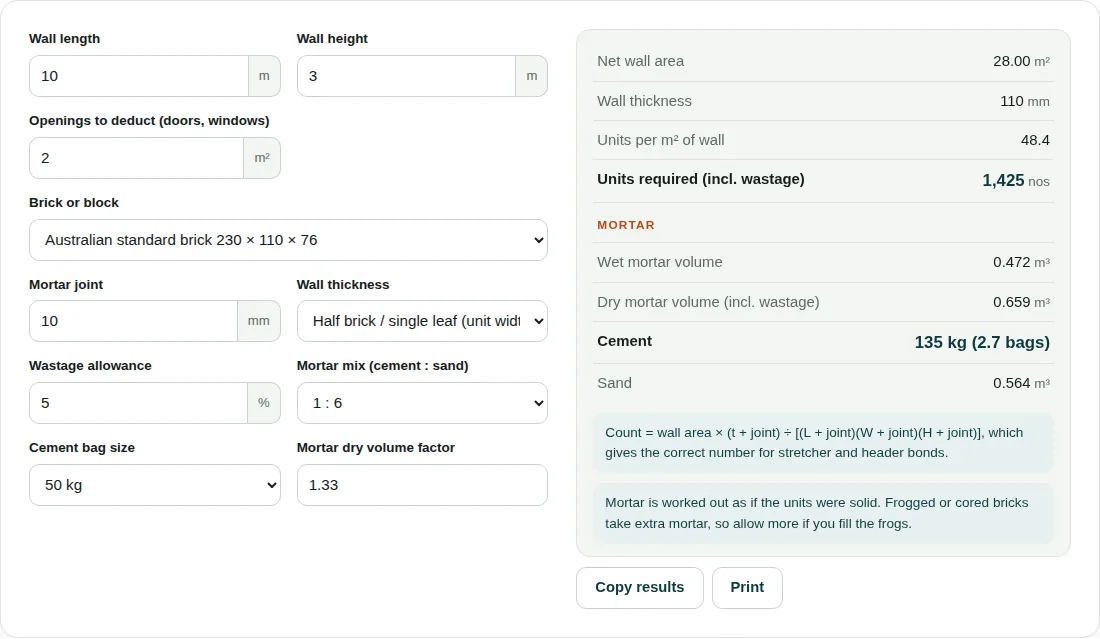
- Net area: 10 × 3 − 2 = 28.00 m². Wall thickness = unit width = 110 mm.
- Bricks per m²: (0.110 + 0.010) / (0.240 × 0.120 × 0.086) = 1 / (0.240 × 0.086) = 48.4.
- Net count: 28 × 48.45 = 1,356.6. With 5% wastage that is 1,424.4, rounded up to 1,425 bricks.
- Mortar: the wall is 28 × 0.110 = 3.080 m³ and the bricks are 1,356.6 × 0.230 × 0.110 × 0.076 = 2.608 m³, which leaves 0.472 m³ of wet mortar.
- Dry mortar: 0.4716 × 1.33 × 1.05 = 0.659 m³.
- 1 : 6 mix: cement = 0.6585 / 7 × 1,440 = 135 kg (2.7 bags of 50 kg); sand = 0.6585 × 6 / 7 = 0.564 m³.
Check these on site
- The mortar sum treats units as solid. Frogs and cores that take mortar will use more, so raise the wastage or the dry volume factor for frogged or cored bricks.
- Measure openings as the hole in the brickwork, not the glass or door leaf size.
- Joints of 5 mm or less, such as the 3 mm joint the AAC block preset sets, are treated as thin-bed adhesive. The mortar rows are hidden, so use the adhesive maker’s coverage per m² of wall.
- If the bricks on your pallet differ from the preset, measure a few and enter them with Custom size.
- Keep spare bricks from the same batch for later repairs, so the colour matches.
Questions people ask
How many bricks are in 1 m² of wall?
For a half-brick wall with 10 mm joints, an Australian standard brick (230 × 76 mm face) gives 48.4 bricks per m², and a UK standard brick (215 × 65 mm face) gives 59.3. A one-brick wall needs twice as many. Add wastage on top.
How many concrete blocks do I need per square metre?
With 390 × 190 mm face blocks and 10 mm joints you need 12.5 blocks per m², from 1 / (0.4 × 0.2). A 28 m² wall would take 350 blocks before wastage.
How much cement and sand do I need for brick mortar?
For the default 28 m² half-brick wall in 1 : 6 mortar, the tool finds 0.472 m³ of wet mortar. That needs 135 kg of cement (2.7 bags of 50 kg) and 0.564 m³ of sand, after multiplying by 1.33 for dry materials and adding 5% wastage.
Related tools
- Plaster & Paint: Cement and sand for plaster, and litres of paint for any area.
- Cement, Sand & Aggregate: Cement bags, sand and aggregate for nominal mixes like 1:2:4 and 1:1.5:3.
- Concrete Volume: Slabs, footings, columns, beams, walls and stairs in m³ or yd³.
Results are for estimating, checking and learning. Design work should be checked against the current code and your project specification, and signed off by a qualified engineer. See all 20 engineering calculators.