
This plaster calculator works out the cement and sand for cement plaster or render from the area, thickness and mix. Switch Calculate to Paint and it gives the litres and number of containers of paint for the same area.
The default example is 100 m² of 12 mm plaster in a 1 : 4 mix. It needs 1.200 m³ of wet mortar, 483 kg of cement (9.7 bags of 50 kg) and 1.341 m³ of sand, including 5% wastage.

Site Engineer Pocket Reference
A free 7-page PDF with the site numbers you use most.
Useful for this job
We may earn a commission if you buy through these links, at no extra cost to you. As an Amazon Associate, EducateLink earns from qualifying purchases. Disclosure
How to use it
- Choose Calculate: Cement plaster / render or Paint.
- Enter the Area to cover in m², after deducting doors and windows.
- For plaster, set the Plaster thickness, Mix (cement : sand), Cement bag size and Dry volume factor.
- For paint, set the Number of coats, the Coverage per coat from the tin and the Container size.
- Enter a Wastage allowance and read the results, which update as you type.
How plaster and paint quantities are calculated
Plaster
- Wet volume = area × thickness, in m³
- Dry volume = wet × 1.33 × (1 + wastage / 100). The 1.33 factor covers voids in the dry mix and mortar used up filling joints and hollows.
- For a 1 : n mix: cement = dry / (1 + n) × 1,440 kg/m³; sand = dry × n / (1 + n)
The cement density is fixed at 1,440 kg/m³ in this tool, so a 50 kg bag is 0.0347 m³.
Paint
- Litres = area × coats / coverage × (1 + wastage / 100)
- Containers = litres / container size, rounded up
Worked example: 100 m² of 12 mm plaster in 1 : 4
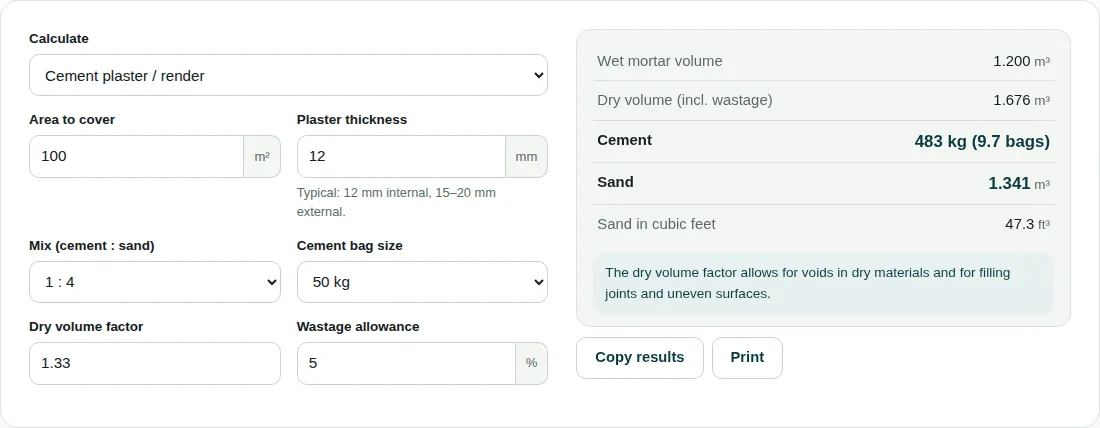
- Wet volume: 100 × 0.012 = 1.200 m³.
- Dry volume: 1.200 × 1.33 × 1.05 = 1.676 m³.
- Cement: 1.6758 / 5 = 0.3352 m³; 0.3352 × 1,440 = 483 kg, which is 9.7 bags of 50 kg (buy 10).
- Sand: 1.6758 × 4 / 5 = 1.341 m³, or 47.3 ft³.
In paint mode with the default inputs, the same 100 m² with 2 coats at 10 m²/L and 5% wastage needs 100 × 2 / 10 × 1.05 = 21.0 litres, which is 6 containers of 4 L.
Check these before you buy
- Thickness drives everything. If walls are out of true and the plaster averages 15 mm where 12 mm was specified, you use 25% more material.
- The help text suggests 12 mm inside and 15–20 mm outside. If render goes on in more than one coat, enter the total thickness.
- Coverage on the tin assumes a smooth, sealed surface. New plaster is porous and usually needs a sealer or primer first, so count that as an extra coat.
- Damp sand bulks, so a cubic metre of wet sand from the heap holds less sand than the tool assumes. Order with some margin.
Questions people ask
How much cement is needed for 100 m² of plaster?
For 12 mm plaster in 1 : 4 with a 1.33 dry volume factor and 5% wastage, you need 483 kg of cement, which is 9.7 bags of 50 kg, plus 1.341 m³ of sand. In a 1 : 6 mix the cement drops to 345 kg (6.9 bags).
Why is plaster volume multiplied by 1.33?
The finished wet plaster takes up less space than the loose dry cement and sand that go into it, because the voids in the dry materials fill with water and fines. Some mortar also goes into joints and hollows in the wall. The 1.33 factor allows for both, and you can change it in the tool.
How many litres of paint do I need for 100 m²?
Multiply the area by the number of coats and divide by the coverage on the tin. 100 m² with 2 coats at 10 m² per litre is 20 litres, or 21 litres with 5% wastage. Emulsions usually cover 10 to 14 m² per litre, so check your tin.
Related tools
- Brick & Block: Bricks or blocks per wall, plus mortar cement and sand.
- Cement, Sand & Aggregate: Cement bags, sand and aggregate for nominal mixes like 1:2:4 and 1:1.5:3.
- Concrete Volume: Slabs, footings, columns, beams, walls and stairs in m³ or yd³.
Results are for estimating, checking and learning. Design work should be checked against the current code and your project specification, and signed off by a qualified engineer. See all 20 engineering calculators.