
This earthwork calculator works out the excavation volume of a pit or trench with sloping sides, the loose volume after bulking and the number of truckloads to cart it away. A second mode takes cross-section areas along a road, channel or embankment and gives cut, fill and the running balance.
The pit uses the prismoidal formula, which is exact for straight sloping sides. Cross-sections use the average end area method, with a Simpson’s rule check when the sections are evenly spaced.

Site Engineer Pocket Reference
A free 7-page PDF with the site numbers you use most.
Useful for this job
- Rotating laser levelFast levels for slabs, cuts and fills
- Measuring wheelQuick site distances and boundaries
We may earn a commission if you buy through these links, at no extra cost to you. As an Amazon Associate, EducateLink earns from qualifying purchases. Disclosure
How to use it
- In Calculate, choose Excavation pit or trench with sloping sides or Cut and fill from cross-sections.
- For a pit, enter Bottom length, Bottom width, Depth and Side slope (horizontal : 1 vertical). Use 0 for vertical sides.
- Set the Bulking factor (bank → loose) and the Truck capacity (loose) in m³.
- For cross-sections, fill in Chainage (m), cut area (m²), fill area (m²): one section per line, for example
20, 18.0, 0, and set the Fill factor (compacted fill needs more bank material). - Read the volumes. In cross-section mode a positive balance is surplus cut, and a negative one means fill has to be imported.
How the volumes are calculated
Pit or trench. For a bottom L × W, depth h and side slope z (horizontal per 1 vertical) on all four sides:
- Top size = (L + 2zh) × (W + 2zh)
- Mid-depth area Am = (L + zh) × (W + zh)
- V = h/6 × (Abottom + 4Am + Atop)
- Loose volume = V × bulking factor. Truckloads = loose volume ÷ truck capacity, rounded up.
Cross-sections. Between each pair of sections, V = (A1 + A2)/2 × distance, for cut and fill separately. The balance is cut − fill × fill factor, and its running total is listed as the mass haul at each chainage. The default five sections, 20 m apart, give 673.0 m³ of cut, 426.0 m³ of fill and a balance of +204.4 m³. The Simpson’s rule check gives 688.7 m³ and 438.7 m³.
Worked example: 10 × 5 m pit, 2 m deep, 1 : 1 sides
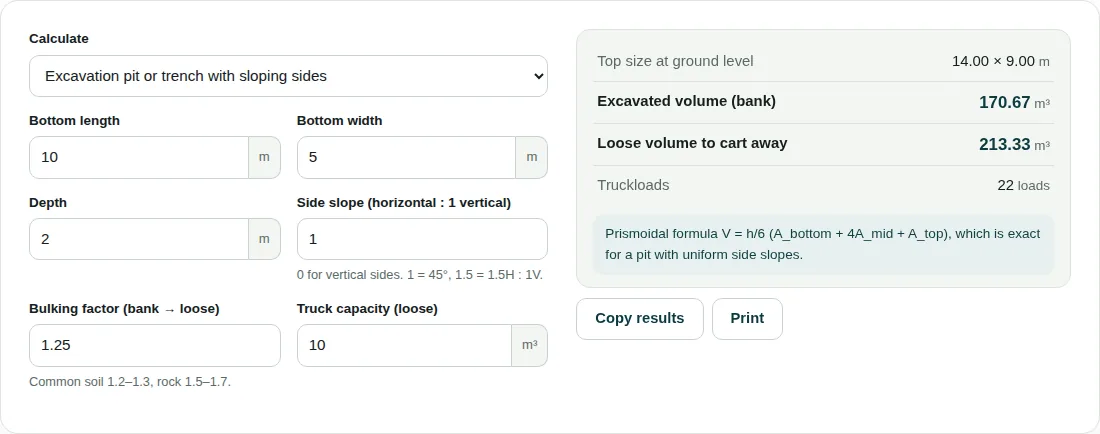
- Top size: 10 + 2 × 1 × 2 = 14 m by 5 + 2 × 1 × 2 = 9 m, so 14.00 × 9.00 m.
- Areas: bottom 10 × 5 = 50 m², top 14 × 9 = 126 m², mid-depth 12 × 7 = 84 m².
- V = 2/6 × (50 + 4 × 84 + 126) = 2/6 × 512 = 170.67 m³ in the bank.
- Loose volume = 170.67 × 1.25 = 213.33 m³.
- Truckloads = 213.33 / 10 = 21.3, rounded up to 22 loads.
Averaging only the top and bottom areas, (50 + 126)/2 × 2 = 176 m³, would overstate this pit by about 3%.
Check these on site
- All four sides slope. A trench with vertical ends, or one that joins another trench, holds less than the pit mode gives. For a long trench, use cross-section mode with the same area at each chainage.
- Bulking depends on the soil and its moisture. The tool’s hint of 1.2–1.3 for common soil and 1.5–1.7 for rock is a starting point; use site data where you have it.
- The loose volume assumes all the spoil leaves site. If some is kept for backfill, take that bank volume off before working out truckloads.
- The fill factor converts compacted fill into the bank volume needed to make it. At 1.1, each 1 m³ of compacted fill uses 1.1 m³ of cut.
Questions people ask
How do you calculate excavation volume with sloping sides?
Use the prismoidal formula V = h/6 × (A_bottom + 4A_mid + A_top). A pit 10 × 5 m at the base and 2 m deep with 1 : 1 sides has a 14 × 9 m top and a volume of 170.67 m³. Averaging just the top and bottom areas would give 176 m³.
What bulking factor should I use for soil?
It depends on the material. The calculator suggests 1.2–1.3 for common soil and 1.5–1.7 for rock, and uses 1.25 by default. At 1.25 the 170.67 m³ example pit becomes 213.33 m³ of loose spoil, or 22 loads in a 10 m³ truck.
What is the average end area method?
It takes the mean of two neighbouring cross-section areas and multiplies it by the distance between them. Cut areas of 12.5 m² and 18.0 m², 20 m apart, give (12.5 + 18.0)/2 × 20 = 305 m³. The calculator adds these up for cut and fill along the whole length.
Related tools
- Levelling (Rise & Fall): Reduced levels from staff readings with arithmetic check and misclosure.
- Concrete Volume: Slabs, footings, columns, beams, walls and stairs in m³ or yd³.
- Slope & Gradient: Convert percent, degrees and 1 in n ratios, and work out falls.
Results are for estimating, checking and learning. Design work should be checked against the current code and your project specification, and signed off by a qualified engineer. See all 20 engineering calculators.