
This levelling calculator reduces staff readings to reduced levels (RLs) by the rise and fall method and runs the standard arithmetic check. Enter each backsight (BS), intermediate sight (IS) and foresight (FS) in metres, starting from a benchmark of known RL.
Close on a second benchmark and the tool also reports the misclosure in millimetres, compares it with an allowable limit of k√K and shares the error back through the set-ups as adjusted RLs.

Site Engineer Pocket Reference
A free 7-page PDF with the site numbers you use most.
Useful for this job
- Automatic level kitFor booking levels in the field
- Telescopic levelling staffRead levels to the millimetre
- Surveying textbookLevelling and setting-out theory
We may earn a commission if you buy through these links, at no extra cost to you. As an Amazon Associate, EducateLink earns from qualifying purchases. Disclosure
How to use it
- Type the known level in Starting benchmark RL (m).
- Add one row per staff reading: a name under Station and the reading under BS, IS or FS. Row one must be a BS on the benchmark.
- At a change point, put the FS and the new BS on the same row, like CP1. Use + Add reading for more rows.
- To test closure, fill Closing benchmark RL (optional), the Allowable misclosure constant (mm√km) and the Length of levelling route (km).
- Check the RL column and the Arithmetic check line, then use Copy results or Print.
How the rise and fall reduction works
Each reading is compared with the previous one on the same set-up. Difference = previous reading − current reading: positive is a rise, negative a fall, and RL = previous RL + rise − fall. The current reading is the IS or the FS. At a change point the BS on the same row becomes the previous reading for the next row. An IS must stand alone: a row with an IS and an FS or BS gives an error.
Arithmetic check: ΣBS − ΣFS = ΣRise − ΣFall = Last RL − First RL. Intermediate sights feed the rises and falls, so a slip in reducing an IS shows up here.
With a closing benchmark, misclosure e = last RL − closing RL, and the allowable value is ±k√K mm with K in km. Each RL is corrected by −e × n/N, where n is the set-up the reading came from and N is the total number of set-ups.
Worked example: BM1 at 100.000 m, one change point
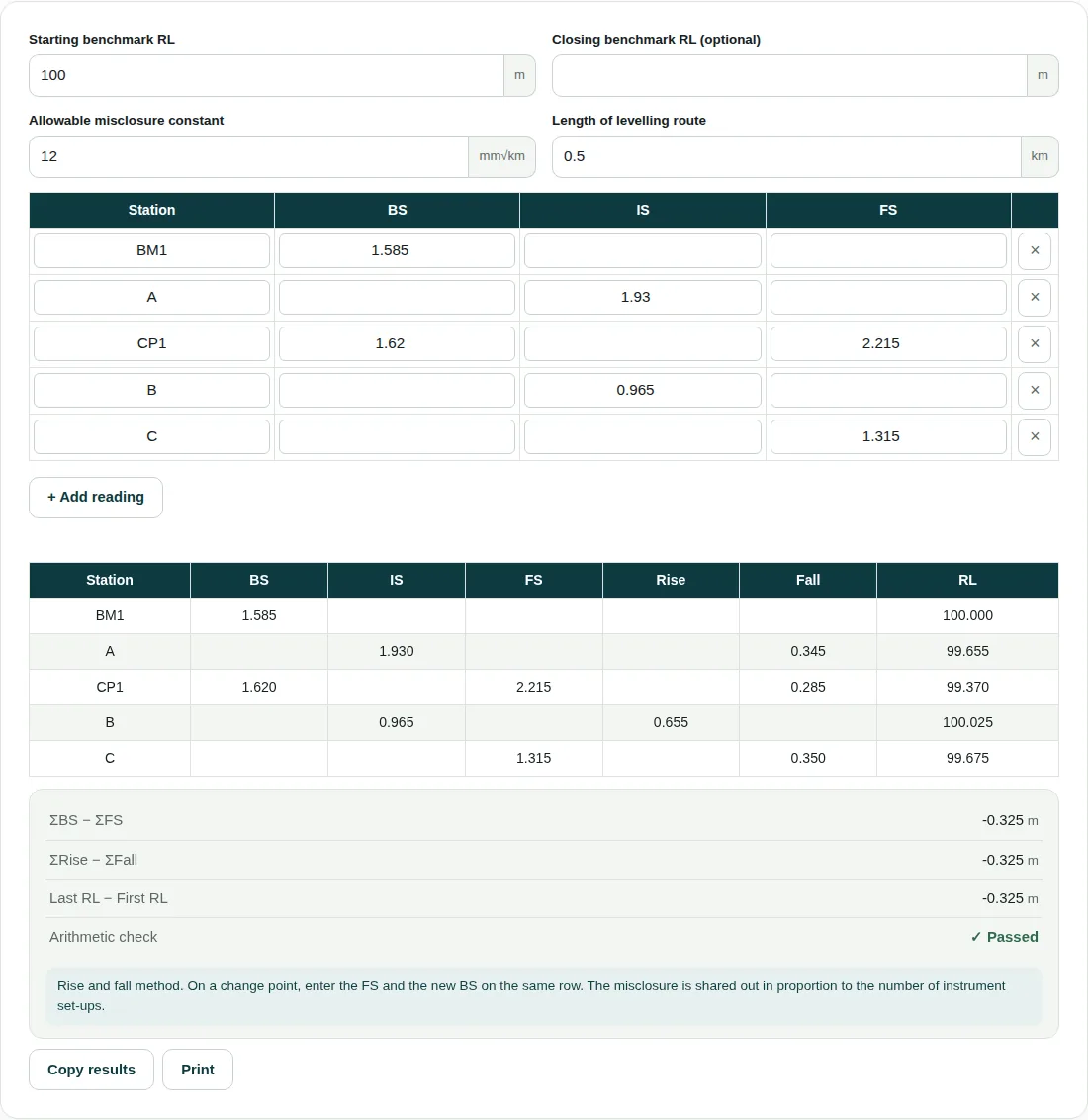
Default readings in metres. Set-up 1 reads BM1, A and CP1; set-up 2 reads CP1, B and C.
| Station | Readings compared | Rise | Fall | RL |
|---|---|---|---|---|
| BM1 | BS 1.585 | 100.000 | ||
| A | 1.585 − 1.930 | 0.345 | 99.655 | |
| CP1 | 1.930 − 2.215 | 0.285 | 99.370 | |
| B | 1.620 − 0.965 | 0.655 | 100.025 | |
| C | 0.965 − 1.315 | 0.350 | 99.675 |
- ΣBS = 1.585 + 1.620 = 3.205; ΣFS = 2.215 + 1.315 = 3.530; difference −0.325 m.
- ΣRise = 0.655; ΣFall = 0.345 + 0.285 + 0.350 = 0.980; difference −0.325 m.
- Last RL − First RL = 99.675 − 100.000 = −0.325 m, so the check passes.
The closing benchmark is blank by default. Enter 99.681 m and the misclosure is −6.0 mm against an allowable ±12√0.5 = ±8.5 mm. The adjusted RLs become 99.658 (A), 99.373 (CP1), 100.031 (B) and 99.681 m (C).
What the check will and won’t catch
- The arithmetic check only proves the sums. A misread staff or a wrong benchmark value still passes; only closing on a known level tests the field work.
- Enter readings in metres (1.585, not 1585). Results show 3 decimals, which is 1 mm.
- Don’t put an IS on the same row as an FS or BS. The tool stops with a message naming the row, because an intermediate sight stands alone and a change point takes an FS and a new BS.
- The 12 mm√km default is a placeholder, so use your specification. The adjustment shares the error by set-up count, not by distance.
Questions people ask
What is the arithmetic check in the rise and fall method?
ΣBS − ΣFS, ΣRise − ΣFall and Last RL − First RL must all be equal. In the default example each one is −0.325 m. Passing the check proves the arithmetic, not the staff readings.
What is the difference between rise and fall and height of collimation?
Both give the same reduced levels. Height of collimation subtracts each reading from the instrument height, while rise and fall compares each reading with the one before. The standard rise and fall check covers intermediate sights; the basic height of collimation check does not.
How do you calculate the allowable misclosure in levelling?
Allowable misclosure is ±k√K mm, where K is the route length in km and k comes from your specification. With the default k = 12 and a 0.5 km route, the limit is ±8.5 mm.
Related tools
- Earthwork & Excavation: Pit and trench volumes, and cut and fill from cross-sections.
- Slope & Gradient: Convert percent, degrees and 1 in n ratios, and work out falls.
- Land Area from Coordinates: Area, perimeter and bearings of a plot from corner coordinates.
Results are for estimating, checking and learning. Design work should be checked against the current code and your project specification, and signed off by a qualified engineer. See all 20 engineering calculators.