
This AI content detector gives a rough estimate of how much a text reads like AI-generated writing. It runs a small open-source language model, distilgpt2, in your browser, measures how predictable the text is (perplexity) and how much that varies between sentences (burstiness), and combines the two into a percentage.
It is an estimate, not proof. It flags some human writing, especially formal technical writing and work by non-native English speakers, and misses some AI text. Never use it alone to accuse anyone. Your text is not uploaded.
Referencing & Report Cheat-Sheet
A free 4-page PDF: APA 7, Harvard and IEEE at a glance, plus a lab report checklist.
Useful for this job
We may earn a commission if you buy through these links, at no extra cost to you. As an Amazon Associate, EducateLink earns from qualifying purchases. Disclosure
How to use it
- Paste 80 to 5,000 words into Paste text (80 to 5,000 words), or use Or upload a file.
- Click Check text. The first check downloads the model (about 80 MB), which your browser keeps.
- Read the AI-likelihood estimate, Perplexity (predictability) and Burstiness (sentence variation).
- In the highlighted text, sentences with perplexity under 20 are shaded darker and under 35 lighter.
- Treat the result as one weak signal, alongside drafts, version history and a conversation with the writer.
How the estimate is calculated
The model reads the text in 256-token windows overlapping by 32 and records the log-probability of each token given those before it.
- Perplexity P = e−(mean log-probability) over all tokens. Low means predictable.
- Burstiness B = standard deviation of the sentence perplexities ÷ their mean. Low means uniform.
With σ(z) = 1 ÷ (1 + e−z):
score = 0.65 × σ(3 × (ln 45 − ln P)) + 0.35 × σ(8 × (0.45 − B))
Perplexity supplies up to 65 points and burstiness up to 35; at P = 45 and B = 0.45 each term is exactly half. These constants are fixed settings chosen for this tool. Bands: High from 65%, Mixed / unclear from 35%, Low below.
Worked example: the sample and the formula
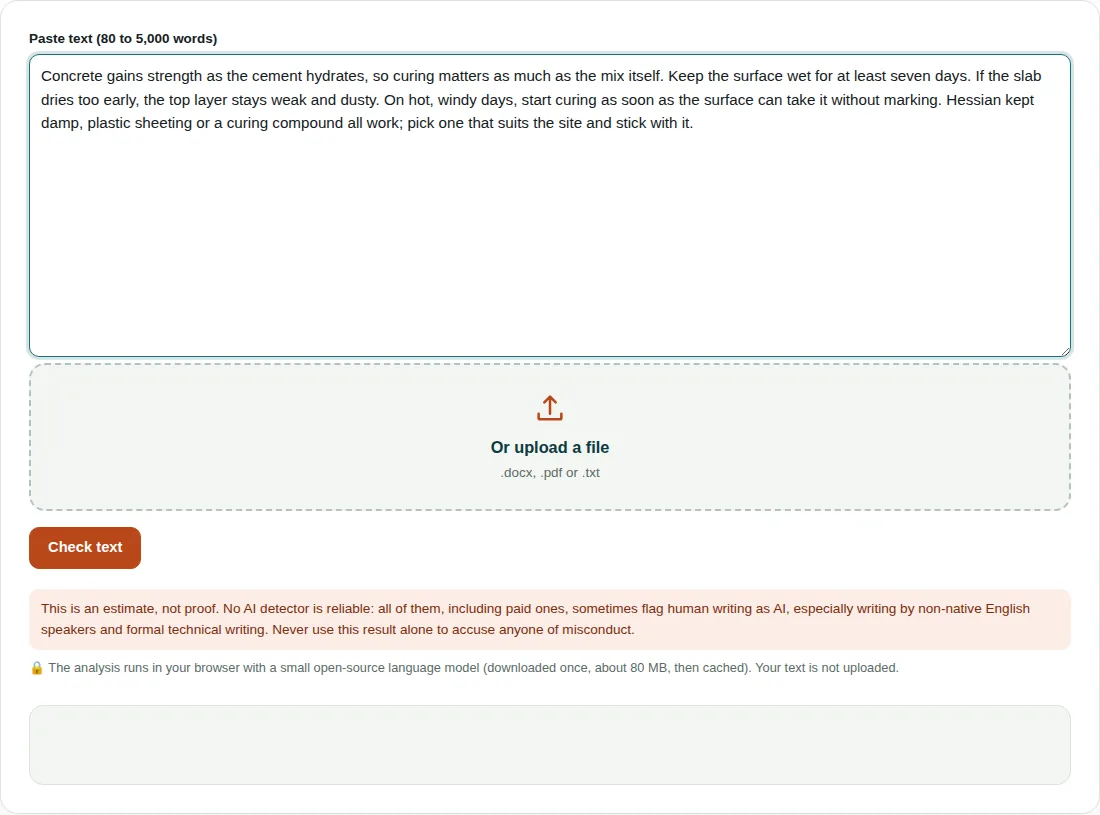
The paragraph in the screenshot has 75 words, so Check text replies “Add at least 80 words. Short texts cannot be estimated.”
To follow the arithmetic, take P = 20 and B = 0.25 (illustration values, not a measurement).
- ln 45 − ln 20 = 0.8109; × 3 = 2.4328; σ = 0.9193.
- 0.45 − 0.25 = 0.20; × 8 = 1.60; σ = 0.8320.
- 0.65 × 0.9193 + 0.35 × 0.8320 = 0.5975 + 0.2912 = 0.8887, shown as 89% · High.
P = 45 with B = 0.45 gives 50%; P = 90 with B = 0.70 gives 11%.
Two real runs on this site show the range. A 171-word first-person account of a slab pour scored 5% · Low (P = 100.5, B = 1.36). A 200-word general paragraph on concrete curing, written in a typical chatbot style, scored 68% · High (P = 19.6, B = 0.61). Two examples are not a validation study; they only show how the two numbers move the score.
Limits you should know
- Formal technical writing, lab methods and careful English from non-native speakers are often predictable to a language model, which raises the score.
- A low score does not show a person wrote the text.
- Quotations, references, tables and code are not the writer’s prose. Remove them first.
Questions people ask
Are AI content detectors accurate?
Not accurate enough to prove anything. Every detector, free or paid, sometimes flags human writing and misses AI-generated text. This one uses a small model and two statistics, so its percentage is a rough estimate.
Can an AI detector prove that a student used AI?
No. The score only says how predictable the text is to one language model, and predictable writing is normal in formal and technical work. A fair review looks at drafts, version history and a conversation with the student.
Why was my own writing flagged as AI-generated?
Clear, formal or formulaic writing gives low perplexity and uniform sentences, and both raise the score. If you are questioned, share your drafts, notes and the version history of your document.
Related tools
- Readability Checker: Readability scores with long sentences and passive voice highlighted.
- Grammar & Spelling Checker: Find grammar, spelling and punctuation mistakes.
- Word Counter: Words, characters, sentences, reading time and keywords.