
Harvard referencing is an author-date system. Each time you use a source, you put the author’s surname and the year in your text, such as (Monteiro, Miller and Horvath, 2017). At the end you list every source in full, A to Z by author, so a reader can go from any citation to the matching entry.
There is no single official Harvard manual. Universities publish their own versions, which disagree on details such as “and” or “&” and when to use et al., and your marker grades against your institution’s guide. This page follows Cite Them Right Harvard, 13th edition (2025), used by many UK universities and by our free citation generator. Each rule was checked against university library guides that follow it.
The journal article, report and standard examples below are real. The others are invented to show the pattern, with links on example.org, a domain reserved for examples.
Harvard is a family of styles, not one style
Harvard has no governing body, so institutions write their own rules. Some have moved to Cite Them Right (Anglia Ruskin University now requires it in place of its own ARU Harvard); others keep a local version. Here are the same sources in four current guides:
| What changes | Cite Them Right (13th ed.) | Hull Harvard | Imperial College Harvard | UNSW Harvard |
|---|---|---|---|---|
| Three authors, in brackets | (Monteiro, Miller and Horvath, 2017) | (Monteiro et al., 2017) | (Monteiro, Miller & Horvath, 2017) | (Monteiro, Miller & Horvath 2017) |
| Seven authors | (Habert et al., 2020) | (Habert et al., 2020) | (Habert et al., 2020) | (Habert et al. 2020) |
| No date | (Riverbend City Council, no date) | (Riverbend City Council, n.d.) | no date or n.d. | (Riverbend City Council n.d.) |
| End of an online reference | Available at: URL (Accessed: 6 October 2026). | URL [Accessed 6 Oct 2026]. | URL [Accessed 6th October 2026]. | accessed 6 October 2026, <URL>. |
None of these is wrong. Mixing them is. If your unit outline just says “Harvard”, find your library’s Harvard page or ask which guide is meant, then stick to it.
The parts of a Harvard reference
Most references answer four questions in the same order: who made it, when, what it is called and where to find it. In Cite Them Right the general pattern is Author (Year) Title. Source details. Available at: link (Accessed: date).
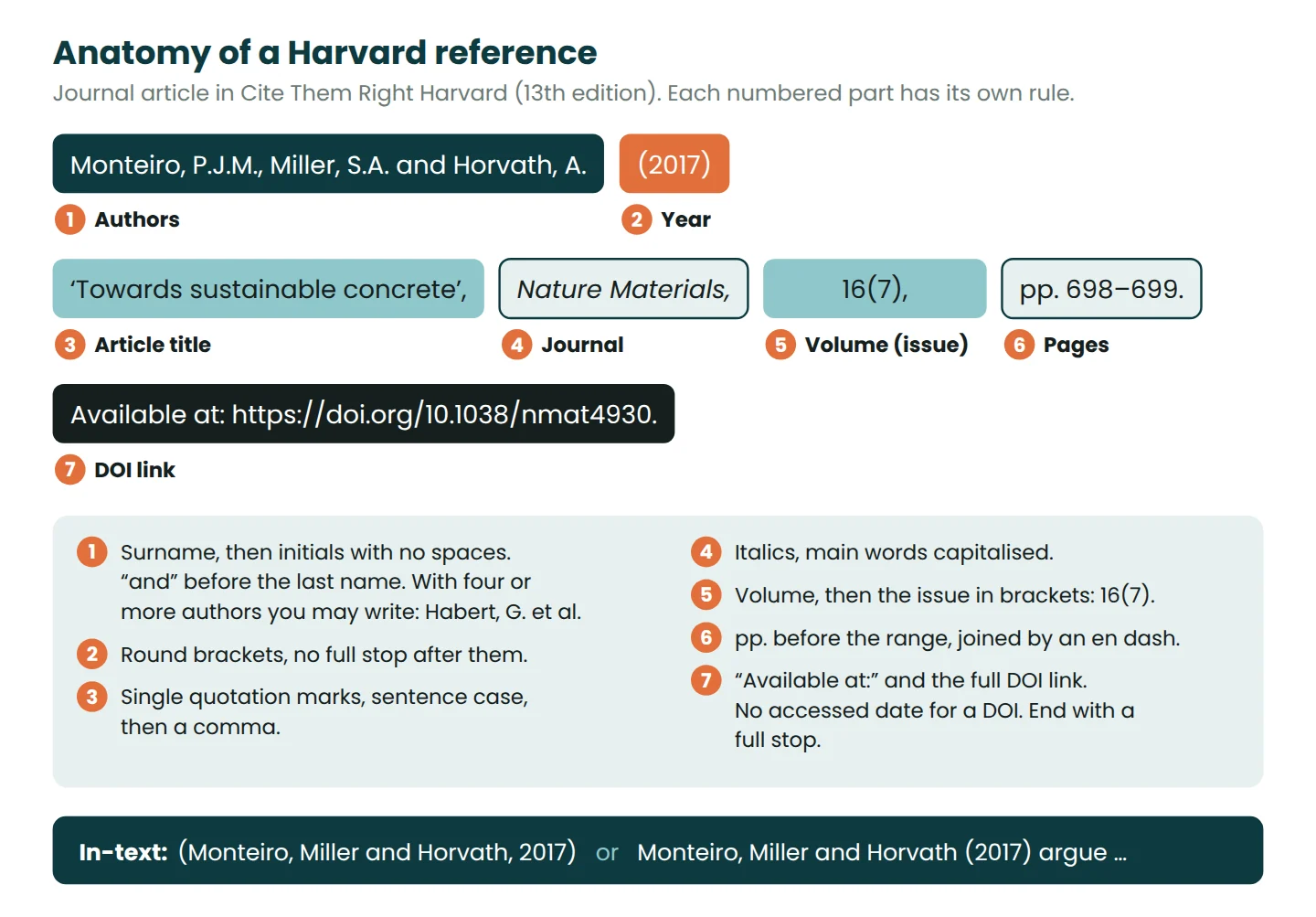
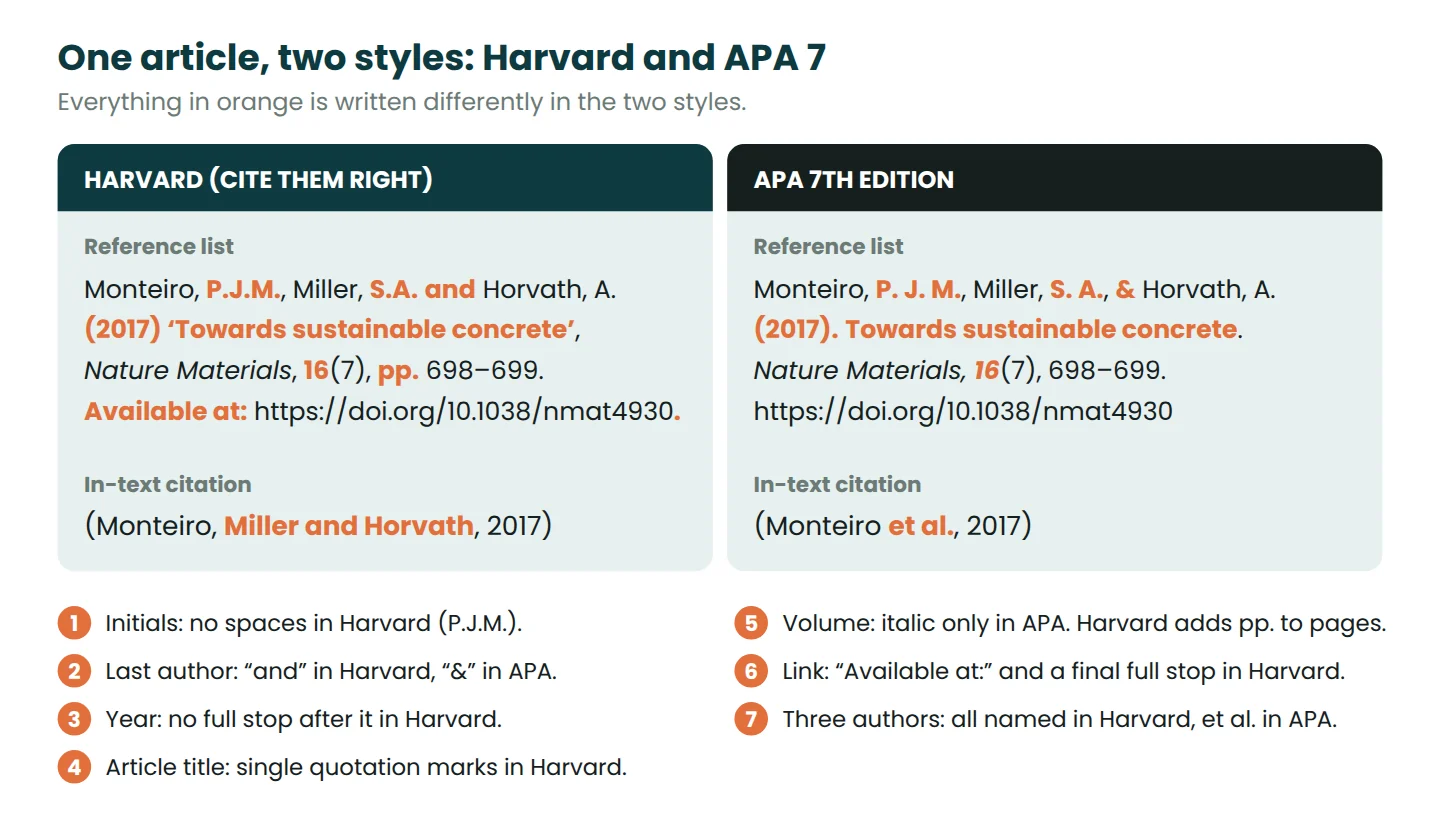
- Authors: surname, then initials with no spaces (Monteiro, P.J.M.). Join the last two names with “and”. For four or more authors you may write the first author and et al. in the list too, though some guides want every name.
- Year: in round brackets straight after the author, with no full stop after it.
- Titles: italicise the item that stands on its own (book, report, standard, webpage, video, journal). A part inside it, such as an article or chapter, goes in single quotation marks. Titles are in sentence case; journal names capitalise the main words.
- Books: add the edition only when it isn’t the first, written as 3rd ed. Since the 13th edition, the place of publication is left out.
- Links: write “Available at:” and the link. A web address takes an accessed date in brackets. A DOI doesn’t, because it never changes.
- Layout: one list, A to Z by the first author’s surname, not split by source type.
Harvard in-text citations
Cite every time you quote, paraphrase or summarise. The citation can sit in brackets at the end of the clause, or the author can be part of your sentence with the year in brackets. Cite Them Right writes “and” in both forms, not “&”.
| Situation | In brackets | In your sentence |
|---|---|---|
| One author | (Kerrigan, 2022) | Kerrigan (2022) |
| Two authors | (Okafor and Lindqvist, 2021) | Okafor and Lindqvist (2021) |
| Three authors | (Monteiro, Miller and Horvath, 2017) | Monteiro, Miller and Horvath (2017) |
| Four or more authors | (Habert et al., 2020) | Habert et al. (2020) |
| Organisation as author | (Standards Australia, 2018) | Standards Australia (2018) |
| No date | (Riverbend City Council, no date) | Riverbend City Council (no date) |
| Same author, same year | (Marsh, 2024a; Marsh, 2024b) | Marsh (2024a) |
| Quote or specific page | (Kerrigan, 2022, p. 87) | Kerrigan (2022, p. 87) |
| Secondary source | (Abrams, 1918, cited in Kerrigan, 2022) | Abrams (1918, cited in Kerrigan, 2022) |
| Two sources at once | (Monteiro, Miller and Horvath, 2017; Habert et al., 2020) | Monteiro, Miller and Horvath (2017) and Habert et al. (2020) |
Page numbers. Use p. for one page and pp. for a range. Webpages can take a paragraph number (para. 3), videos a timestamp and slides a slide number. Give a location for every quote and whenever you point to one part of a long work.
Secondary sources. If you only read about Abrams’s 1918 work in Kerrigan’s textbook, write “cited in” (“quoted in” for a quote) and list only Kerrigan, because that is what you read. Better still, find the original.
Organisations. Give a long name in full the first time with the abbreviation in brackets, then use the abbreviation: (National Transportation Safety Board (NTSB), 2025), then (NTSB, 2025). Keep the full name in the reference list.
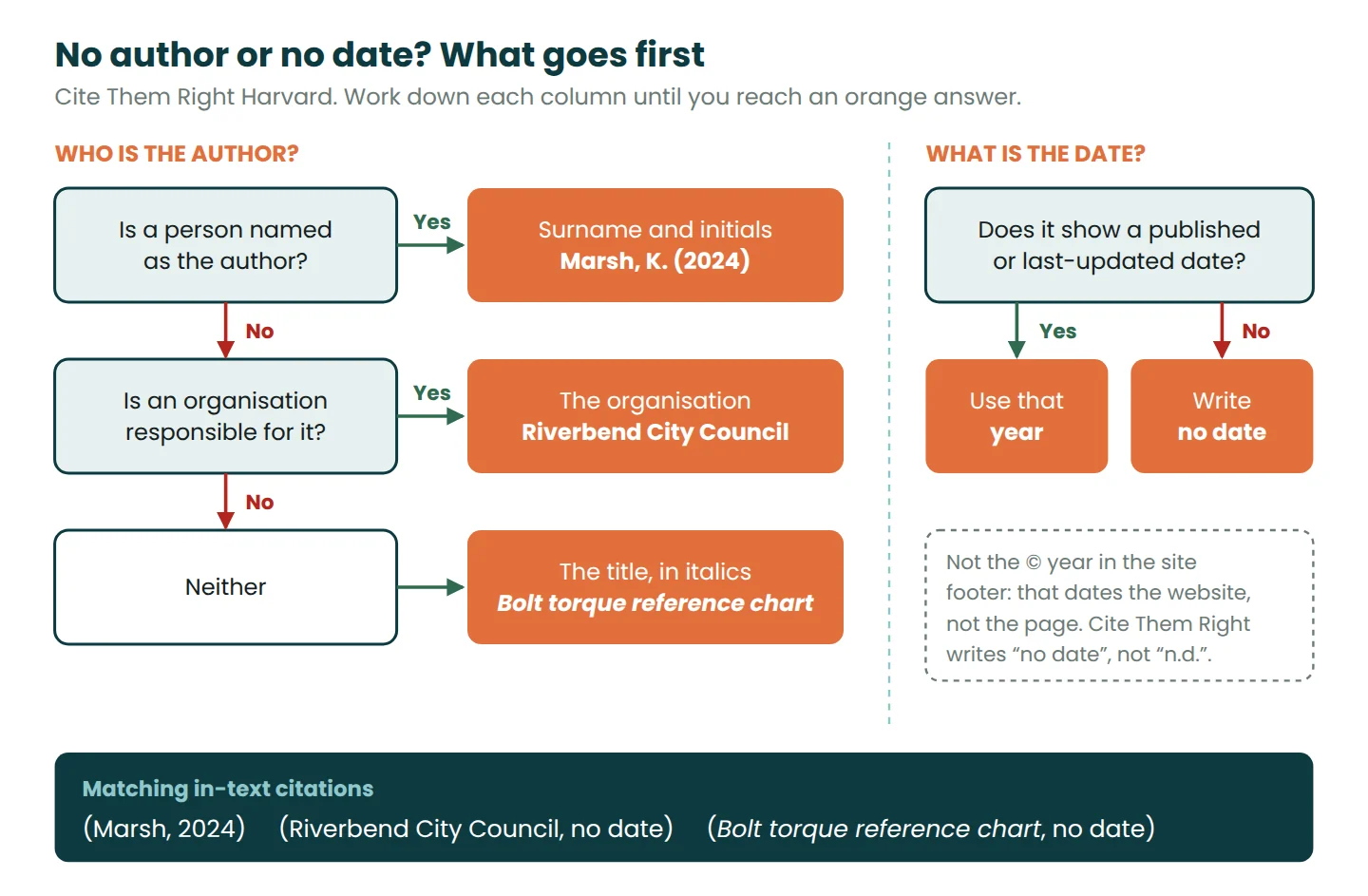
No author or no date. An organisation behind the page counts as the author. Only with no person and no organisation does the italic title move to the front. A missing date becomes “no date”, never the footer copyright year, which dates the website rather than the page.
Harvard referencing examples by source type
Each example gives the reference list entry, then the in-text citation.
1. Book
Reference list: Kerrigan, J. (2022) Structural design for building students. 3rd ed. Harbourside Academic.
In-text: (Kerrigan, 2022), or (Kerrigan, 2022, p. 87) for a quote.
An ebook with the same details as the print edition is referenced the same way, with no link.
2. Chapter in an edited book
Reference list: Okafor, C.N. and Lindqvist, M. (2021) ‘Moisture control in timber-framed walls’, in H.R. Patel and S.J. Moore (eds), Building science for designers. 2nd ed. Harbourside Academic, pp. 112–139.
In-text: (Okafor and Lindqvist, 2021)
Cite the people who wrote the chapter, not the editors. Editors’ initials go before their surnames, followed by (ed.) for one editor or (eds) for more. The chapter’s page range closes the entry.
3. Journal article with a DOI
Reference list: Monteiro, P.J.M., Miller, S.A. and Horvath, A. (2017) ‘Towards sustainable concrete’, Nature Materials, 16(7), pp. 698–699. Available at: https://doi.org/10.1038/nmat4930.
In-text: (Monteiro, Miller and Horvath, 2017)
With seven authors, shorten to the first author and et al.:
Reference list: Habert, G. et al. (2020) ‘Environmental impacts and decarbonization strategies in the cement and concrete industries’, Nature Reviews Earth & Environment, 1(11), pp. 559–573. Available at: https://doi.org/10.1038/s43017-020-0093-3.
In-text: (Habert et al., 2020)
Keep a title’s original spelling, such as “decarbonization”. A DOI needs no accessed date, and a print article without one ends after the page range.
4. Webpage with an author
Reference list: Marsh, K. (2024) How to read a concrete test certificate. Available at: https://www.example.org/concrete-test-certificate (Accessed: 2 October 2026).
In-text: (Marsh, 2024)
Use the year the page was published or last updated, and the day you read it as the accessed date. Unlike APA, there is no website name.
5. Webpage with no author or no date
Reference list: Riverbend City Council (no date) Building over or near council stormwater pipes. Available at: https://www.example.org/stormwater-build-over (Accessed: 2 October 2026).
In-text: (Riverbend City Council, no date)
With no organisation behind the page either, the italic title takes the author’s place:
Reference list: Bolt torque reference chart (no date) Available at: https://www.example.org/bolt-torque-chart (Accessed: 2 October 2026).
In-text: (Bolt torque reference chart, no date)
A page with no author, owner or date is a weak source, so look for a better one first.
6. Government or organisation report
Reference list: National Transportation Safety Board (2025) Contact of containership Dali with Francis Scott Key Bridge and subsequent bridge collapse, Patapsco River, Baltimore, Maryland, March 26, 2024 (Marine Investigation Report MIR-25-40). Available at: https://www.ntsb.gov/investigations/AccidentReports/Reports/MIR2540.pdf (Accessed: 6 October 2026).
In-text: (National Transportation Safety Board (NTSB), 2025), then (NTSB, 2025)
The agency is the author, and the report number follows the title in brackets. A printed report with an ISBN is referenced like a book, with its publisher. Our article on the Key Bridge collapse draws on this report.
7. Engineering standard
Reference list: Standards Australia (2018) AS 3600:2018 Concrete structures. Standards Australia.
In-text: (Standards Australia, 2018)
The standards body is the author, so (AS 3600, 2018) is wrong. The number opens the italic title, and the year is that of the edition you used. A British Standard follows the same pattern with the British Standards Institution as author. If you read it through a library database, the entry normally stays the same unless your guide asks you to name the database.
8. Lecture notes or slides
Reference list: Nguyen, T. (2026) ‘Week 4: shear in reinforced concrete beams’ [PowerPoint presentation]. CIV3020: Reinforced concrete design. Available at: https://www.example.org/lms/civ3020/week-4 (Accessed: 30 September 2026).
In-text: (Nguyen, 2026, slide 14)
The module code and title are italic. Readers outside your course can’t open your learning system, so when a slide summarises a textbook or standard, cite that source instead.
9. Video
Reference list: Northfield Polytechnic Materials Lab (2023) Concrete cylinder compression test, step by step. 14 May. Available at: https://www.example.org/videos/cylinder-test (Accessed: 2 October 2026).
In-text: (Northfield Polytechnic Materials Lab, 2023, 3:42)
Whoever posted the video is the author, and the upload date follows the title. Link to the video itself, and add a timestamp when you quote or point to one moment.
10. Generative AI output
Reference list: OpenAI ChatGPT (2026) ChatGPT response to Sam Taylor, 14 March.
In-text: (OpenAI ChatGPT, 2026)
Cite Them Right treats an AI chat as a personal communication, because nobody else can retrieve it. The entry gives the tool, the year, the type of communication, who received it and the day. With a share link, some guides add your prompt as an italic title and end with “Available at:” and the link. Quote AI text in quotation marks, keep the whole chat in case your lecturer wants it as an appendix, and add any AI-use statement your university requires. Only cite AI where the task allows it, and check every reference an AI tool suggests: these tools can invent sources.
Harvard vs APA 7: the differences that cost marks
Both are author-date styles, so students mix them up. This table compares Cite Them Right Harvard with the rules in our APA 7 referencing examples.
| Feature | Harvard (Cite Them Right) | APA 7th edition |
|---|---|---|
| Two authors in brackets | (Okafor and Lindqvist, 2021) | (Okafor & Lindqvist, 2021) |
| Three authors | All named: (Monteiro, Miller and Horvath, 2017) | et al. from the first citation: (Monteiro et al., 2017) |
| et al. in the reference list | Allowed for four or more authors | Never; list up to 20 authors |
| Initials | Monteiro, P.J.M. | Monteiro, P. J. M. |
| Year in the list | (2017) with no full stop | (2017). with a full stop |
| Article title | ‘In single quotation marks’ | Plain, no quotation marks |
| Volume and pages | 16(7), pp. 698–699, volume not italic | 16(7), 698–699, volume italic |
| DOI | Available at: https://doi.org/… with a final full stop | https://doi.org/… with no full stop |
| Webpage | Available at: URL (Accessed: date); no site name | Site name (unless it is the author), then URL; retrieval date only for pages designed to change |
| Edition | 3rd ed. after the title | (3rd ed.) in brackets |
| No date | no date | n.d. |
Checking the citation generator’s Harvard output
The citation generator has a Harvard (Cite Them Right) setting for journal articles, books and webpages. It handles initials, “and”, et al., quotation marks, pp. and DOI links without accessed dates. Adjust these by hand:
- Edition: it writes 3rd edn. The 13th edition examples we checked write 3rd ed.
- No date: a blank year prints n.d. Type no date in the Year box instead.
- Place of publication: leave the box empty for the 13th edition.
- Webpage with no author: it puts the website name first, which suits an organisation’s page, but its in-text citation shows the page title. Change it to the organisation’s name.
- Titles come out exactly as typed, so type them in sentence case.
- Reports and standards: choose Book and type the organisation as author (a line with no comma). Move a report number outside the italics after pasting.
- Four or more authors become the first author et al. in the list. If your guide wants every name, type them in.
- Chapters, lectures, videos and AI chats aren’t covered, so write them from the examples above.
Common mistakes
- Mixing styles. An “&” in a citation or n.d. in the list usually means APA or another Harvard version has crept in.
- The standard number as author. Write (Standards Australia, 2018), not (AS 3600, 2018).
- The footer copyright year as the date. If the page itself has no date, write no date.
- Accessed dates in the wrong place. Every web address needs one; a DOI doesn’t.
- Listing a source you never read. For a secondary citation, only the work you read goes in the list.
- Orphans. Every citation needs a list entry and every entry needs a citation.
- Year letters in one place only. If the citation says 2024a, the list entry must say 2024a too.
A literature review leans on narrative citations to compare authors, while a lab report cites mostly in its introduction and discussion. At some universities, including the Open University, in-text citations count toward the word limit and the reference list doesn’t, so check your brief before pasting text into the word counter. Build routine entries in the citation generator, then apply the checks above.
Frequently asked questions
Do you use et al. in a Harvard reference list?
In Cite Them Right Harvard you may, for works with four or more authors. Some versions want every name: Hull Harvard, for example, lists up to eight authors before using et al.
Is Harvard referencing the same as APA?
No. Both put the author and year in the text, but they differ in punctuation, the et al. threshold, quotation marks, italics and link wording. Use whichever your unit specifies.
Do I need an accessed date for a DOI in Harvard?
No. A DOI is a permanent identifier, so Cite Them Right leaves the accessed date off. Ordinary web addresses still take (Accessed: day month year).
What is the difference between a reference list and a bibliography?
A reference list holds only the sources you cited, while a bibliography also includes background reading you didn’t cite. Many assignments want a reference list only, so check your brief.
References
- Brunel University Library (no date) Referencing: Harvard examples and FAQs. Available at: https://libguides.brunel.ac.uk/referencing/harvard (Accessed: 6 October 2026).
- Imperial College London (no date) Harvard style. Available at: https://www.imperial.ac.uk/admin-services/library/learning-support/reference-management/harvard-style/ (Accessed: 6 October 2026).
- Purdue Writing Lab (no date) Reference list: basic rules. Available at: https://owl.purdue.edu/owl/research_and_citation/apa_style/apa_formatting_and_style_guide/reference_list_basic_rules.html (Accessed: 6 October 2026).
- Robert Gordon University (no date) Cite Them Right Harvard templates. Available at: https://library.rgu.ac.uk/harvard-referencing-templates (Accessed: 6 October 2026).
- The Open University (no date) Quick guide to Harvard referencing (Cite Them Right). Available at: https://university.open.ac.uk/library/referencing-and-plagiarism/quick-guide-to-harvard-referencing-cite-them-right (Accessed: 6 October 2026).
- University of Hull Library (no date) Referencing your work: Hull Harvard. Available at: https://libguides.hull.ac.uk/referencing/harvard (Accessed: 6 October 2026).
- University of Westminster (no date) Referencing your sources: Harvard style. Available at: https://libguides.westminster.ac.uk/referencing/harvard (Accessed: 6 October 2026).
- UNSW Sydney (no date) UNSW’s Harvard referencing guide. Available at: https://www.unsw.edu.au/student/managing-your-studies/academic-skills-support/toolkit/referencing/harvard (Accessed: 6 October 2026).
This article is general information for learning. Always check your unit outline and your university library’s Harvard guide, because institutions set their own versions and your marker will follow theirs.

Leave a Reply