
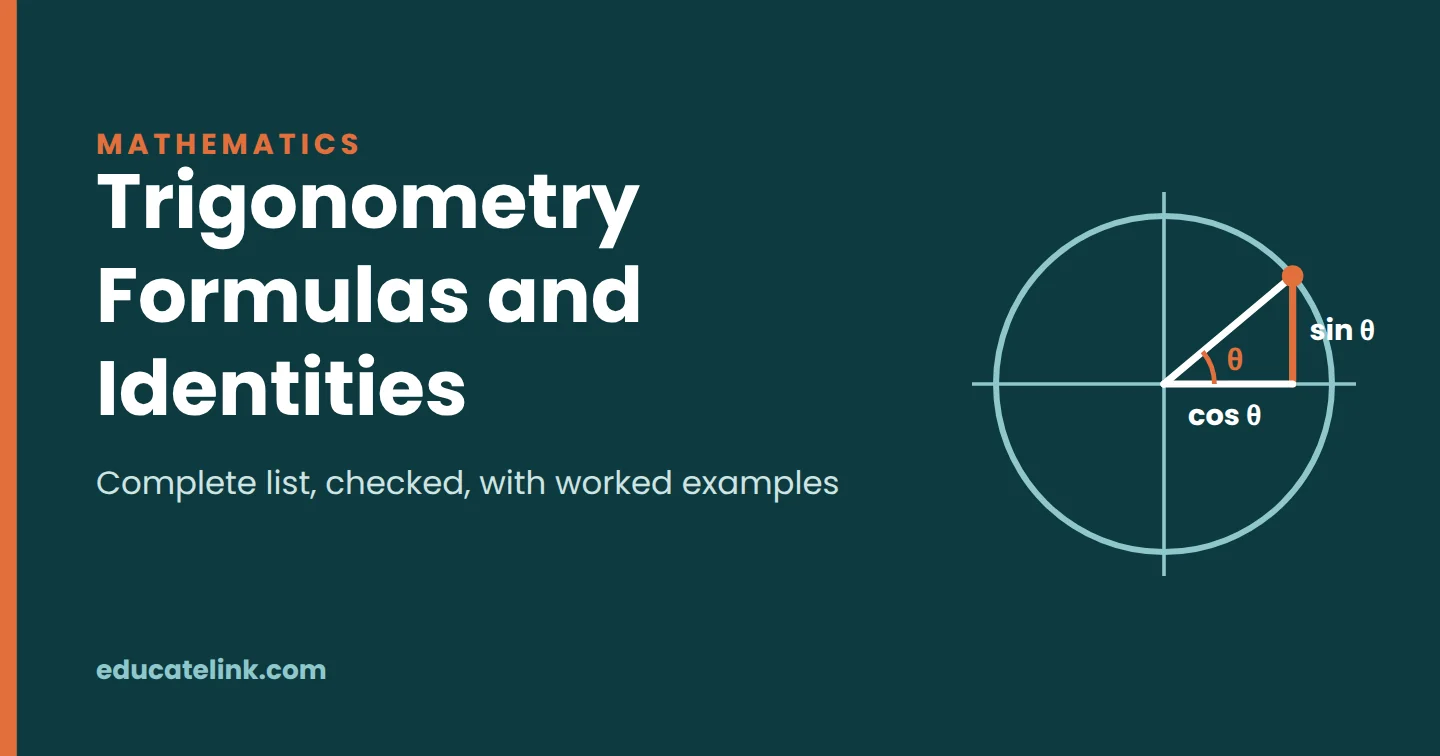
Trigonometry formulas connect the angles of a triangle to the ratios of its sides. Nearly every formula on this page grows from three definitions, sin θ = opposite ÷ hypotenuse, cos θ = adjacent ÷ hypotenuse and tan θ = opposite ÷ adjacent, plus one fact: sin²θ + cos²θ = 1.
Below is the full list for senior school and first-year university: right-triangle ratios, the unit circle, exact values, every standard identity, inverse functions, and the sine and cosine rules. Each identity was checked symbolically and at several test angles before it went in, and the worked examples include two practical site calculations. More maths and science revision is on the study notes page.
Right-triangle definitions (SOH CAH TOA)
In a right-angled triangle, pick one of the acute angles and call it θ. The hypotenuse is the longest side, opposite the right angle. The opposite side faces θ. The adjacent side touches θ and is not the hypotenuse.
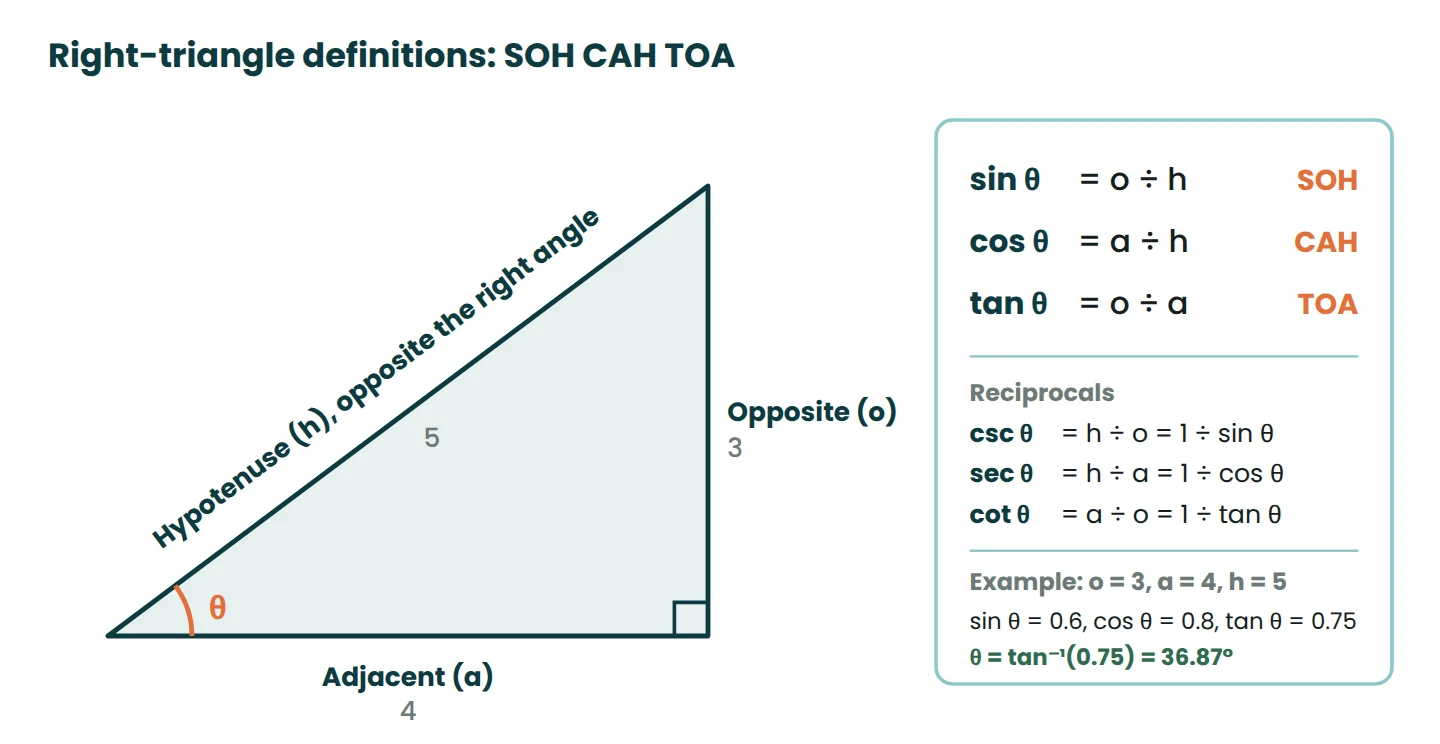
The ratios depend only on the angle, not the size of the triangle. A 3-4-5 triangle and a 30-40-50 triangle have the same angles, so they have the same sine, cosine and tangent. That is why, in a right-angled triangle, one acute angle and one side are enough to find every other side.
The unit circle and the signs in each quadrant
For angles beyond 90°, use the unit circle: a circle of radius 1 centred on the origin. Measure θ anticlockwise from the positive x-axis. The point where the arm meets the circle has coordinates (cos θ, sin θ), and tan θ = y ÷ x. Because x and y can be negative, so can the ratios.
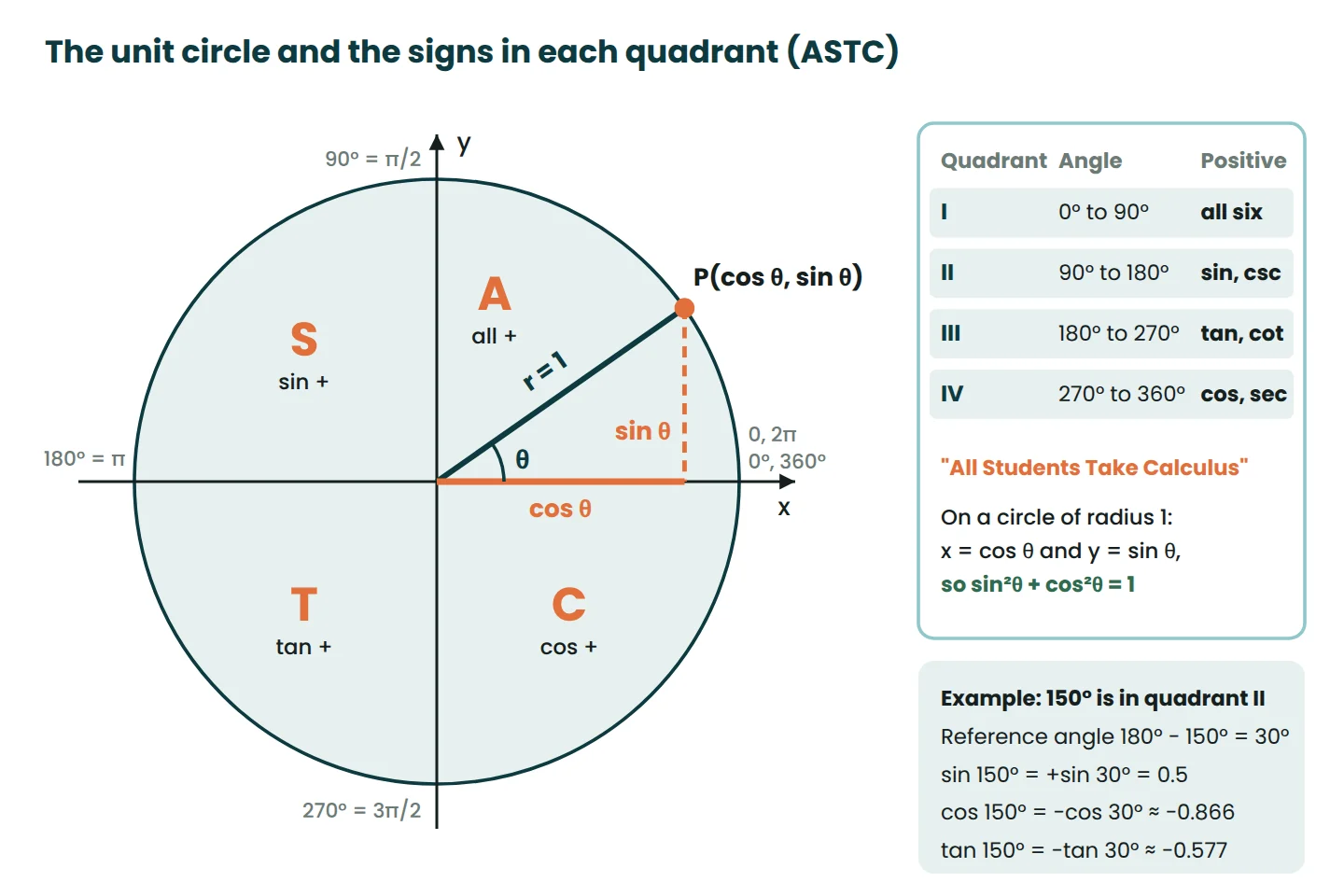
Remember the signs with ASTC, starting in quadrant I and going anticlockwise: All positive, then Sine, then Tangent, then Cosine. To evaluate any angle, find its reference angle (the acute angle to the x-axis), take the ratio of that, then apply the sign of the quadrant.
Exact values table
| θ (degrees) | θ (radians) | sin θ | cos θ | tan θ |
|---|---|---|---|---|
| 0° | 0 | 0 | 1 | 0 |
| 30° | π/6 | 1/2 | √3/2 | 1/√3 = √3/3 |
| 45° | π/4 | √2/2 | √2/2 | 1 |
| 60° | π/3 | √3/2 | 1/2 | √3 |
| 90° | π/2 | 1 | 0 | undefined |
A quick way to rebuild the sine column: √0/2, √1/2, √2/2, √3/2, √4/2. The cosine column is the same list in reverse. Tangent is sine divided by cosine.
Core trigonometry formulas: reciprocal, quotient and Pythagorean identities
| Group | Identities |
|---|---|
| Reciprocal | csc θ = 1 ÷ sin θ, sec θ = 1 ÷ cos θ, cot θ = 1 ÷ tan θ |
| Quotient | tan θ = sin θ ÷ cos θ, cot θ = cos θ ÷ sin θ |
| Pythagorean | sin²θ + cos²θ = 1, 1 + tan²θ = sec²θ, 1 + cot²θ = csc²θ |
The second and third Pythagorean identities come from dividing the first by cos²θ and by sin²θ. Example: if sin θ = 3/5 and θ is in quadrant II, then cos²θ = 1 − 9/25 = 16/25. Cosine is negative in quadrant II, so cos θ = −4/5 and tan θ = −3/4.
Even, odd, co-function and periodic identities
| Type | Identities |
|---|---|
| Even and odd | cos(−θ) = cos θ, sin(−θ) = −sin θ, tan(−θ) = −tan θ |
| Co-function | sin(90° − θ) = cos θ, cos(90° − θ) = sin θ, tan(90° − θ) = cot θ, sec(90° − θ) = csc θ |
| Supplementary | sin(180° − θ) = sin θ, cos(180° − θ) = −cos θ |
| Period | sin(θ + 360°) = sin θ, cos(θ + 360°) = cos θ, tan(θ + 180°) = tan θ |
Sine and cosine repeat every 360° (2π). Tangent repeats every 180° (π). Keep an eye on sin(180° − θ) = sin θ: it is the reason the sine rule can give two answers.
Sum and difference formulas
sin(A ± B) = sin A cos B ± cos A sin Bcos(A ± B) = cos A cos B ∓ sin A sin B(the sign flips)tan(A ± B) = (tan A ± tan B) ÷ (1 ∓ tan A tan B)
Example: sin 75° = sin(45° + 30°) = (√2/2)(√3/2) + (√2/2)(1/2) = (√6 + √2)/4 ≈ 0.9659. A calculator gives sin 75° = 0.9659, so the exact form checks out.
Double angle, half angle and triple angle formulas
| Formula | Identity |
|---|---|
| sin 2θ | 2 sin θ cos θ |
| cos 2θ | cos²θ − sin²θ = 2cos²θ − 1 = 1 − 2sin²θ |
| tan 2θ | 2 tan θ ÷ (1 − tan²θ) |
| sin²θ (power reduction) | (1 − cos 2θ) ÷ 2 |
| cos²θ (power reduction) | (1 + cos 2θ) ÷ 2 |
| sin(θ/2) | ±√[(1 − cos θ) ÷ 2] |
| cos(θ/2) | ±√[(1 + cos θ) ÷ 2] |
| tan(θ/2) | (1 − cos θ) ÷ sin θ = sin θ ÷ (1 + cos θ) |
| sin 3θ | 3 sin θ − 4 sin³θ |
| cos 3θ | 4 cos³θ − 3 cos θ |
| tan 3θ | (3 tan θ − tan³θ) ÷ (1 − 3 tan²θ) |
Pick the cos 2θ form that suits the question: use 1 − 2sin²θ if you know sin θ, 2cos²θ − 1 if you know cos θ. In the half-angle formulas the ± sign depends on the quadrant of θ/2, not θ. Example: θ is acute with sin θ = 3/5, so cos θ = 4/5. Then sin 2θ = 2(3/5)(4/5) = 24/25 = 0.96 and cos 2θ = 1 − 2(9/25) = 7/25 = 0.28.
Product-to-sum and sum-to-product formulas
| Product to sum | Sum to product |
|---|---|
| sin A sin B = ½[cos(A − B) − cos(A + B)] | sin A + sin B = 2 sin((A + B)/2) cos((A − B)/2) |
| cos A cos B = ½[cos(A − B) + cos(A + B)] | sin A − sin B = 2 cos((A + B)/2) sin((A − B)/2) |
| sin A cos B = ½[sin(A + B) + sin(A − B)] | cos A + cos B = 2 cos((A + B)/2) cos((A − B)/2) |
| cos A sin B = ½[sin(A + B) − sin(A − B)] | cos A − cos B = −2 sin((A + B)/2) sin((A − B)/2) |
These turn products into sums, which are easier to integrate, and explain why two waves of slightly different frequency produce a slow beat.
Inverse trigonometric functions: domains and ranges
| Function | Domain (input) | Range (principal value) |
|---|---|---|
| sin⁻¹ x (arcsin) | −1 ≤ x ≤ 1 | −90° to 90° (−π/2 to π/2) |
| cos⁻¹ x (arccos) | −1 ≤ x ≤ 1 | 0° to 180° (0 to π) |
| tan⁻¹ x (arctan) | all real numbers | between −90° and 90° (−π/2 to π/2), ends excluded |
A calculator returns only the principal value. Find the other solutions with the unit circle. For sin x = 0.5 in 0° to 360°, the calculator gives 30°, and sin(180° − 30°) gives the second answer, 150°.
Sine rule, cosine rule and area of a triangle
For triangles without a right angle, label the angles A, B and C and the opposite sides a, b and c.
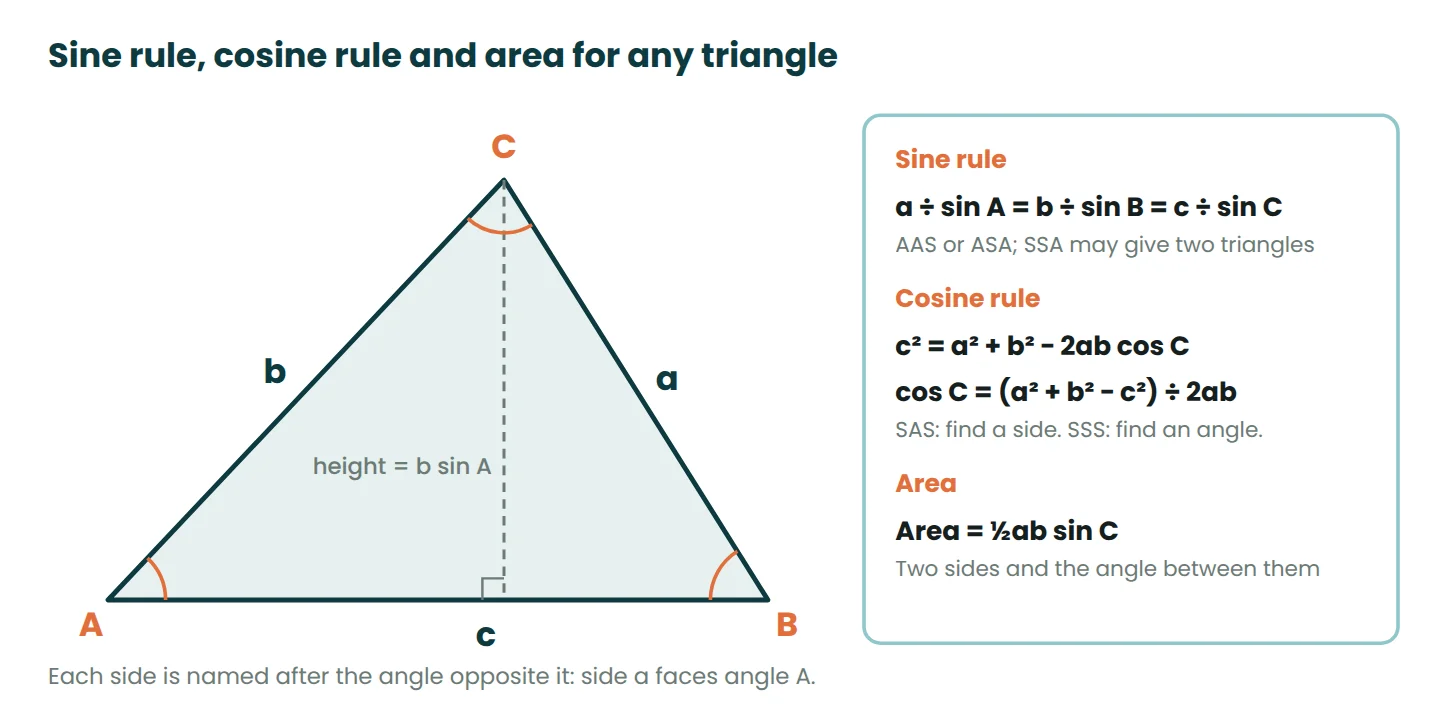
- Sine rule:
a ÷ sin A = b ÷ sin B = c ÷ sin C. Use it when you know a side and its opposite angle. - Cosine rule:
a² = b² + c² − 2bc cos A, orcos A = (b² + c² − a²) ÷ 2bc. Use it for two sides and the included angle (SAS) or three sides (SSS). - Area:
Area = ½ab sin C, using two sides and the angle between them.
The ambiguous case of the sine rule
Given two sides and a non-included angle (SSA), there may be zero, one or two triangles. Take A = 40°, a = 7 and b = 10. The height from C is b sin A = 6.43. Because 6.43 < 7 < 10, side a can swing to two positions.
sin B = 10 sin 40° ÷ 7 = 0.9183, soB = 66.67°orB = 180° − 66.67° = 113.33°.- Triangle 1:
C = 180° − 40° − 66.67° = 73.33°,c = 7 sin 73.33° ÷ sin 40° = 10.43. - Triangle 2:
C = 26.67°,c = 4.89.
The rule for an acute angle A: if a < b sin A there is no triangle; if a = b sin A there is one right-angled triangle; if b sin A < a < b there are two; if a ≥ b there is one.
Worked engineering examples
Example 1: slope angle and length of a driveway
A levelling run gives a reduced level of 24.630 m at the bottom of a driveway and 25.980 m at the top, 9.000 m apart horizontally. If you need to reduce the staff readings first, the rise and fall method shows how.
- Rise = 25.980 − 24.630 = 1.350 m.
- Gradient = 1.350 ÷ 9.000 = 0.150, which is 15% or 1 in 6.67.
- Angle =
tan⁻¹(0.150) = 8.53°. - Sloping length =
√(9.000² + 1.350²) = 9.101 m. Check:9.000 ÷ cos 8.53° = 9.101 m.
A 15% grade is 8.53°, not 15°. The free slope calculator converts between percent, degrees and ratio, which is handy for checking drawings that mix them.
Example 2: checking two set-out pegs with the cosine rule
A total station at S sets out pegs P and Q. Before anything is built off them, I tape between the pegs as an independent check. The instrument recorded SP = 42.350 m, SQ = 57.120 m and angle PSQ = 38°15′20″ (38.2556°).
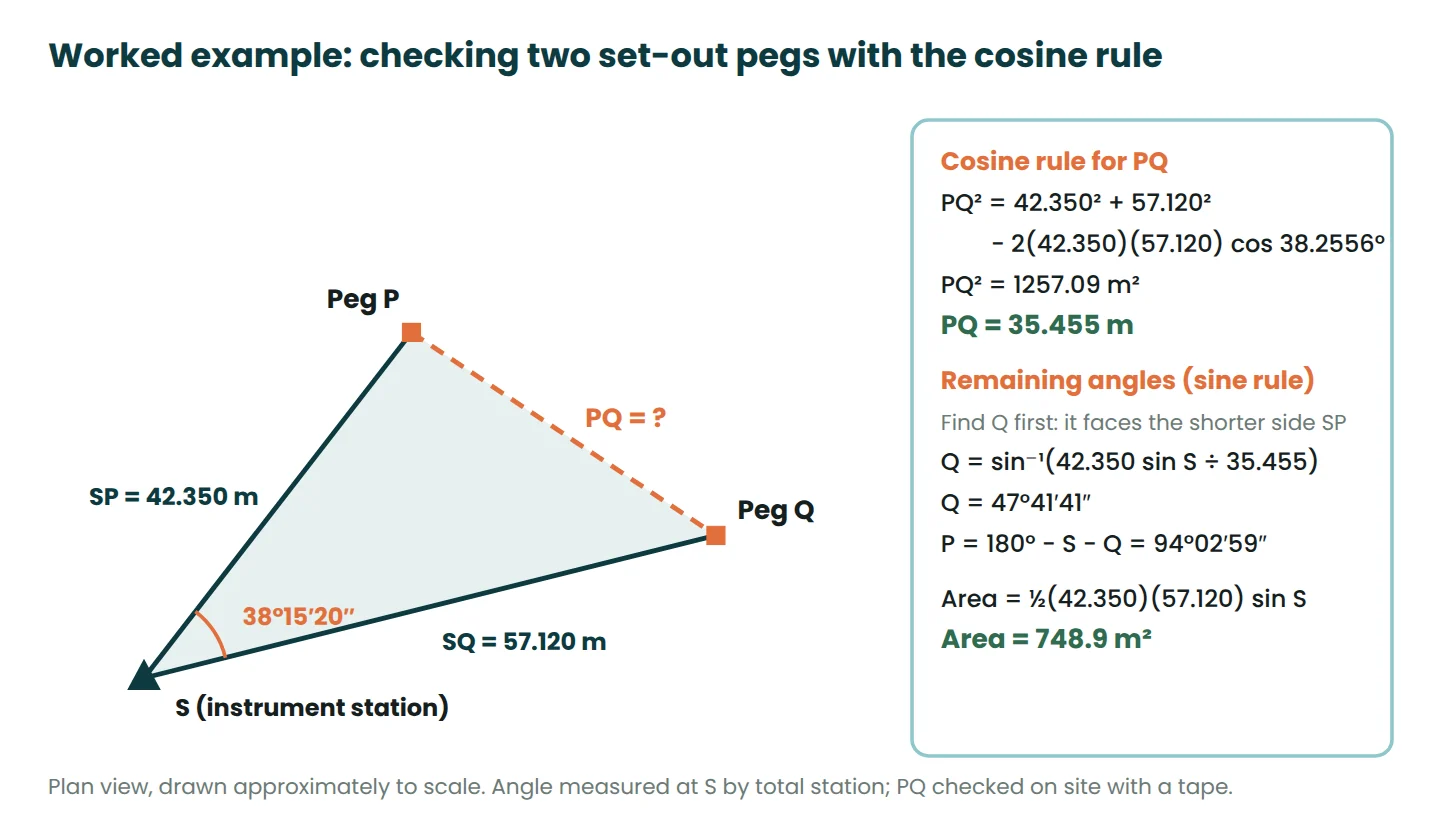
PQ² = 42.350² + 57.120² − 2(42.350)(57.120) cos 38.2556° = 1257.09, so PQ = 35.455 m. If the tape agrees within the job’s tolerance, the pegs are accepted.- Angle Q faces SP, which is shorter than SQ, so Q cannot be the largest angle and must be acute:
Q = sin⁻¹(42.350 sin 38.2556° ÷ 35.455) = 47°41′41″. P = 180° − 38°15′20″ − 47°41′41″ = 94°02′59″.- Area of the triangle =
½(42.350)(57.120) sin 38.2556° = 748.9 m².
Order matters. Only the angle opposite the longest side (P, facing SQ) can be obtuse. Apply the sine rule to P directly and the calculator returns 85.95°, the acute twin of the true 94.05°, and the three angles still add to 180°, so nothing looks wrong. The cosine rule settles it: cos P = (42.350² + 35.455² − 57.120²) ÷ (2 × 42.350 × 35.455) = −0.071, and a negative cosine means an obtuse angle. If your dimensions arrive in feet, convert them first with the engineering unit converter. For a full method, see how to set out a building.
Degrees vs radians
A radian is the angle at which the arc length equals the radius. A full turn is 2π radians, so 180° = π rad, radians = degrees × π ÷ 180 and 1 rad ≈ 57.2958°. Use degrees for triangles and surveying. Use radians in calculus (the derivative of sin x is cos x only in radians) and for arc length, s = rθ. A road curve of radius 150 m turning through 35° has an arc length of 150 × (35 × π ÷ 180) = 150 × 0.6109 = 91.63 m.
Common mistakes
- Calculator in the wrong mode. In radian mode sin 30 returns −0.988, not 0.5. A quick test: sin 90 should give exactly 1 in degree mode.
- Reading sin²x as sin x².
sin²x = (sin x)². sin²30° = 0.25, while sin(30²) in degree mode is sin 900° = 0. - Treating sin⁻¹ x as 1 ÷ sin x. The inverse gives an angle; the reciprocal is csc x.
- Splitting a function across a sum. sin(30° + 60°) = 1, but sin 30° + sin 60° = 1.366. Use the sum formula.
- Missing the ambiguous case. With SSA data, always test the obtuse option
180° − B. When solving a whole triangle, use the sine rule on a smaller angle first, because only the angle opposite the longest side can be obtuse. - Mixing percent grade and degrees. 100% is 45°, and 15° is about 26.8%.
- Dropping the ± in half-angle formulas. Decide the sign from the quadrant of θ/2.
Practice questions
1. Find the exact value of cos 75°.
Answer: cos(45° + 30°) = cos 45° cos 30° − sin 45° sin 30° = (√6 − √2)/4 ≈ 0.2588.
2. tan θ = 5/12 and θ is in quadrant III. Find sin θ, cos θ and sin 2θ.
Answer: the hypotenuse is √(5² + 12²) = 13. Both sine and cosine are negative in quadrant III, so sin θ = −5/13 and cos θ = −12/13. Then sin 2θ = 2(−5/13)(−12/13) = 120/169 ≈ 0.710.
3. Solve sin x = −0.5 for 0° ≤ x < 360°.
Answer: the reference angle is 30°. Sine is negative in quadrants III and IV, so x = 180° + 30° = 210° and x = 360° − 30° = 330°.
4. Show that (1 − cos 2x) ÷ sin 2x = tan x.
Answer: 1 − cos 2x = 2sin²x and sin 2x = 2 sin x cos x. Dividing gives sin x ÷ cos x = tan x.
5. In a triangle, b = 8.0 m, c = 11.0 m and A = 52°. Find a and the area.
Answer: a² = 8.0² + 11.0² − 2(8.0)(11.0) cos 52° = 185 − 108.36 = 76.64, so a = 8.75 m. Area = ½(8.0)(11.0) sin 52° = 34.7 m².
Frequently asked questions
How many trigonometry formulas do I need to memorise?
Fewer than this list suggests. Learn SOH CAH TOA, the exact values, sin²θ + cos²θ = 1 and the sum formulas for sine and cosine; the double, half-angle and product formulas all follow from those. Check which formulas your exam’s formula sheet already provides.
What is the difference between an identity and an equation?
An identity is true for every angle where both sides are defined, such as sin²θ + cos²θ = 1. An equation is true only for particular angles, which you solve for.
Why is tan 90° undefined?
Because tan θ = sin θ ÷ cos θ and cos 90° = 0, so you would be dividing by zero. On the graph, tan θ grows without limit as θ approaches 90° from below, and there is a vertical asymptote at 90°.
Should I use degrees or radians?
Use degrees for triangle, navigation and surveying problems, and radians for calculus, arc length and anything involving angular speed. Whichever you choose, set the calculator to match.
References
- OpenStax. Precalculus 2e, 6.3 Inverse Trigonometric Functions. Rice University.
- OpenStax. Precalculus 2e, 8.1 Non-right Triangles: Law of Sines. Rice University.
- OpenStax. Precalculus 2e, 8.2 Non-right Triangles: Law of Cosines. Rice University.
- National Institute of Standards and Technology. NIST Digital Library of Mathematical Functions, Chapter 4: Elementary Functions.
- Dawkins, P. Trig Cheat Sheet. Lamar University.
This page is general information for learning and revision. Check your course notes and your exam board’s requirements for the notation and formula sheet you will be given, and follow your project specification and the responsible engineer for any site work.

Leave a Reply