
The real difference between cold-blooded vs warm-blooded animals is where their body heat comes from. Warm-blooded animals, which biologists call endotherms, make most of their heat inside their own bodies by breaking down food, and they hold their core temperature fairly steady. Cold-blooded animals, or ectotherms, get most of their heat from the sun, warm ground or water around them, so their body temperature rises and falls with their surroundings unless they move somewhere warmer or cooler.
Mammals and birds are endotherms. Reptiles, amphibians, most fish and almost all invertebrates are ectotherms. The everyday names are misleading: a “cold-blooded” lizard is only as cold as its surroundings allow, and after a morning on a sunny rock it can be warmer than the air around it.
Each strategy has a price. Making your own heat takes a lot of food: in the wild, a 1 kg mammal eats over eight times as much each day as a 1 kg reptile. That trade-off explains most of the differences below.
Plain-language definitions
- Warm-blooded animal (endotherm): an animal that produces most of its body heat from its own metabolism and keeps its core temperature within a narrow range, whatever the weather.
- Cold-blooded animal (ectotherm): an animal that gets most of its body heat from its surroundings, so its body temperature depends on where it is and what it is doing.
Neither definition mentions blood. Both are about the source of body heat.
Everyday terms versus scientific terms
Biologists use two pairs of words because they measure two different things. Endotherm and ectotherm describe where the heat comes from. Homeotherm and poikilotherm describe how stable the body temperature is.
| Term | What it describes | Meaning | Typical examples |
|---|---|---|---|
| Endotherm | Heat source | Most body heat is made inside by metabolism | Mammals, birds |
| Ectotherm | Heat source | Most body heat comes from outside | Lizards, frogs, most fish, insects |
| Homeotherm | Stability | Core temperature held within a narrow range | Most mammals and birds |
| Poikilotherm | Stability | Body temperature varies widely | Most reptiles, amphibians and fish |
| Heterotherm | Switching | Regulates at some times, lets temperature drop at others | Hummingbirds in torpor, hibernating mammals |
The two pairs usually line up, but not always. A deep-sea fish is an ectotherm, yet its body temperature hardly changes because the cold water around it hardly changes. A hummingbird is an endotherm, yet some species let their body temperature fall by more than 35 °C overnight. That is why “cold-blooded” and “warm-blooded” are fine for conversation but too rough for an exam answer.
Why “cold-blooded” is misleading
There are three problems with the old word. First, the blood is not necessarily cold: leatherback turtles have been measured at 25.5 °C while swimming in 7.5 °C seawater. Second, ectotherms do control their temperature, mostly through behaviour. Third, some “warm-blooded” animals deliberately let themselves get very cold during torpor or hibernation.
How animals gain and lose heat
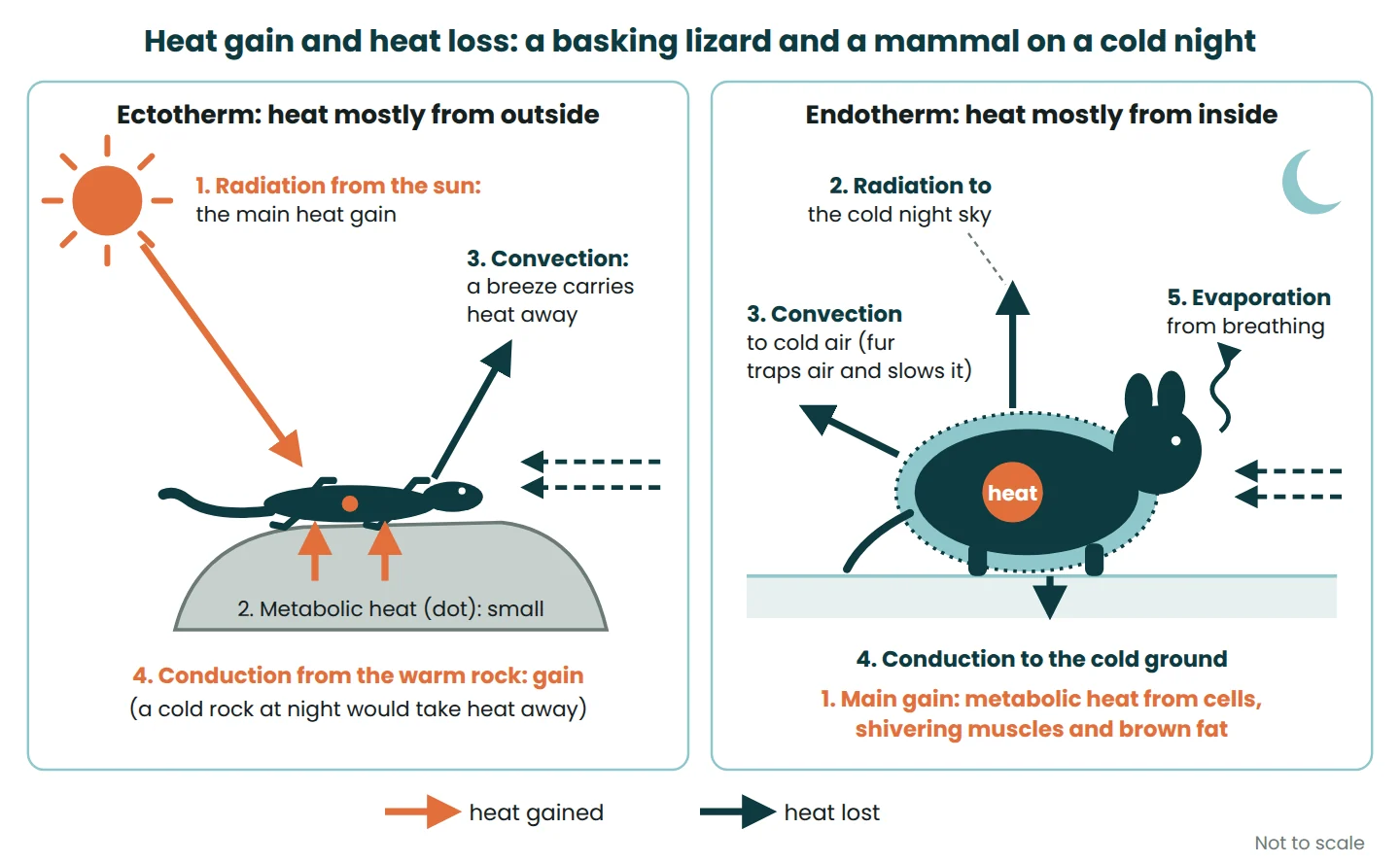
Every animal swaps heat with its surroundings in four physical ways, plus the heat its own cells release. The OpenStax Biology 2e section on homeostasis uses the same four headings, so learn them in this form:
- Radiation: infrared heat, such as sunshine on a lizard or warmth lost to a clear night sky.
- Conduction: heat passing by direct contact, such as a belly on a warm rock.
- Convection: moving air or water carrying heat away. Wind chill is convection.
- Evaporation: water turning to vapour on the skin or in the airways takes heat with it.
- Metabolism: heat released by respiration in cells. Large in endotherms, small in ectotherms.
How ectotherms control body heat
Ectotherms regulate mainly by choosing where to be. A lizard basks side-on to the morning sun, presses its body onto warm rock to gain heat by conduction, then shuttles between sun and shade through the day. In hot deserts many reptiles shelter in burrows at midday and are active at dawn, dusk or night. This fails on a cold, cloudy day, because an ectotherm’s muscles and enzymes slow down as it cools.
Some ectotherms make useful heat too. A bumblebee’s flight muscles need to be at least 30 °C before it can fly, so it shivers them first. At an air temperature of 13 °C this warm-up takes around five minutes.
How endotherms control body heat
In mammals the hypothalamus in the brain acts like a thermostat. It compares blood temperature with a set point and switches on corrections, a classic negative feedback loop.
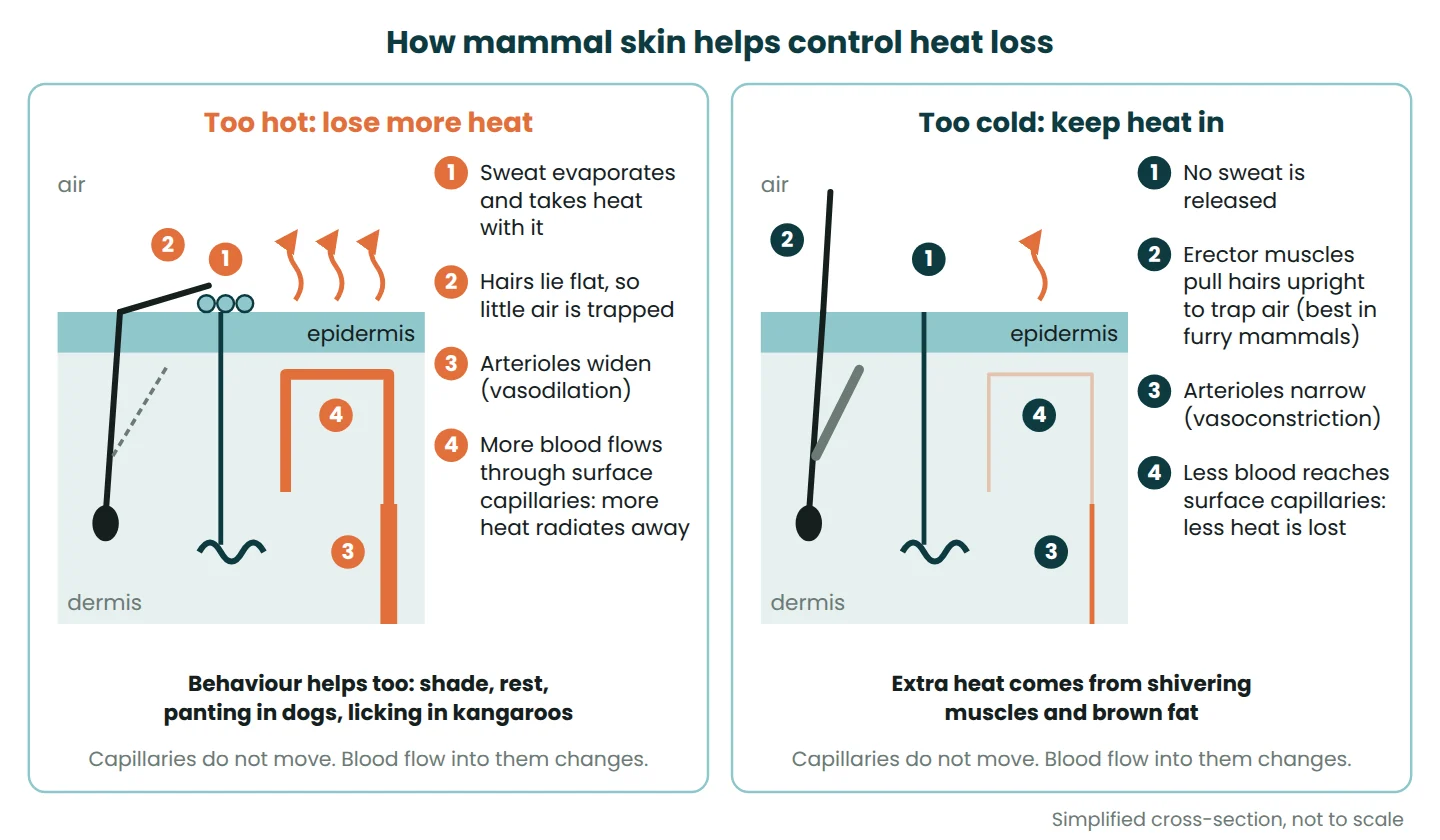
- When too cold: arterioles supplying the skin narrow (vasoconstriction), muscles shiver, brown fat releases heat directly, hair or feathers are raised to trap still air, and the animal huddles or curls up. In bird legs and seal flippers, warm arteries run beside cool veins so heat passes back towards the core (countercurrent heat exchange).
- When too hot: skin arterioles widen (vasodilation), sweat evaporates, dogs pant, red kangaroos lick their forearms, and most animals rest in shade.
Reading the body temperature graph
Exam questions often show the two graphs below. In panel A the endotherm’s line stays flat near 37 °C across the whole range, while the ectotherm’s line climbs with the surroundings. In panel B the endotherm’s metabolic rate is lowest in a band called the thermoneutral zone. Below it, the animal must burn more fuel to stay warm. Above it, the cost rises again because panting and sweating take energy. The ectotherm’s resting rate simply rises as it warms, often doubling or even tripling for each 10 °C rise across its normal range, because chemical reactions speed up.
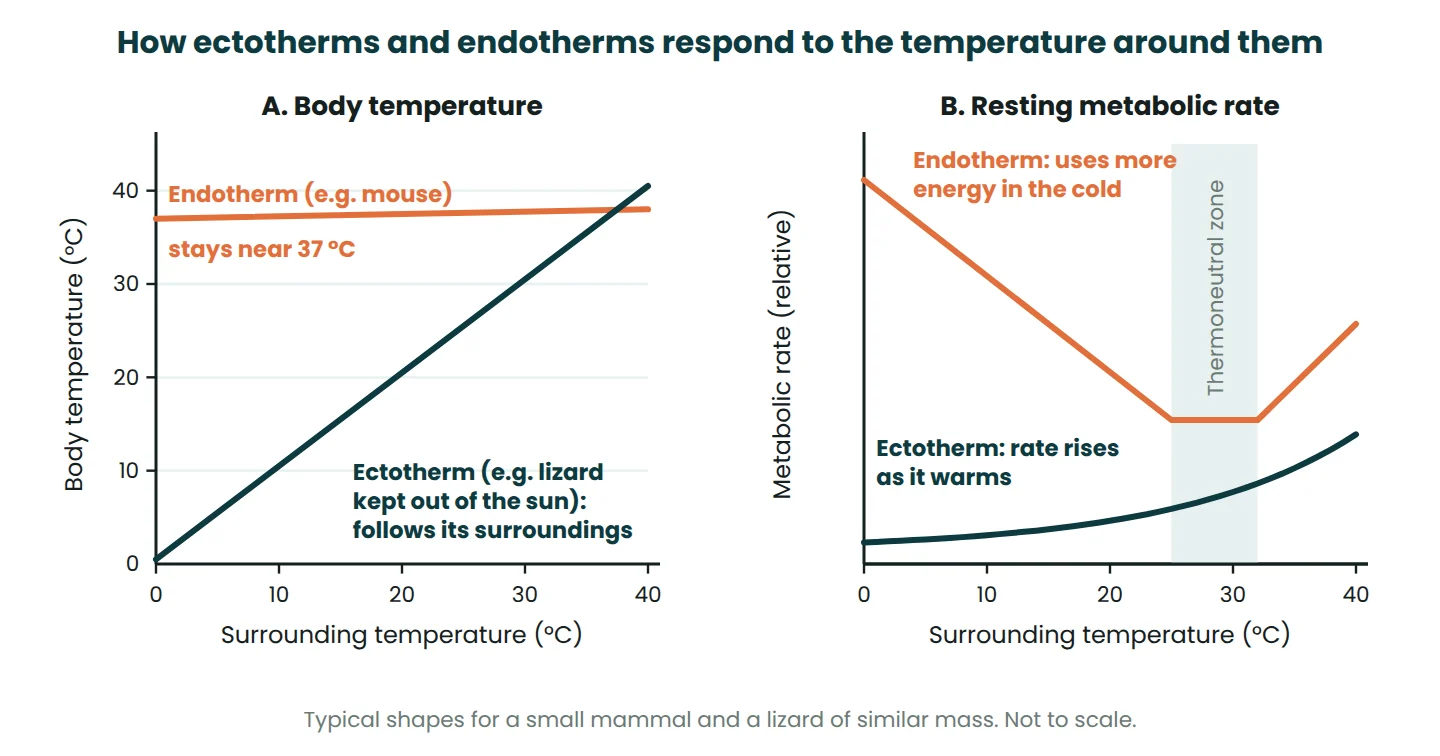
One caution: the ectotherm line in panel A is for an animal kept out of the sun. In the field a basking ectotherm is often well above air temperature.
The energy cost of being warm-blooded
Field studies have measured how much energy free-living animals use, then turned the results into prediction equations. A review by Nagy (2001) gives these figures for animals with a body mass of 1 kg, measured as dry matter eaten per day.
Worked example 1: a 1 kg mammal versus a 1 kg reptile
- Data: a 1 kg mammal eats about 55 g of dry food per day. A 1 kg bird eats about 72 g. A 1 kg reptile eats about 9% of the bird’s amount.
- Reptile:
0.09 × 72 g ≈ 6.5 g per day. - Ratio:
55 ÷ 6.5 ≈ 8.5, so the mammal needs about eight and a half times as much food. - Over 30 days: mammal
55 × 30 = 1,650 g; reptile6.5 × 30 ≈ 195 g. - Time to eat its own body mass in dry food: mammal
1,000 ÷ 55 ≈ 18 days; reptile1,000 ÷ 6.5 ≈ 154 days.
Most of the mammal’s extra food is burned simply to make heat. In return it can hunt on cold nights and stay active in winter. The reptile gets by on a fraction of the food, which is why ectotherms do well in deserts and other places where food is scarce. These are averages across many species, so treat them as a rule of thumb, not a value for one animal.
Worked example 2: body size and heat loss
Heat is made by the volume of living tissue but lost through the surface, so the surface area to volume ratio (SA:V) matters. Model three animals as cubes:
| Cube side | Surface area (6 × side²) | Volume (side³) | SA:V |
|---|---|---|---|
| 1 cm | 6 cm² | 1 cm³ | 6 : 1 |
| 2 cm | 24 cm² | 8 cm³ | 3 : 1 |
| 10 cm | 600 cm² | 1,000 cm³ | 0.6 : 1 |
Making the cube ten times longer cuts the surface per unit of volume by ten. Small endotherms therefore lose heat fast compared with the heat they can make, so they must eat often, and some save energy by going into torpor on cold nights. Large bodies hold heat well, which is part of the leatherback turtle’s secret below. You can test the idea with flasks of hot water of different sizes and a set of thermometers; our guide on how to write a lab report shows how to present the cooling curves.
Cold-blooded vs warm-blooded animals: key differences
| Feature | Ectotherms (cold-blooded) | Endotherms (warm-blooded) |
|---|---|---|
| Main heat source | Surroundings: sun, warm ground, water | Own metabolism |
| Body temperature | Changes with surroundings and behaviour | Held fairly steady: about 37 °C in humans, about 41 °C in active birds |
| Main control method | Behaviour: basking, shade, burrows | Physiology plus behaviour: shivering, sweating, panting, blood flow changes |
| Insulation | Usually none (scales, moist skin) | Fur, feathers, fat, blubber |
| Food needed | Low: roughly one-eighth of a same-sized mammal | High |
| Activity in the cold | Slow or inactive until warmed | Can stay active at night and in winter |
| Share of food used for growth | Larger, because little is burned as heat | Smaller |
Examples by animal group
| Group | Usual strategy | Examples | Exceptions to know |
|---|---|---|---|
| Mammals | Endotherm | Humans, kangaroos, whales, bats | Naked mole-rat; hibernators |
| Birds | Endotherm | Penguins, eagles, parrots | Hummingbirds in nightly torpor |
| Reptiles | Ectotherm | Lizards, snakes, crocodiles, turtles | Leatherback turtle stays warm in cold seas |
| Amphibians | Ectotherm | Frogs, toads, salamanders | Wood frogs survive freezing |
| Fish | Ectotherm | Goldfish, trout, most sharks | Tuna, great white and mako sharks, opah |
| Insects and other invertebrates | Ectotherm | Beetles, butterflies, spiders, crabs | Bumblebees shiver to warm flight muscles |
Tricky cases that break the rules
Heterotherms: torpor and hibernation
Small endotherms lose heat fast, so some switch off their thermostat to save energy. The black metaltail, a hummingbird of the Peruvian Andes at about 3,000 m, runs at around 40 °C by day. In a 2020 study published in Biology Letters, one dropped to 3.26 °C overnight, the lowest body temperature recorded in a bird. Hibernation is the long version. Arctic ground squirrels supercool their core to −2.9 °C, the lowest body temperature known for any mammal, holding torpor for up to 24 days at a time and rewarming for less than a day between bouts.
Regional endothermy in tuna and some sharks
Most fish lose the heat their muscles make as blood passes through the gills. Tuna keep it with countercurrent heat exchangers (bundles of fine blood vessels called retia mirabilia), so their swimming muscles, gut, brain and eyes stay warm. Bluefin tuna can run up to 21 °C warmer than the water. Lamnid sharks, such as the great white and the shortfin mako, use similar heat exchangers, and swordfish warm their brain and eyes. The opah goes further: its constant fin flapping makes heat, and heat exchangers in its gills help keep its average muscle temperature about 5 °C above the water at depths of 45 to 305 m.
The leatherback turtle
Leatherbacks can exceed 900 kg and range from tropical seas to waters north of the Arctic Circle. They hold body temperatures well above cold seawater using large size, peripheral tissues as insulation and changes in blood flow. This is called gigantothermy, and their metabolic rate sits between the values predicted for a typical reptile and a mammal.
The naked mole-rat
This almost hairless rodent is a mammal that cannot keep a steady body temperature. Its temperature tracks the burrow around it, so it behaves much like a reptile: colonies huddle to slow heat loss and individuals bask in shallow tunnels warmed by the sun.
Adaptations to climate
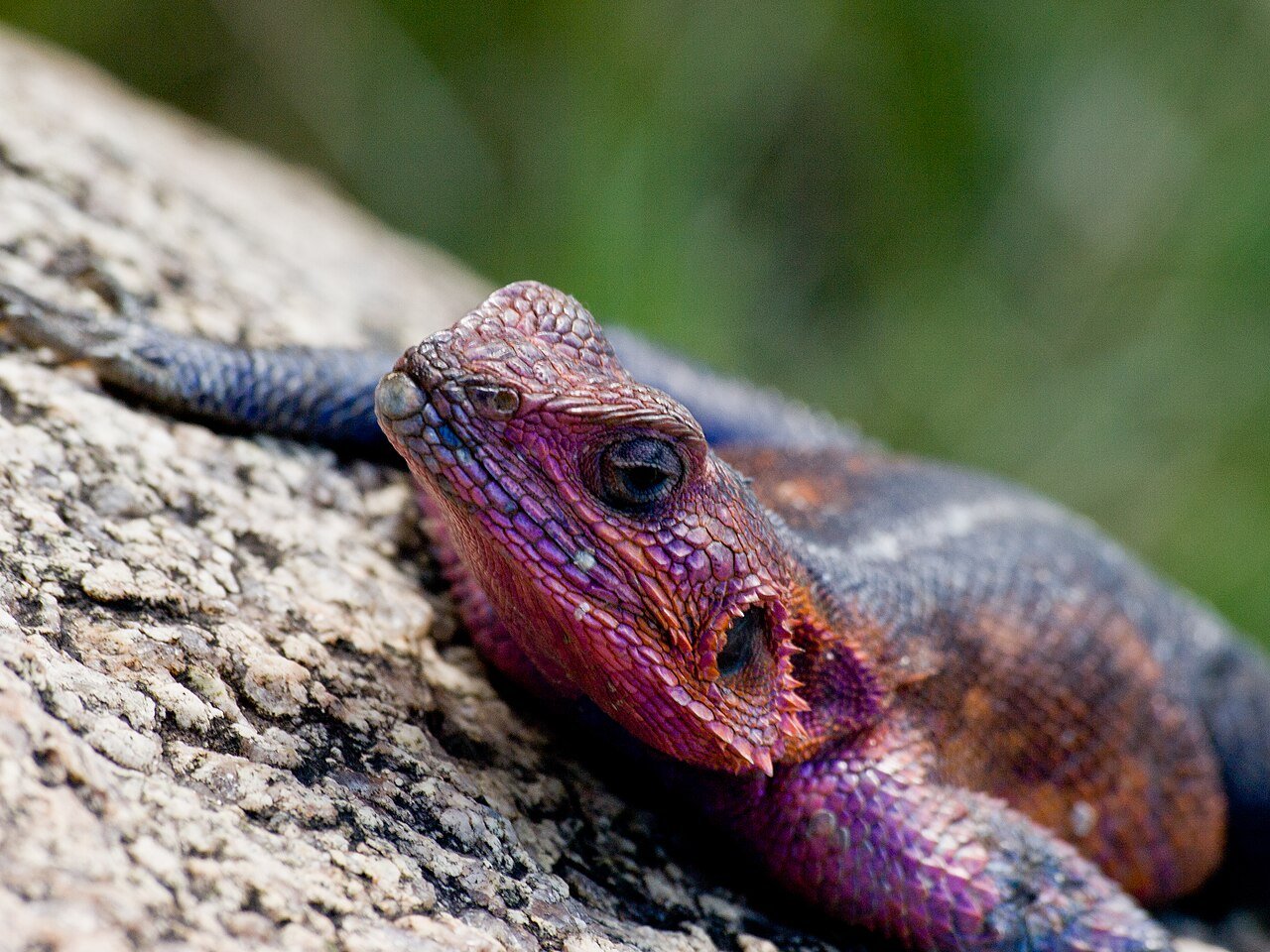
Temperature is one of the main abiotic factors that decide where an animal can live, and the two groups handle it differently.
- Ectotherms in the cold: reptiles and amphibians become scarce towards the poles because the warm season gets too short. Some tolerate freezing: wood frogs from Alaska survived experimental freezing to −16 °C, with glucose and urea in their tissues acting as cryoprotectants. Dissolved substances lower the freezing point of body fluids (see our note on solutes and solvents).
- Endotherms in the cold: fur, feathers, blubber and countercurrent exchange. Bergmann’s rule says related animals tend to be larger in colder climates (lower SA:V), and Allen’s rule says they tend to have shorter ears and limbs. Both are tendencies with many exceptions.
- Both groups in hot, dry places: they shelter in burrows at midday and are active at night, dawn or dusk. Endotherms there must balance cooling by evaporation against the risk of running out of water.
Common mistakes
- “Cold-blooded animals have cold blood.” Their blood is the same temperature as the body, which can be warm after basking.
- “Ectotherms cannot control their temperature.” They control it mostly through behaviour, and they are often very good at it.
- Treating endotherm and homeotherm as the same word. One is about the heat source, the other about stability.
- “Capillaries move closer to the skin.” They do not move. Arterioles widen or narrow, which changes how much blood flows through the surface capillaries.
- Assuming every endotherm sits at 37 °C. Active birds average about 41 °C, and heterotherms drop far lower.
- Calling ectotherms primitive or inefficient. They turn a bigger share of their food into growth and can live where an endotherm would starve.
Practice questions
Question 1: classify the animals
Say whether each is mainly an ectotherm or an endotherm, and flag any heterotherm or regional endotherm: emperor penguin, saltwater crocodile, goldfish, bluefin tuna, black metaltail hummingbird.
Answer: Emperor penguin: endotherm. Saltwater crocodile: ectotherm. Goldfish: ectotherm. Bluefin tuna: ectotherm overall, but a regional endotherm because it warms its muscles, gut, brain and eyes. Black metaltail: endotherm by day and a heterotherm because it enters deep torpor at night.
Question 2: weekly food
Using 55 g and 6.5 g of dry food per day for a 1 kg mammal and a 1 kg reptile, find each animal’s weekly need. How many weeks would the reptile take to eat the mammal’s weekly amount?
Answer: Mammal 55 × 7 = 385 g. Reptile 6.5 × 7 = 45.5 g. Weeks 385 ÷ 45.5 ≈ 8.5, the same as the daily ratio, which is a useful check.
Question 3: surface area to volume
Two model animals are cubes with sides of 3 cm and 6 cm. Calculate SA:V for each and say which cools faster from the same starting temperature.
Answer: 3 cm cube: SA = 6 × 3² = 54 cm², V = 3³ = 27 cm³, SA:V = 2 : 1. 6 cm cube: SA = 216 cm², V = 216 cm³, SA:V = 1 : 1. The smaller cube has twice the surface per unit volume, so it cools faster.
Question 4: cooling by sweat
A runner loses 0.8 kg of sweat in one hour and all of it evaporates. Taking the heat needed to evaporate water at skin temperature as 2.4 kJ per gram, how much heat is removed, and what is that as an average power?
Answer: 800 g × 2.4 kJ/g = 1,920 kJ. Power 1,920,000 J ÷ 3,600 s ≈ 533 W. Sweat that drips off without evaporating removes almost none of this heat, which is why humid days feel so draining.
Question 5: interpret the data
At air temperatures of 10, 20 and 30 °C, animal X measures 11, 21 and 30 °C, and animal Y measures 38.9, 39.1 and 39.2 °C. Identify each. Later, X is found basking on a rock at an air temperature of 20 °C with a body temperature of 33 °C. Does that change your answer?
Answer: X is an ectotherm because its temperature follows the air. Y is an endotherm because its temperature stays almost constant. The basking result does not change anything: X gained heat from outside, by radiation from the sun and conduction from the rock, which is exactly what ectotherms do.
Frequently asked questions
Are humans warm-blooded?
Yes, humans are endotherms. We keep our core near 37 °C using the hypothalamus, which triggers sweating and vasodilation when we are hot and shivering and vasoconstriction when we are cold.
Are all fish cold-blooded?
No. Most fish are ectotherms, but tuna, lamnid sharks and swordfish warm parts of their bodies, and the opah warms its whole body, with its muscles about 5 °C above the surrounding water.
Why do warm-blooded animals need more food?
Because they turn most of their food energy into heat to hold their core temperature steady. A 1 kg wild mammal eats over eight times as much as a 1 kg reptile.
Are snakes cold-blooded?
Yes, snakes are ectotherms. They warm up by basking and lying on warm surfaces, and they shelter underground or in shade when it is too hot or too cold. For more biology topics, browse our study notes.
References
- OpenStax (2018) Biology 2e, section 33.3: Homeostasis. Rice University.
- Nagy, K.A. (2001) Food requirements of wild animals: predictive equations for free-living mammals, reptiles, and birds. Nutrition Abstracts and Reviews, Series B, 71, 21R–31R.
- Prinzinger, R., Preßmar, A. and Schleucher, E. (1991) Body temperature in birds. Comparative Biochemistry and Physiology, 99A(4).
- Cornell Lab of Ornithology (2020) The coolest hummingbird, as measured by an actual thermometer. All About Birds.
- Williams, C.T. et al. (2011) Hibernating above the permafrost: effects of ambient temperature and season on expression of metabolic genes in liver and brown adipose tissue of arctic ground squirrels. Journal of Experimental Biology, 214(8), 1300.
- Smithsonian’s National Zoo and Conservation Biology Institute. Naked mole-rat.
- Paladino, F.V., O’Connor, M.P. and Spotila, J.R. (1990) Metabolism of leatherback turtles, gigantothermy, and thermoregulation of dinosaurs. Nature, 344, 858–860.
- Wegner, N.C. et al. (2015) Whole-body endothermy in a mesopelagic fish, the opah, Lampris guttatus. Science, 348(6236), 786–789.
This article is general information for learning and revision. Always check your course notes and your exam board’s requirements for the terms and level of detail expected.

.jpg)
Leave a Reply