
Solute vs solvent in one line: the solute is the substance that dissolves, and the solvent is the substance it dissolves in. Stir a teaspoon of salt into a glass of water and the salt is the solute, the water is the solvent, and the clear salty liquid you end up with is the solution.
The solvent is usually the component present in the larger amount, and it sets the physical state of the solution. Water is by far the most common solvent, and a solution in water is called an aqueous solution. But air, brass and soda water are solutions too, with solutes and solvents that are gases or solids.
Solution, solute and solvent: plain definitions
A solution is a homogeneous mixture: its composition is the same all the way through. The dissolved particles are single molecules or ions, so you cannot see them, they do not settle out on standing and filter paper will not separate them. Muddy water fails all three tests, which is why it is a suspension, not a solution.
The solute is the substance that dissolves. It is usually present in the smaller amount, and a solution can hold several solutes at once: seawater carries sodium, chloride, magnesium and sulfate ions plus dissolved oxygen and carbon dioxide.
The solvent is the substance that does the dissolving. It is usually present in the larger amount, and the solution takes its state: a solid dissolved in a liquid gives a liquid solution. When two liquids mix in similar amounts, such as ethanol and water, the label is a convention. Most courses call the larger component the solvent, and water is normally named as the solvent in an aqueous solution.
Solute vs solvent: the main differences
| Point of comparison | Solute | Solvent |
|---|---|---|
| Role | Gets dissolved | Does the dissolving |
| Usual amount | Smaller | Larger |
| State of the solution | Does not set it | Sets it |
| How many in one solution | One or more | Usually one |
| Particles after dissolving | Spread out as separate molecules or ions | Surrounds the solute particles |
| Effect on the other | Changes the solvent’s properties, e.g. salt lowers the freezing point of water | Its nature, with the temperature, sets how much solute can dissolve |
| Recovery | Usually left behind when the solvent evaporates | Can be evaporated or distilled off |
| Salt water example | Sodium chloride | Water |
Types of solutions by state
Solutions are not just solids in liquids. Solutes and solvents can be gases, liquids or solids, as long as the result is a single uniform phase.
| Solute (state) | Solvent (state) | Example |
|---|---|---|
| Oxygen, argon (gas) | Nitrogen (gas) | Air |
| Carbon dioxide (gas) | Water (liquid) | Soda water and soft drinks |
| Oxygen (gas) | Water (liquid) | River water that fish breathe from |
| Ethanol (liquid) | Water (liquid) | Wine and other alcoholic drinks |
| Acetic acid (liquid) | Water (liquid) | Vinegar |
| Sodium chloride (solid) | Water (liquid) | Seawater, brine |
| Hydrogen (gas) | Palladium (solid) | Hydrogen stored in palladium metal |
| Zinc (solid) | Copper (solid) | Brass, an alloy |
| Copper (solid) | Silver (solid) | Sterling silver (92.5% silver) |
Alloys such as brass are called solid solutions: the zinc atoms take up places in the copper crystal, so the metal is uniform throughout. Not every alloy is a single solid solution, though. Steel, for example, usually contains more than one phase.
Why water dissolves so many substances
Water is often called the “universal solvent” because it dissolves more substances than any other common liquid. The reason is its polarity. Oxygen pulls the shared electrons away from the two hydrogens, so the oxygen end of the bent molecule carries a partial negative charge (δ−) and the hydrogen ends a partial positive charge (δ+). The polar vs non-polar covalent bonds note explains where those partial charges come from.
When salt goes into water, water molecules crowd around the ions at the surface of each crystal. The δ− oxygen ends face the positive Na+ ions and the δ+ hydrogen ends face the negative Cl− ions. Each ion that breaks free is wrapped in a shell of water molecules, a process called hydration, and drifts off into the solution. Water also has a high relative permittivity, about 78 at 25 °C, which weakens the attraction between oppositely charged ions to roughly 1/78 of its strength in a vacuum, so the ions stay apart.
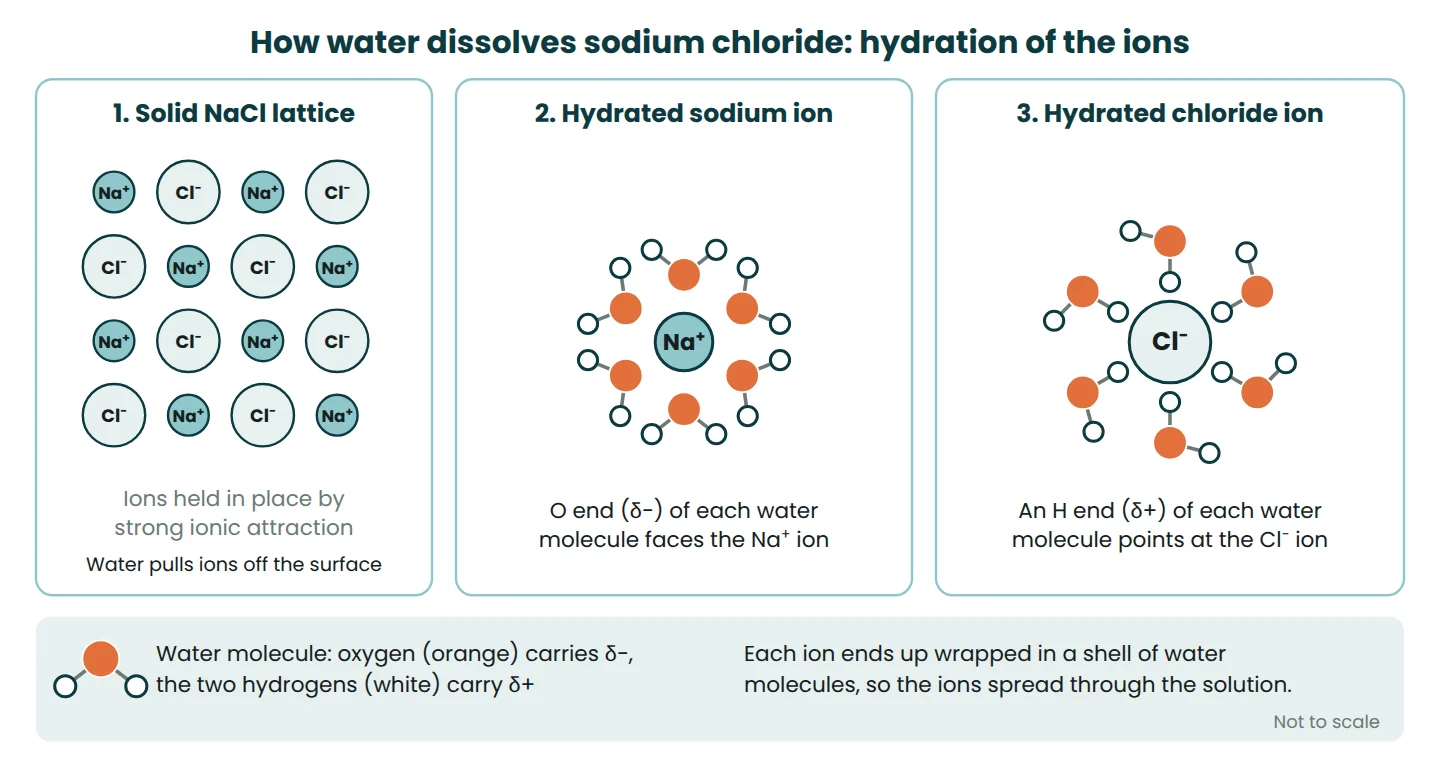
Molecular solutes such as sugar and ethanol dissolve a different way. They do not split into ions, but they have O–H groups that form hydrogen bonds with water. “Universal” is an exaggeration, though: water will not dissolve oil, wax, most plastics or most metals.
Like dissolves like
The working rule is that polar solvents dissolve polar and ionic solutes, and non-polar solvents dissolve non-polar solutes. Water dissolves salt and sugar but leaves cooking oil floating on top. Grease on a bike chain comes off with a non-polar solvent such as mineral turpentine, not with plain water. A solute dissolves when the attractions it can form with the solvent are comparable to the attractions it has to break, in itself and in the solvent.
Solubility, saturation and the effect of temperature and pressure
Solubility is the maximum amount of solute that dissolves in a given amount of solvent at a stated temperature, often quoted as grams per 100 g of water. Against that limit, a solution is:
- Unsaturated: holds less solute than the limit, so more will dissolve.
- Saturated: holds exactly the limit. Extra solute sits undissolved on the bottom.
- Supersaturated: temporarily holds more than the limit. It is unstable, and a seed crystal or a knock starts crystallisation. Reusable hand warmers use a supersaturated sodium acetate solution, and a freshly opened soft drink is supersaturated with carbon dioxide.
Temperature
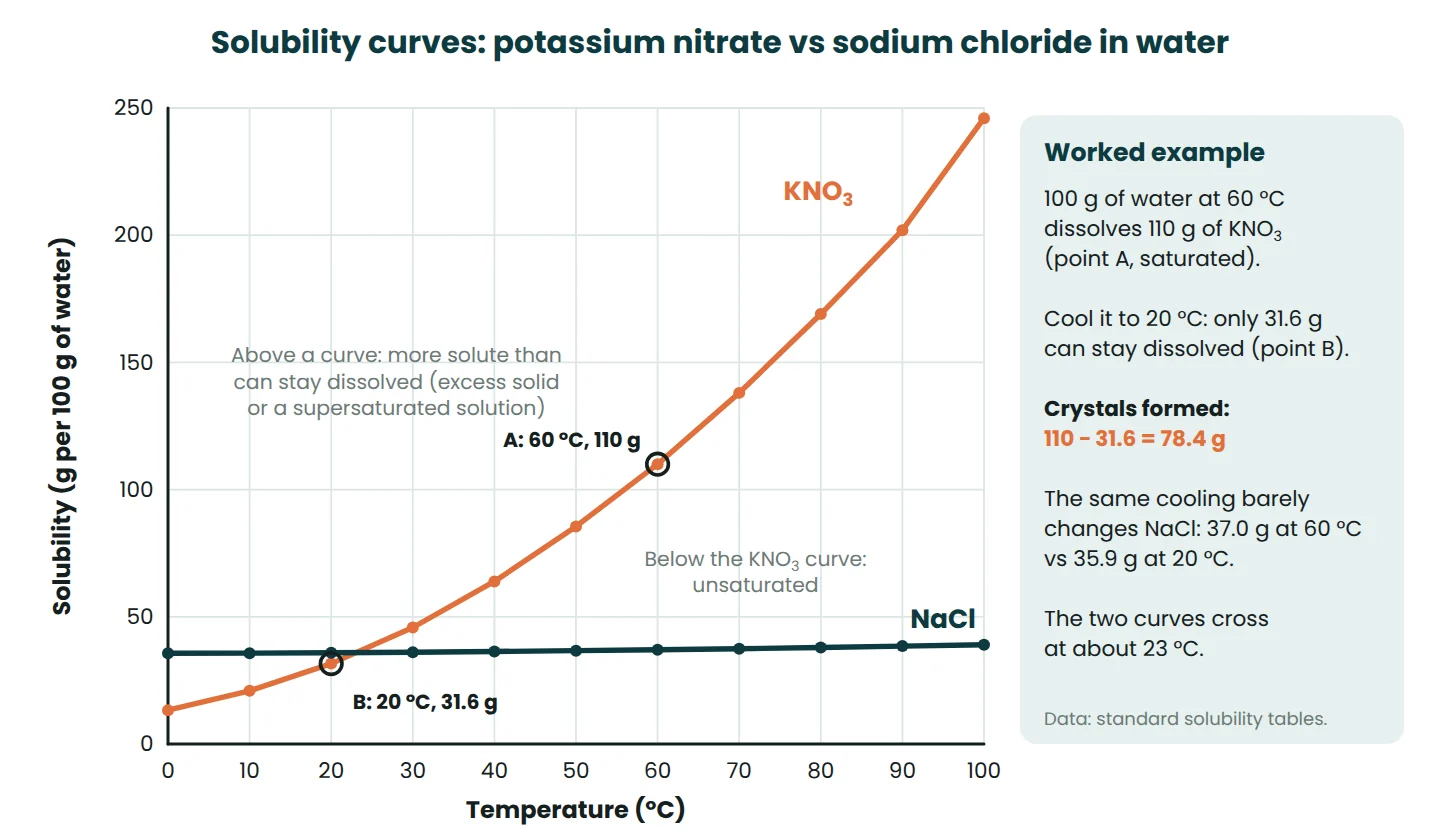
Most solids dissolve better in hot water, but by very different amounts. Potassium nitrate goes from about 13 g per 100 g of water at 0 °C to more than 240 g at 100 °C. Sodium chloride barely moves: about 35.7 g at 0 °C and 39.0 g at 100 °C. A few salts, such as cerium(III) sulfate, become less soluble as the water warms.
Gases do the opposite: they are less soluble in warm water. Fresh water at sea-level pressure holds about 14.6 mg/L of oxygen at 0 °C, 11.3 mg/L at 10 °C, 9.1 mg/L at 20 °C and 7.6 mg/L at 30 °C. That is why warm, still water can leave fish short of oxygen, and why dissolved oxygen is one of the key abiotic factors in rivers and lakes.
Pressure and Henry’s law
Pressure makes little difference to solids and liquids, but a big one to gases. Henry’s law says that, at constant temperature, the amount of a gas that dissolves in a liquid is proportional to the partial pressure of that gas above the liquid: C = k × P, where k depends on the gas, the solvent and the temperature. Double the pressure of carbon dioxide above the drink and you double the CO2 it can hold.
Soft drinks are bottled under carbon dioxide pressure. Open the cap and the pressure above the liquid falls, the solution is suddenly supersaturated, and the extra gas leaves as bubbles. A warm drink goes flat faster because the temperature effect adds to the pressure effect.
Concentration: worked examples
Concentration tells you how much solute is in a given amount of solution. Which unit you use depends on the job: mass percent for mixtures you weigh, ppm for traces, and molarity for reactions.
Mass percent
Mass % = mass of solute ÷ mass of solution × 100. Dissolve 15.0 g of sodium chloride in 235.0 g of water. The solution has a mass of 250.0 g, so the concentration is 15.0 ÷ 250.0 × 100 = 6.00%. A saturated brine at 20 °C holds 35.9 g of salt per 100 g of water, which is 35.9 ÷ 135.9 × 100 = 26.4% by mass, not 35.9%.
Parts per million (ppm)
ppm = mass of solute ÷ mass of solution × 1,000,000, so 1 ppm is 1 mg per kg. For dilute water samples, 1 kg is about 1 L, so 1 ppm ≈ 1 mg/L. Seawater carries about 35 g of dissolved salts per kilogram: 35 ÷ 1,000 × 1,000,000 = 35,000 ppm, or 3.5%.
Molarity
c = n ÷ V, where n is the amount of solute in moles (n = m ÷ M) and V is the volume of solution in litres. Dissolve 11.69 g of NaCl (M = 58.44 g/mol) and make it up to 500.0 mL:
- n = 11.69 ÷ 58.44 = 0.2000 mol
- V = 500.0 mL = 0.5000 L
- c = 0.2000 ÷ 0.5000 = 0.4000 mol/L (often written 0.4000 M)
“Make it up to” matters: you dissolve the salt in some water, then add water until the total volume of solution reaches 500.0 mL in a volumetric flask. If you need to switch between mL, L and cm³, the unit converter handles volume units.
Dilution with C1V1 = C2V2
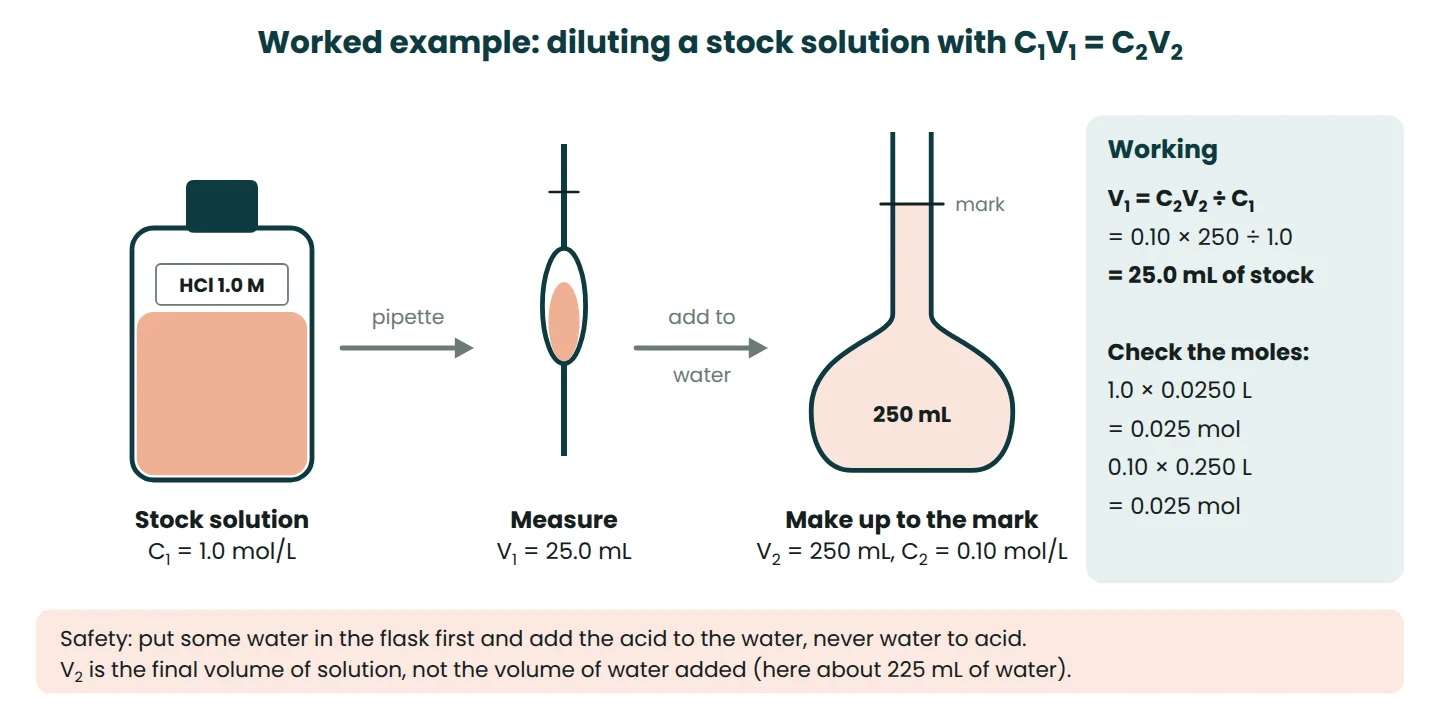
Adding solvent does not change the moles of solute, only the volume they are spread through, so C1 × V1 = C2 × V2. To make 250 mL of 0.10 mol/L hydrochloric acid from a 1.0 mol/L stock: V1 = 0.10 × 250 ÷ 1.0 = 25.0 mL of stock, made up to 250 mL. Check: 1.0 × 0.0250 L = 0.025 mol, and 0.10 × 0.250 L = 0.025 mol. A standard 25 mL bulb pipette measures the stock accurately.
Everyday and engineering examples
Seawater and brine. Seawater is about 3.5% dissolved salts, and chloride alone is about 19,000 mg/L. Brine is a strong salt solution used for food preservation and in water treatment. Salt spread on icy roads works because a dissolved solute lowers the freezing point of water.
Concrete mixing water. On site, the water in a concrete mix is a solvent carrying whatever is dissolved in it, and chloride is a key solute to watch because it promotes corrosion of reinforcing steel. EN 1008 (Mixing water for concrete) limits chloride in mixing water to 1,000 mg/L for reinforced concrete and 500 mg/L for prestressed concrete, and seawater is not suitable for either. ASTM C1602/C1602M (Mixing Water Used in the Production of Hydraulic Cement Concrete) also sets optional limits, and it counts water added at the truck as mixing water. That matters when someone adds water on site to chase slump.
A quick check shows the scale of the problem. Suppose a mix uses 175 L of water per cubic metre and the bore water tests at 250 mg/L chloride, well inside the 1,000 mg/L limit. The water brings 250 × 175 = 43,750 mg, or about 44 g of chloride per m³. The same mix made with seawater at about 19,000 mg/L would receive 19,000 × 175 = 3,325,000 mg, about 3.3 kg per m³, 76 times as much. Concrete specifications also cap the total chloride from all the ingredients, so the water’s share counts.
Carbonated drinks are Henry’s law in a bottle: carbon dioxide forced in under pressure, held there by the cap, and released as bubbles when the pressure drops.

Common mistakes
- Confusing solubility with the rate of dissolving. Stirring, crushing and warming make a solute dissolve faster. For a given solute and solvent, only temperature (and pressure, for gases) changes how much can dissolve.
- Dividing by the mass of solvent in mass percent. The bottom line is the mass of the whole solution, solute plus solvent.
- Using the volume of water in molarity or dilution. V is the final volume of solution. In the dilution above you add about 225 mL of water, not 250 mL.
- Reading g per 100 g of water as a percentage. 35.9 g per 100 g of water is 26.4% by mass.
- Assuming everything dissolves better when hot. Gases are less soluble in warm water, and some salts are too.
- Thinking a dissolved solute has gone. Dissolving is a physical change. Mass is conserved, and evaporating the water gives the salt back.
Practice questions
Question 1. Name the solute and solvent in (a) 20 mL of ethanol mixed with 80 mL of water, (b) a brass that is 65% copper and 35% zinc, (c) soda water.
Answer: (a) Ethanol is the solute, water the solvent. (b) Zinc is the solute, copper the solvent, because copper is present in the larger amount. (c) Carbon dioxide is the solute, water the solvent.
Question 2. 12.0 g of sugar is dissolved in 188.0 g of water. What is the mass percent of sugar?
Answer: Mass of solution = 12.0 + 188.0 = 200.0 g. Mass % = 12.0 ÷ 200.0 × 100 = 6.00%.
Question 3. 4.00 g of sodium hydroxide (M = 40.00 g/mol) is dissolved and made up to 250.0 mL. Find the molarity.
Answer: n = 4.00 ÷ 40.00 = 0.100 mol. c = 0.100 ÷ 0.2500 = 0.400 mol/L.
Question 4. 50.0 mL of 1.20 mol/L solution is diluted to a final volume of 300.0 mL. What is the new concentration?
Answer: C2 = C1V1 ÷ V2 = 1.20 × 50.0 ÷ 300.0 = 0.200 mol/L.
Question 5. Using the solubility curve, 50 g of potassium nitrate is stirred into 100 g of water at 40 °C. Is the solution saturated? What happens when it cools to 20 °C?
Answer: At 40 °C the limit is about 63.9 g, so the solution is unsaturated and could take about 13.9 g more. At 20 °C the limit is 31.6 g, so about 50 − 31.6 = 18.4 g crystallises out.
Frequently asked questions
What is the difference between a solute and a solvent?
The solute is the substance that dissolves and the solvent is the substance that dissolves it. The solvent is usually present in the larger amount and sets the state of the solution.
Can a solution have more than one solute?
Yes. Seawater holds many dissolved salts and gases, and a soft drink contains sugar, acids, flavourings and carbon dioxide, all dissolved in the same water.
Does stirring make more solute dissolve?
No. Stirring only makes the solute dissolve faster. The maximum amount that can dissolve is set by the solubility, which depends on temperature, and on pressure for gases.
Why is water called the universal solvent?
Because it dissolves more substances than any other common liquid, thanks to its polar molecules and hydrogen bonding. It still cannot dissolve non-polar substances such as oils and waxes.
Find more chemistry and biology study notes in the notes section. If you are writing up a solubility or dilution practical, see how to write a lab report.
References
- Flowers, P., Theopold, K., Langley, R. and Robinson, W. R. (2019). Chemistry 2e, Section 11.1 The Dissolution Process. OpenStax. openstax.org
- Flowers, P. et al. (2019). Chemistry 2e, Section 11.3 Solubility. OpenStax. openstax.org
- U.S. Geological Survey, Water Science School. Water, the Universal Solvent. usgs.gov
- U.S. Geological Survey, Water Science School. Saline Water and Salinity. usgs.gov
- California State Water Resources Control Board. Dissolved Oxygen fact sheet, Clean Water Team Guidance Compendium for Watershed Monitoring and Assessment. waterboards.ca.gov
- ASTM C1602/C1602M, Standard Specification for Mixing Water Used in the Production of Hydraulic Cement Concrete. ASTM International.
- EN 1008, Mixing water for concrete: Specification for sampling, testing and assessing the suitability of water, including water recovered from processes in the concrete industry, as mixing water for concrete. CEN.
These notes are general information for learning and revision. Always check your course notes and your exam board’s requirements, including the units and data values you are expected to use.




Leave a Reply