
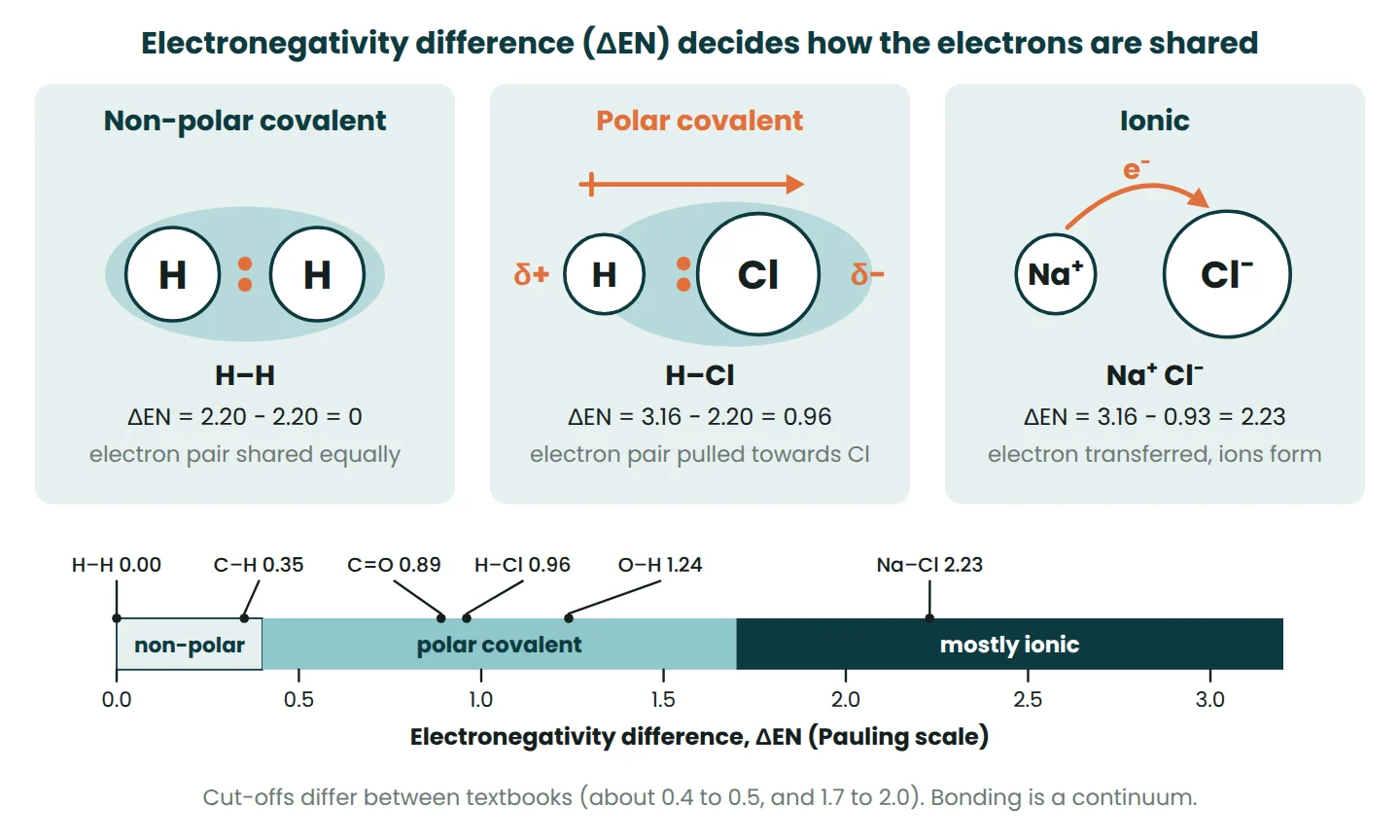
The short answer on polar vs non-polar covalent bonds: it depends on how evenly two atoms share their electrons. When both atoms pull on the shared pair with the same strength, the bond is non-polar. When one atom pulls harder, the electrons spend more time near it, that end picks up a small negative charge (δ−), the other end a small positive charge (δ+), and the bond is polar. The number that tells you which case you have is the electronegativity difference, ΔEN, between the two atoms.
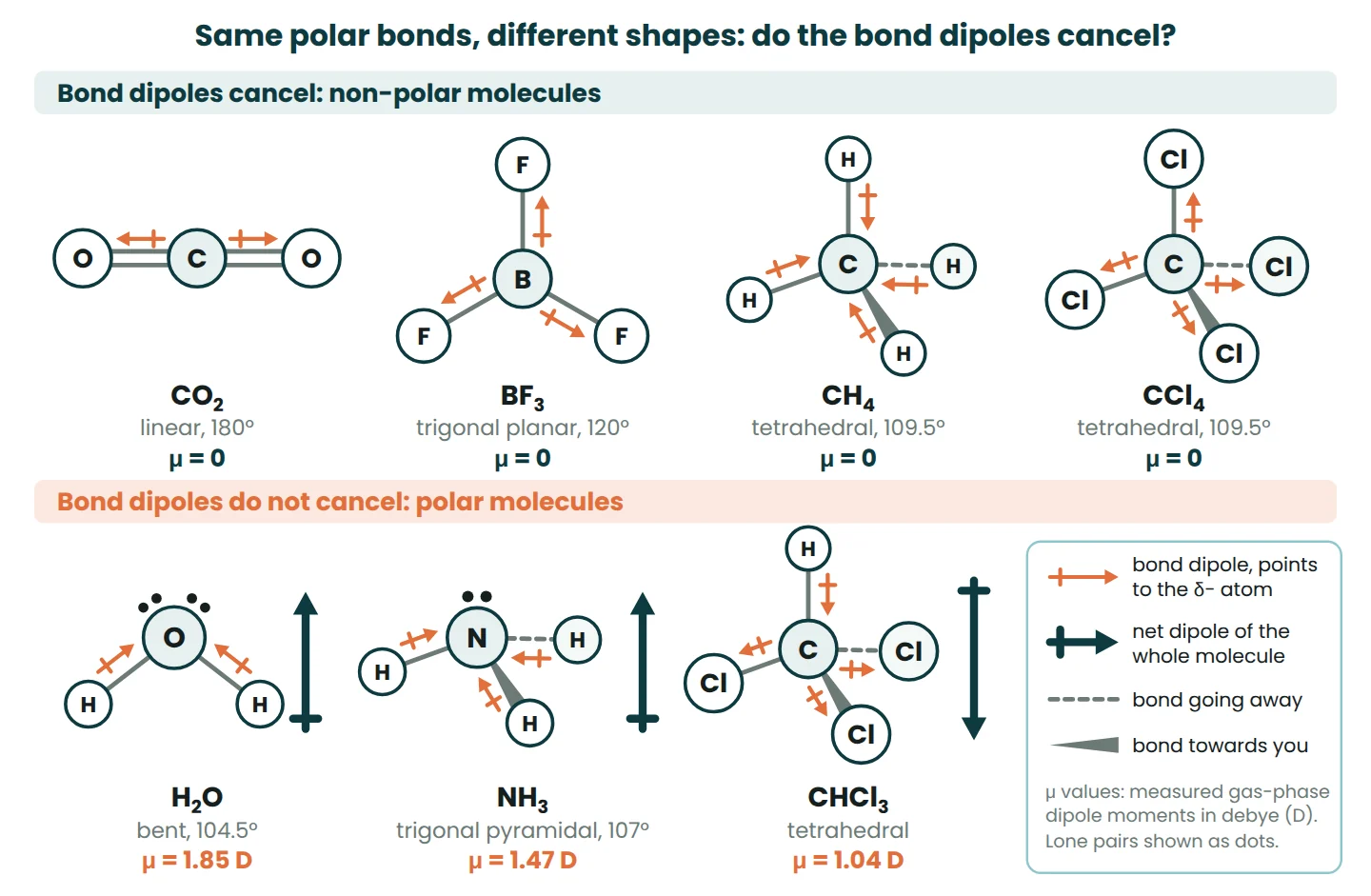
Molecules need a second check. A molecule can be built from polar bonds and still be non-polar overall if its shape makes the bond dipoles cancel. Carbon dioxide is the classic case: both C=O bonds are polar, but they point in opposite directions, so CO2 has no overall dipole. Water’s O–H bonds are polar too, yet water is strongly polar because the molecule is bent.
So work in two steps every time: classify each bond from ΔEN, then use the shape of the molecule to decide whether the bond dipoles add up or cancel.
What polar and non-polar covalent bonds are
A covalent bond is a pair of electrons shared between two atoms. In a non-polar covalent bond the pair is shared equally, so neither end of the bond carries a charge. Bonds between two identical atoms, such as H–H in hydrogen gas or Cl–Cl in chlorine, are the purest examples.
In a polar covalent bond the pair is shared unequally. The atom with the stronger pull gets a partial negative charge (δ−) and its partner a partial positive charge (δ+). These are fractions of an electron’s charge, not full charges. That is the key difference from an ionic bond, where the pull is so uneven that an electron is effectively transferred and two ions form, as in Na+Cl−.
Electronegativity and the Pauling scale
Electronegativity is how strongly an atom in a bond attracts the shared electrons towards itself. Linus Pauling built the most widely used scale from bond energies, so the values are calculated rather than measured, and they have no units. Fluorine tops the scale at 3.98. Values rise across a period and fall down a group, so fluorine, oxygen, nitrogen and chlorine are the strong electron-pullers you meet most.
| Element | Pauling electronegativity | Element | Pauling electronegativity |
|---|---|---|---|
| Fluorine (F) | 3.98 | Hydrogen (H) | 2.20 |
| Oxygen (O) | 3.44 | Phosphorus (P) | 2.19 |
| Chlorine (Cl) | 3.16 | Boron (B) | 2.04 |
| Nitrogen (N) | 3.04 | Silicon (Si) | 1.90 |
| Bromine (Br) | 2.96 | Magnesium (Mg) | 1.31 |
| Iodine (I) | 2.66 | Sodium (Na) | 0.93 |
| Sulfur (S) | 2.58 | Potassium (K) | 0.82 |
| Carbon (C) | 2.55 |
Older textbooks and some exam data booklets round these values (oxygen as 3.4 or 3.5, hydrogen as 2.1 or 2.2). Use the values your exam gives you, because a borderline answer can change with rounding.
Polar vs non-polar covalent bonds: the ΔEN guideline
To classify a bond, subtract the smaller electronegativity from the larger one and compare the result with these commonly taught cut-offs:
| ΔEN | Bond type | Example | Variations you may see |
|---|---|---|---|
| Below about 0.4 | Non-polar covalent | H–H (0), C–H (0.35) | Some books use 0.5 |
| About 0.4 to 1.7 | Polar covalent | H–Cl (0.96), O–H (1.24) | Upper limit 1.8 or 2.0 in some books |
| Above about 1.7 | Mostly ionic | Na–Cl (2.23) | Metal plus non-metal is the better clue |
Treat these as a guide, not a law. Bonding is a continuum from equal sharing to near-complete transfer, and the boundaries are lines drawn on a smooth scale. One reason 1.7 is popular: Pauling’s estimate of ionic character, % ionic ≈ (1 − e−(ΔEN)²/4) × 100, gives about 51% at ΔEN = 1.7. There are well-known exceptions. H–F has a ΔEN of 1.78 and B–F has 1.94, yet hydrogen fluoride and boron trifluoride are both covalent molecules, not ionic solids. In practice, a metal bonded to a non-metal is usually ionic, and two non-metals bonded together are covalent, polar or not.
Worked example 1: classifying six bonds
- Look up the Pauling value for each atom.
- Subtract the smaller from the larger, so ΔEN is never negative.
- Compare ΔEN with the cut-offs above.
- Put δ− on the more electronegative atom and δ+ on the other.
| Bond | Working | ΔEN | Classification | δ− end |
|---|---|---|---|---|
| H–Cl | 3.16 − 2.20 | 0.96 | Polar covalent | Cl |
| C–H | 2.55 − 2.20 | 0.35 | Non-polar (very weakly polar) | C |
| O–H | 3.44 − 2.20 | 1.24 | Polar covalent | O |
| N–H | 3.04 − 2.20 | 0.84 | Polar covalent | N |
| C=O | 3.44 − 2.55 | 0.89 | Polar covalent | O |
| Na–Cl | 3.16 − 0.93 | 2.23 | Ionic | Cl (as Cl−) |
Three things stand out. O–H is the most polar covalent bond in the list, which is a big part of why water behaves so differently from other small molecules. C–H is so close to equal sharing that hydrocarbons such as methane, petrol and wax are treated as non-polar. And a double bond does not change the calculation: C=O uses the same carbon and oxygen values as a single C–O bond.
From bonds to molecules: shape decides
Each polar bond has a bond dipole, which has a size and a direction, so it behaves like a vector. The polarity of the whole molecule comes from adding those vectors in three dimensions. A molecule is non-polar if its bonds are non-polar, or if its polar bonds are arranged so symmetrically that they cancel. It is polar when the bond dipoles leave a net dipole, which usually happens when the central atom carries lone pairs or is bonded to different kinds of atom.
To know the arrangement you need the shape, and at this level that comes from VSEPR theory: electron pairs around the central atom spread as far apart as they can. Lone pairs push the bonds around, but they are not counted when you name the shape. Four pairs with no lone pairs give a tetrahedron (CH4); four pairs with one lone pair give a trigonal pyramid (NH3); four pairs with two lone pairs give a bent molecule (H2O).
| Molecule | Shape | Bond angle | Polar bonds? | Polar molecule? | Dipole moment |
|---|---|---|---|---|---|
| CO2 | Linear | 180° | Yes, C=O (0.89) | No | 0 |
| BF3 | Trigonal planar | 120° | Yes, B–F (1.94) | No | 0 |
| CH4 | Tetrahedral | 109.5° | Barely, C–H (0.35) | No | 0 |
| CCl4 | Tetrahedral | 109.5° | Yes, C–Cl (0.61) | No | 0 |
| H2O | Bent | 104.5° | Yes, O–H (1.24) | Yes | 1.85 D |
| NH3 | Trigonal pyramidal | about 107° | Yes, N–H (0.84) | Yes | 1.47 D |
| CHCl3 | Tetrahedral (slightly distorted) | close to 109.5° | Yes, C–Cl and C–H | Yes | 1.04 D |
Three pairs worth comparing
CO2 and H2O. Both have two polar bonds. Carbon in CO2 has no lone pairs, so the molecule is straight and the two bond dipoles pull in exactly opposite directions. Oxygen in water has two lone pairs, which bend the molecule to 104.5°. Both O–H dipoles now point partly “up” towards oxygen, and those parts add.
BF3 and NH3. Both have a central atom with three bonds. Boron has no lone pair, so BF3 is flat with bonds 120° apart, and three equal B–F dipoles cancel even though each bond is very polar. Nitrogen has one lone pair, which pushes the three N–H bonds down into a pyramid, so their dipoles add towards nitrogen.
CCl4 and CHCl3. Carbon tetrachloride has four identical C–Cl dipoles at tetrahedral angles, and they cancel. Swap one chlorine for hydrogen and the balance is gone: the C–H bond is almost non-polar and points the other way, so chloroform has a net dipole with its negative end on the chlorine side.
Dipole moment: putting a number on polarity
The dipole moment, μ, measures how strongly a molecule’s charge is separated: μ = Q × r, where Q is the size of the partial charges and r the distance between them. Chemists use the debye (D), where 1 D = 3.336 × 10⁻³⁰ C·m. Water’s 1.85 D is therefore about 6.17 × 10⁻³⁰ C·m. Non-polar molecules such as CO2, CH4, CCl4 and BF3 have a dipole moment of zero.
Worked example 2: adding the bond dipoles in water
Split each O–H bond dipole into a part along the molecule’s axis and a part across it. Each bond sits at half the bond angle from the axis, 104.5° ÷ 2 = 52.25°. The sideways parts are equal and opposite, so they cancel. The parts along the axis add: μ = 2 × μ(O–H) × cos 52.25°.
Working backwards from the measured 1.85 D: μ(O–H) = 1.85 ÷ (2 × 0.612) ≈ 1.51 D per bond. Now change only the angle. If water were straight, each bond would sit 90° from the axis and cos 90° = 0, so μ would be zero, exactly as in CO2. With the same polar bonds, the bend is what makes water polar. If the cosine step is rusty, the trigonometry formulas note covers it.
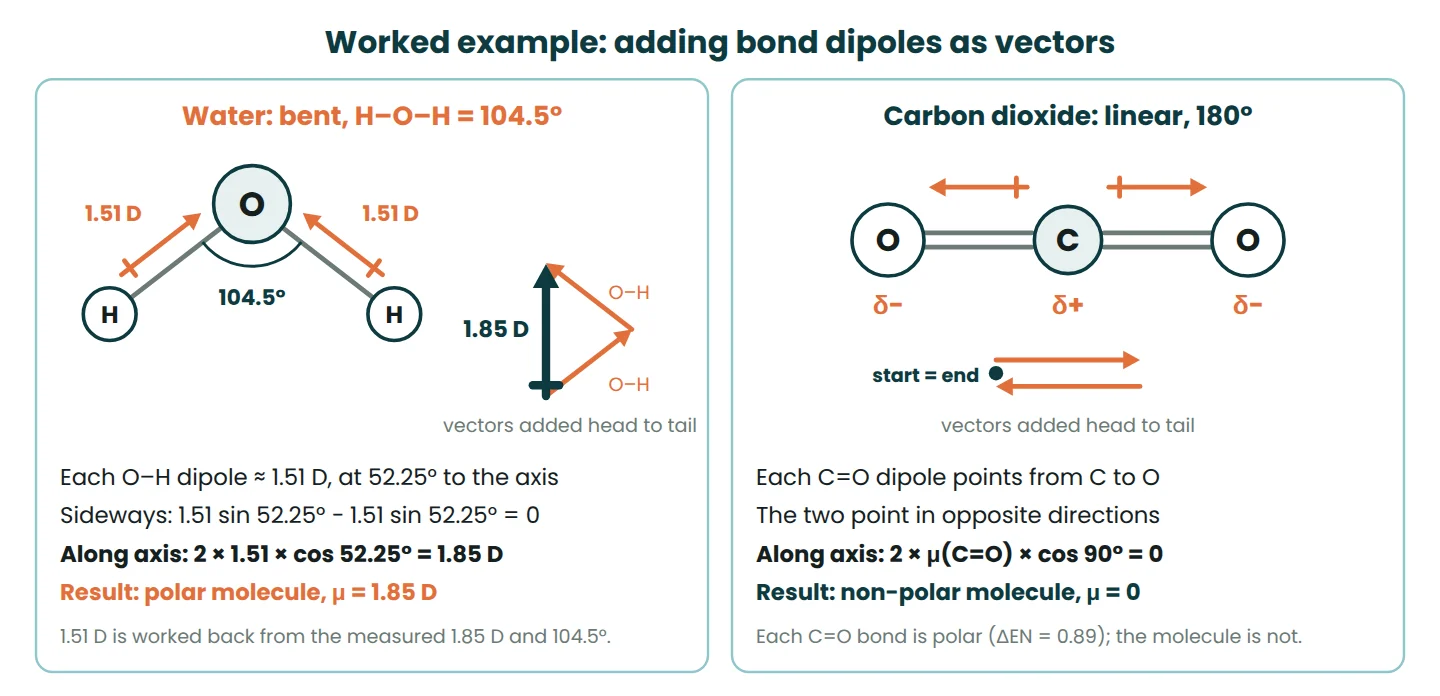
One warning on arrows. Chemistry courses draw a bond dipole as a crossed arrow (+→) pointing towards the δ− end, as in these diagrams. Physics courses define the dipole moment vector the other way, from negative to positive. Use your course’s convention and label the δ+ and δ− ends so the marker can see what you mean.
Why polarity matters
Boiling points and hydrogen bonding
Polar molecules attract each other through dipole–dipole forces. When a hydrogen atom bonded to nitrogen, oxygen or fluorine is attracted to a lone pair on a neighbouring N, O or F atom, the attraction is strong enough to have its own name: a hydrogen bond. Compare three molecules of almost the same molar mass:
| Substance | Molar mass (g/mol) | Polarity | Main forces between molecules | Boiling point |
|---|---|---|---|---|
| Methane, CH4 | 16.04 | Non-polar | Dispersion only | −161.5 °C |
| Ammonia, NH3 | 17.03 | Polar | Hydrogen bonds | −33.3 °C |
| Water, H2O | 18.02 | Polar | Strong hydrogen bonds | 100 °C |
Polarity is not the only factor, though. Non-polar CCl4 (153.8 g/mol) boils at 76.7 °C, higher than polar CHCl3 (119.4 g/mol) at 61.2 °C, because dispersion forces grow with the size of the molecule.
Solubility: like dissolves like
Polar solvents dissolve polar and ionic substances; non-polar solvents dissolve non-polar ones. Water dissolves salt, sugar and ethanol but not cooking oil or candle wax, which dissolve in non-polar solvents such as hexane. Iodine (I–I, ΔEN = 0) barely dissolves in water but dissolves readily in hexane. Soaps and detergents work because each molecule has a charged, water-loving head and a long non-polar tail that sits in the grease. The solute vs solvent note explains what happens when a substance dissolves and how to work out concentrations.
Everyday and engineering examples
Microwave ovens heat food by dielectric heating. The oscillating electric field keeps twisting polar molecules, mostly water, and the jostling turns into heat. A popular myth says the oven is tuned to a resonant frequency of water. It is not: the frequency band is set by radio regulations, and many polar molecules absorb the energy.
Cleaning and coatings follow the same rule. Water alone will not lift grease from machinery or tools because the grease is non-polar; you need a detergent or a non-polar solvent. Paints and adhesives come as water-based or solvent-based systems, and the thinner and clean-up liquid have to match: water will not thin a solvent-based enamel.
Common mistakes
- Calling a molecule polar because it has polar bonds. CO2, BF3 and CCl4 all have polar bonds and are non-polar molecules. Always check the shape.
- Drawing the molecule flat. Drawn flat on paper, NH3 looks like BF3, and CHCl3 looks as though its dipoles might cancel. Work out the 3D shape with VSEPR first, including lone pairs.
- Treating the cut-offs as exact. A ΔEN of 0.41 is not suddenly different from 0.39. Quote the guideline your course uses and mention borderline cases.
- Putting δ− on the wrong atom. δ− always goes on the atom with the higher electronegativity. In C–H that is carbon, which surprises many students.
- Confusing polar molecules with ionic compounds. HCl gas is made of polar molecules with partial charges. Solid NaCl is a lattice of ions with full charges. They are different kinds of substance.
- Assuming polar always means a higher boiling point. The CCl4 and CHCl3 comparison above shows size can win.
Practice questions
Use the Pauling values in the table above. Try each one before reading the answer.
Question 1. Classify the C–Cl, S–H and Mg–O bonds as non-polar covalent, polar covalent or ionic.
Answer: C–Cl: 3.16 − 2.55 = 0.61, polar covalent with δ− on Cl. S–H: 2.58 − 2.20 = 0.38, just under 0.4, so non-polar by the usual guideline (very weakly polar). Mg–O: 3.44 − 1.31 = 2.13, ionic, and magnesium oxide is indeed an ionic solid.
Question 2. BCl3 and PCl3 both have three chlorine atoms around a central atom. Which one is polar?
Answer: PCl3. Both have polar bonds (B–Cl: 3.16 − 2.04 = 1.12; P–Cl: 3.16 − 2.19 = 0.97). Boron has no lone pair, so BCl3 is trigonal planar and the dipoles cancel. Phosphorus has one lone pair, so PCl3 is trigonal pyramidal, like NH3, and the dipoles add.
Question 3. Is dichloromethane, CH2Cl2, polar or non-polar?
Answer: Polar. The carbon is tetrahedral, but two of the four positions hold Cl and two hold H. The two C–Cl dipoles point towards the chlorines and the near-non-polar C–H bonds cannot balance them, so there is a net dipole towards the chlorine side.
Question 4. Taking each O–H bond dipole as 1.51 D and the H–O–H angle as 104.5°, calculate the dipole moment of water in debye and in C·m.
Answer: μ = 2 × 1.51 × cos 52.25° = 2 × 1.51 × 0.612 = 1.85 D. In SI units: 1.85 × 3.336 × 10⁻³⁰ = 6.17 × 10⁻³⁰ C·m.
Question 5. Will iodine dissolve better in water or in hexane? Explain using polarity.
Answer: Hexane. The I–I bond has ΔEN = 0, so I2 is non-polar. Water molecules hold each other through hydrogen bonds, and iodine cannot replace those attractions, so very little dissolves. Hexane molecules are non-polar, held together by dispersion forces, the same kind iodine offers, so iodine mixes in easily.
Frequently asked questions
Is water polar or non-polar?
Water is polar. Its O–H bonds are polar (ΔEN = 1.24) and the molecule is bent at 104.5°, so the bond dipoles add to a measured dipole moment of 1.85 D, with oxygen as the negative end.
Can a molecule with polar bonds be non-polar?
Yes, if the bonds are identical and arranged symmetrically so their dipoles cancel. CO2 (linear), BF3 (trigonal planar) and CCl4 (tetrahedral) are the standard examples.
What electronegativity difference makes a bond polar?
Most courses call a bond polar covalent when ΔEN is between about 0.4 and 1.7. Some use 0.5 as the lower limit and 1.8 or 2.0 as the upper one, so check your course notes.
Is the C–H bond polar?
Only very slightly. ΔEN is 2.55 − 2.20 = 0.35, below the usual 0.4 cut-off, so C–H is treated as non-polar, which is why hydrocarbons such as methane and hexane are non-polar molecules.
More chemistry, biology and maths study notes are in the notes section. Writing up a solubility practical? See how to write a lab report.
References
- Flowers, P., Theopold, K., Langley, R. and Robinson, W. R. (2019). Chemistry 2e, Section 7.2 Covalent Bonding. OpenStax. openstax.org
- Flowers, P. et al. (2019). Chemistry 2e, Section 7.6 Molecular Structure and Polarity. OpenStax. openstax.org
- McMurry, J. (2023). Organic Chemistry, Section 2.2 Polar Covalent Bonds and Dipole Moments. OpenStax. openstax.org
- National Institute of Standards and Technology. Computational Chemistry Comparison and Benchmark Database (CCCBDB), experimental dipole moments. cccbdb.nist.gov
- National Institute of Standards and Technology. NIST Chemistry WebBook, SRD 69 (boiling points of CCl4 and CHCl3). webbook.nist.gov
- Baird, C. (2014). Why are the microwaves in a microwave oven tuned to water? West Texas A&M University, Science Questions with Surprising Answers. wtamu.edu
- Pauling, L. (1960). The Nature of the Chemical Bond, 3rd edition. Cornell University Press.
These notes are general information for learning and revision. Always check your course notes and your exam board’s requirements, including which electronegativity values and cut-offs you are expected to use.




Leave a Reply